Product Design, Manufacturing & Innovation Resources
Home » Gaussian Beam

Gaussian Beam

1960
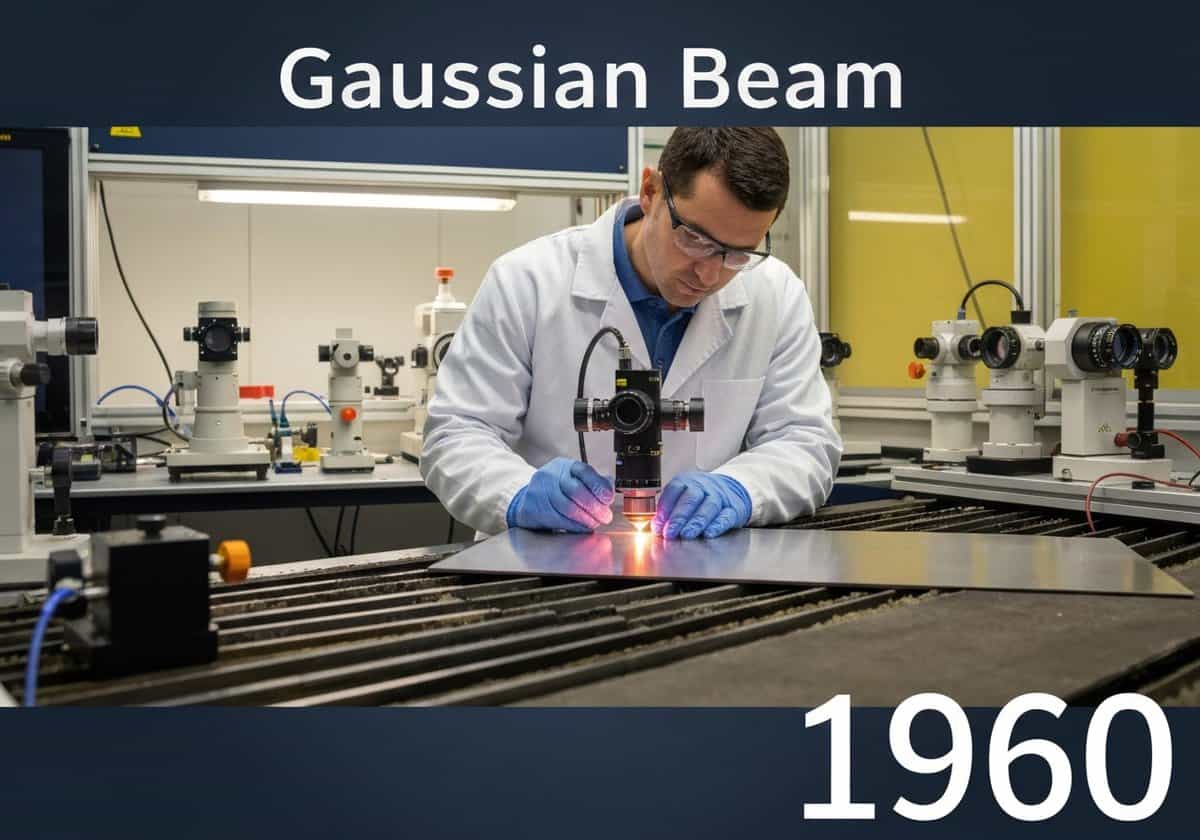
Laser cutting machine utilizing a Gaussian beam in an optics laboratory.

(generated image for illustration only)

A Gaussian beam is a beam of electromagnetic radiation whose transverse electric field and intensity distributions are described by Gaussian functions. It is the most common output profile of lasers operating in the fundamental transverse mode (TEM00). This profile allows the beam to remain tightly focused over a long distance and represents the ideal case for high beam quality.

The Gaussian beam is a solution to the paraxial Helmholtz equation, which is an approximation of Maxwell’s equations for beams that do not diverge rapidly. The intensity \(I(r, z)\) of a Gaussian beam as a function of radial distance \(r\) from the center of the beam and axial distance \(z\) from its narrowest point (the ‘beam waist’) is given by \(I(r, z) = I_0 \left(\frac{w_0}{w(z)}\right)^2 \exp\left(\frac{-2r^2}{w(z)^2}\right)\). Here, \(I_0\) is the peak intensity at the beam waist, \(w_0\) is the beam waist radius (where the intensity drops to \(1/e^2\) of its axial value), and \(w(z)\) is the beam radius at distance \(z\).

Key parameters describing a Gaussian beam include the beam waist (\(w_0\)), the Rayleigh range (\(z_R\)), which is the distance over which the beam remains relatively collimated, and the beam divergence angle (\(\theta\)), which describes how fast the beam spreads out in the far field. These parameters are all interrelated. A smaller beam waist results in a larger divergence angle, a consequence of diffraction. The quality of a real laser beam is often described by the M-squared (\(M^2\)) factor, which compares its beam parameter product (waist radius times far-field divergence) to that of an ideal Gaussian beam, for which \(M^2=1\). The Gaussian profile is desirable because it can be focused to the smallest possible spot size for a given wavelength, maximizing intensity.

UNESCO Nomenclature: 2210
– Optics

Type

Abstract System

Disruption

Foundational

Usage

Widespread Use

Precursors

  • Maxwell’s equations of electromagnetism
  • Huygens–Fresnel principle of diffraction
  • development of laser resonators that naturally support a fundamental mode

Applications

  • laser cutting and welding
  • fiber optic coupling
  • laser pointers
  • barcode scanners
  • optical trapping (‘optical tweezers’)
  • laser communication systems

Patents:

NA

Potential Innovations Ideas

Due to scrapping bot traffic, currently more than 40k per day, this content is reserved to community members.
> Login < or > Register < (100% free) to access this, so as all other restricted content and tools.

Related to: Gaussian beam, laser beam profile, EM00, beam waist, Rayleigh range, beam divergence, M-squared, paraxial approximation, diffraction, beam quality.

Historical Context

Gaussian Beam

1960
1960
1960
1960
1961
1962
1963
1960
1960
1960
1960
1960-05-16
1962
1963
1964

(if date is unknown or not relevant, e.g. "fluid mechanics", a rounded estimation of its notable emergence is provided)

Related Invention, Innovation & Technical Principles

Full size images and downloads are only available, 100% free, for registered members.

> Login <