Product Design, Manufacturing & Innovation Resources
Home » Fused Deposition Modeling (FDM)

Fused Deposition Modeling (FDM)

1989
  • S. Scott Crump
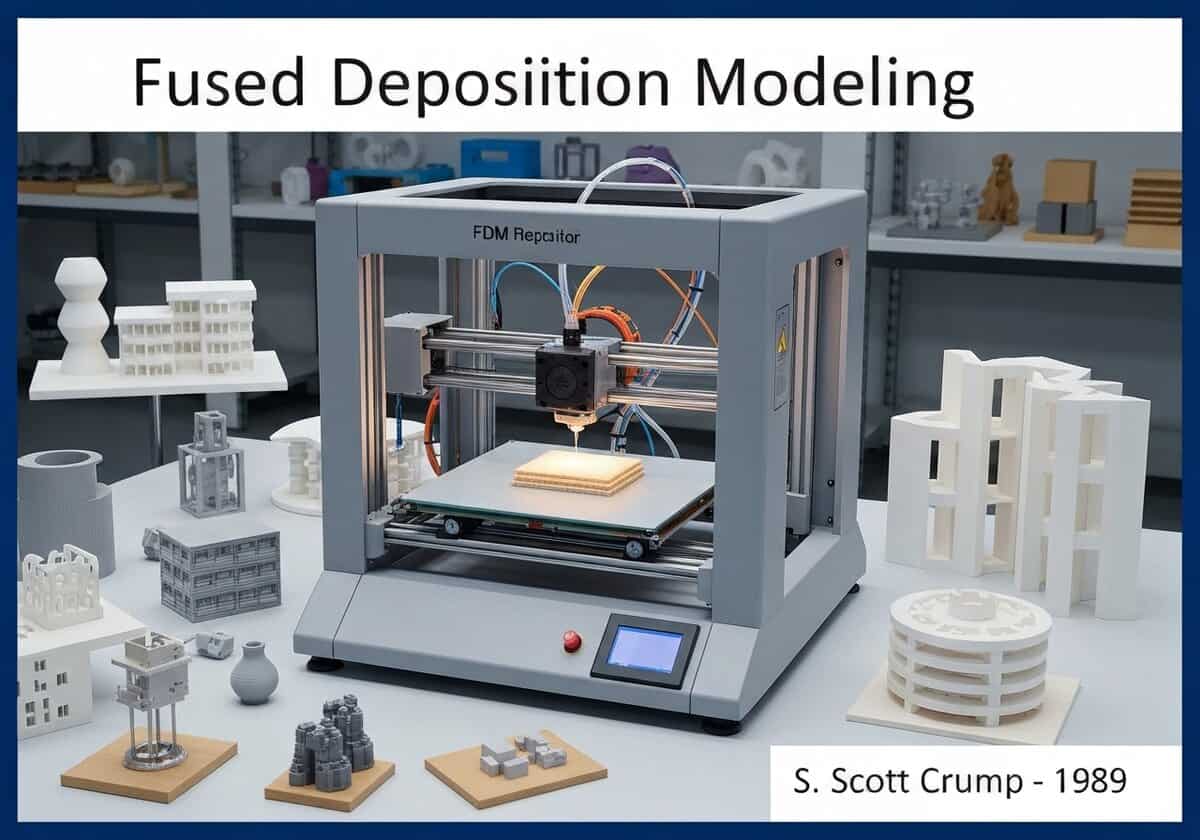
3D printer demonstrating Fused Deposition Modeling in an industrial workspace.

(generated image for illustration only)

Fused Deposition Modeling (FDM), sometimes named Fused Filament Fabrication (FFF), a material extrusion technique, builds objects by selectively depositing molten material in a pre-determined path layer-by-layer. A thermoplastic filament is unwound from a coil and fed through a heated extruder nozzle. The nozzle melts the filament and deposits it onto a build platform, where it cools and solidifies, fusing with the layer below.


In an FDM printer, the motion of the extruder head and/or the build platform is controlled by a computer that interprets a sliced 3D model (G-code). The head moves in the X and Y axes, while the platform typically moves in the Z axis after each layer is complete. The process relies on precise thermal management: the ‘hot end’ of the extruder must keep the plastic at a temperature that allows it to flow but not degrade, while the deposited material must cool quickly enough to hold its shape. Layer adhesion is critical for part strength and is highly dependent on temperature, speed, and material properties. FDM parts are not fully dense; their internal structure is often a pre-defined infill pattern (e.g., grid, honeycomb) to save material and print time while providing structural support. Common materials include polylactic acid (PLA), acrylonitrile butadiene styrene (ABS), polyethylene terephthalate glycol (PETG), and various engineering-grade polymers. The expiration of the original FDM patent in 2009 was a catalyst for the open-source RepRap project and the subsequent explosion of affordable, consumer-grade 3D printers, making the technology widely accessible.

UNESCO Nomenclature: 3313
– Industrial technology

Type

Manufacturing Process

Disruption

Substantial

Usage

Widespread Use

Precursors

  • extrusion technology used in plastics manufacturing
  • hot-melt glue guns, which demonstrate a similar principle of heating and extruding a thermoplastic
  • computer numerical control (cnc) plotters and milling machines
  • development of a wide range of thermoplastic polymers
  • computer-aided design (cad) software

Applications

  • hobbyist and consumer 3D printing
  • educational models for schools and universities
  • functional prototypes for form, fit, and function testing
  • manufacturing aids like jigs, fixtures, and gauges
  • end-use parts for low-volume production
  • architectural models

Patents:

  • US 5121329 A

Potential Innovations Ideas

Due to scrapping bot traffic, currently more than 40k per day, this content is reserved to community members.
> Login < or > Register < (100% free) to access this, so as all other restricted content and tools.

Related to: fused deposition modeling, fdm, fused filament fabrication, fff, material extrusion, thermoplastic, filament, 3d printing, stratasys, reprap.

Historical Context

Fused Deposition Modeling (FDM)

1986
1986
1987
1989
1990
1990
1990
1984
1986
1986
1987-03
1990
1990
1990
1990

(if date is unknown or not relevant, e.g. "fluid mechanics", a rounded estimation of its notable emergence is provided)

Related Invention, Innovation & Technical Principles

Full size images and downloads are only available, 100% free, for registered members.

> Login <