Product Design, Manufacturing & Innovation Resources
Home » Flywheel Energy Storage (FES)

Flywheel Energy Storage (FES)

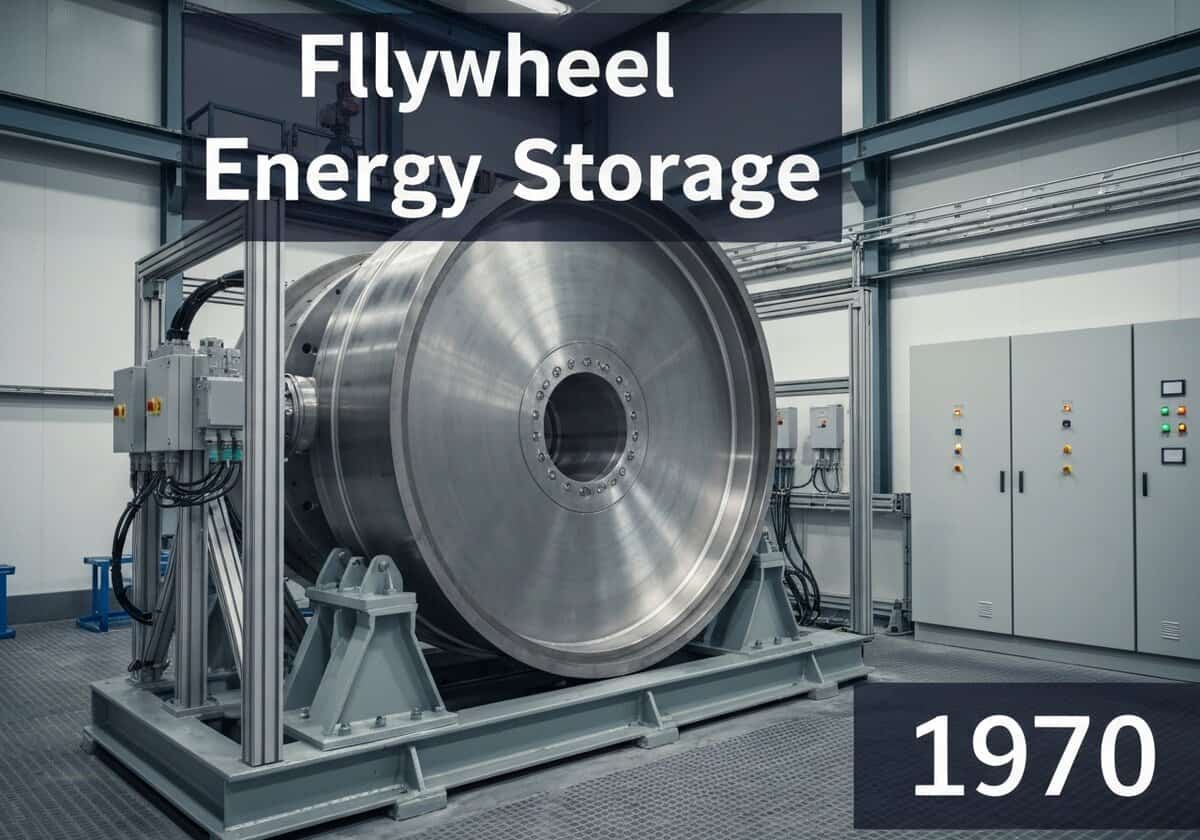
1970
Flywheel energy storage system in industrial mechanics application.

(generated image for illustration only)

Flywheel energy storage (FES) works by accelerating a rotor (flywheel) to a very high speed and maintaining the energy in the system as rotational kinetic energy. The energy stored is proportional to the square of the rotational speed. When energy is extracted, the flywheel’s rotation slows down. The formula for stored energy is [latex]E = \frac{1}{2} I \omega^2[/latex], where I is the moment of inertia and ω is the angular velocity.

A modern FES system consists of a massive rotor spinning in a near-vacuum enclosure to minimize air friction. The rotor is connected to a motor/generator. To store energy, the motor uses electricity to spin the flywheel up to speed. To release energy, the spinning flywheel drives the generator, producing electricity and slowing the rotor down. The amount of energy stored is given by [latex]E = frac{1}{2} I omega^2[/latex]. To maximize energy storage, rotors are designed to have a high moment of inertia and be able to withstand the immense centrifugal forces at very high rotational speeds (tens of thousands of RPM). Advanced FES systems use rotors made from high-strength carbon-fiber composites and employ magnetic bearings to eliminate friction from mechanical contact, allowing for extremely high efficiency (often over 90%) and very long lifespans with minimal degradation (hundreds of thousands of cycles). FES is particularly well-suited for applications requiring frequent, rapid charge and discharge cycles, such as grid frequency regulation, as it can respond to power fluctuations in milliseconds.

UNESCO Nomenclature: 2210
– Mechanics

Type

Physical Device

Disruption

Substantial

Usage

Niche/Specialized

Precursors

  • the Potter’s wheel (ancient)
  • Newton’s laws of motion
  • invention of the electric motor/generator
  • development of high-strength materials like steel and carbon composites
  • advances in vacuum technology and magnetic bearings

Applications

  • uninterruptible power supplies (ups) for data centers
  • grid frequency regulation
  • kinetic energy recovery systems (kers) in motorsport and vehicles
  • energy storage for spacecraft attitude control
  • power stabilization for industrial processes

Patents:

NA

Potential Innovations Ideas

Due to scrapping bot traffic, currently more than 40k per day, this content is reserved to community members.
> Login < or > Register < (100% free) to access this, so as all other restricted content and tools.

Related to: flywheel, kinetic energy, rotational energy, FES, energy storage, moment of inertia, frequency regulation, UPS, high-speed rotor, magnetic bearings.

Historical Context

Flywheel Energy Storage (FES)

1963
1965
1970
1970
1974-11-15
1980
1980
1963
1964
1968
1970
1970
1975
1980
1980

(if date is unknown or not relevant, e.g. "fluid mechanics", a rounded estimation of its notable emergence is provided)

Related Invention, Innovation & Technical Principles

Full size images and downloads are only available, 100% free, for registered members.

> Login <