Product Design, Manufacturing & Innovation Resources
Home » Finite Volume Method (FVM)

Finite Volume Method (FVM)

1980
  • Suhas V. Patankar (popularized)
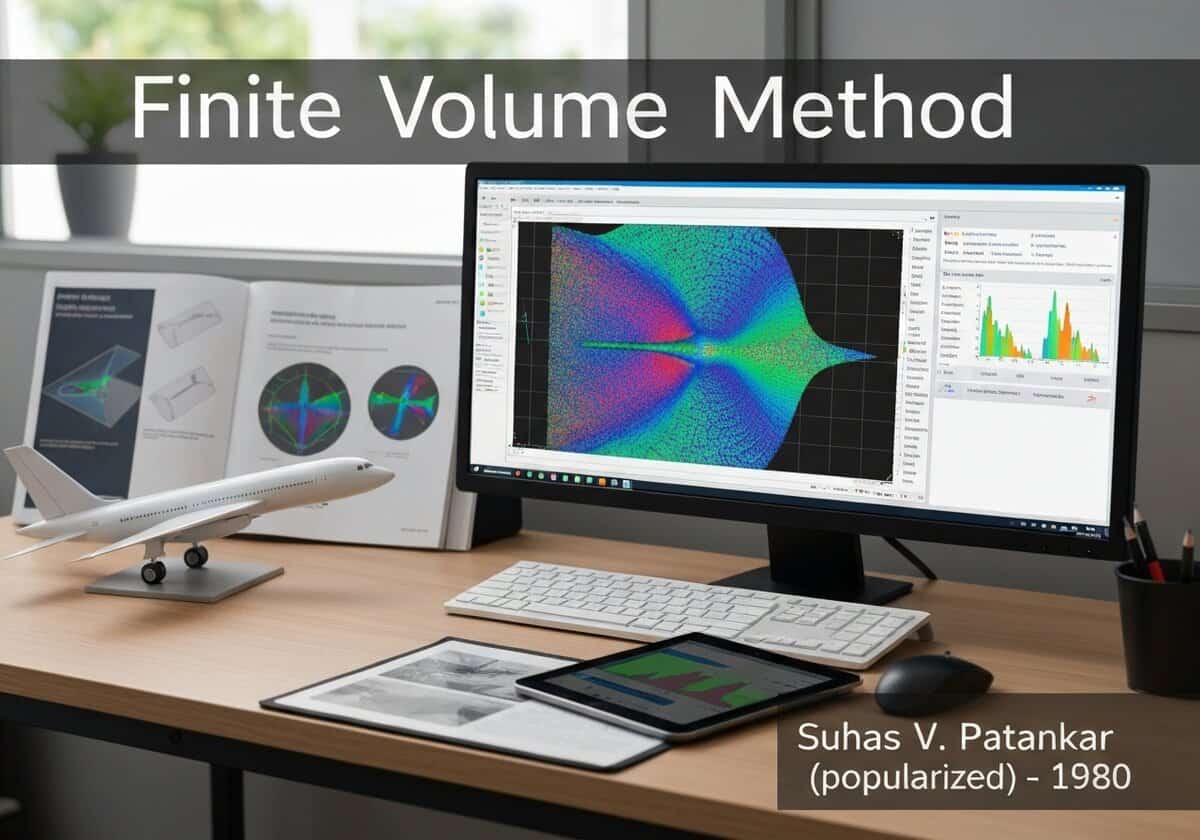
Computational fluid dynamics workspace showcasing finite volume method simulation for aerospace engineering.

(generated image for illustration only)

The Finite Volume Method (FVM) is a dominant numerical technique in CFD for solving partial differential equations. It discretizes the domain into a mesh of control volumes and applies the governing equations in their integral form to each volume. By converting volume integrals to surface integrals using the divergence theorem, it focuses on calculating the flux of conserved properties across cell faces.


The Finite Volume Method’s strength lies in its approach to discretization, which is particularly well-suited for fluid dynamics problems governed by conservation laws. The process begins by dividing the geometric domain into a set of non-overlapping control volumes, or cells, which collectively form a mesh. The governing partial differential equations are then integrated over each of these control volumes.

A key step is the application of the Gauss-Divergence theorem, which transforms volume integrals of divergence terms into surface integrals of fluxes across the cell boundaries. For a generic conserved scalar \(\phi\), the conservation equation in integral form is \(\frac{\partial}{\partial t} \int_V \phi dV + \oint_S \mathbf{F} \cdot d\mathbf{S} = \int_V Q dV\), where \(\mathbf{F}\) is the flux vector and \(Q\) is a source term. The FVM discretizes this exact equation, approximating the surface and volume integrals. The flux across each face is calculated, often using interpolation schemes to find the value of \(\phi\) at the cell face from the values stored at the cell centers.

This flux-based approach ensures that the quantity \(\phi\) is conserved perfectly at the discrete level, both locally for each cell and globally for the entire domain. This property of exact conservation is a major advantage over methods like the Finite Difference Method and makes FVM robust and physically realistic, especially when dealing with shocks or sharp gradients in the flow. It is also flexible in handling unstructured meshes, which are necessary for modeling complex geometries.

UNESCO Nomenclature: 1208
– Numerical Analysis

Type

Software/Algorithm

Disruption

Substantial

Usage

Widespread Use

Precursors

  • Integral Calculus and the Gauss-Divergence Theorem
  • Finite Difference Method (FDM)
  • Concept of Conservation Laws in Physics
  • Early work on numerical solutions to PDEs by Courant, Friedrichs, and Lewy
  • Development of unstructured meshing techniques

Applications

  • aerospace engineering for external aerodynamics
  • automotive design for drag reduction and cooling
  • hvac system design and analysis
  • chemical process engineering for reactor modeling
  • environmental engineering for pollutant dispersal in air and water
  • heat transfer analysis in electronics

Patents:

NA

Potential Innovations Ideas

Due to scrapping bot traffic, currently more than 40k per day, this content is reserved to community members.
> Login < or > Register < (100% free) to access this, so as all other restricted content and tools.

Related to: finite volume method, fvm, discretization, cfd, numerical analysis, conservation law, divergence theorem, mesh.

Historical Context

Finite Volume Method (FVM)

1970
1970
1973
1980
1980
1980
1982-07-01
1970
1970
1970-01-01
1975-06-01
1980
1980
1980
1986-01-01

(if date is unknown or not relevant, e.g. "fluid mechanics", a rounded estimation of its notable emergence is provided)

Related Invention, Innovation & Technical Principles

Full size images and downloads are only available, 100% free, for registered members.

> Login <