EMF from Faraday’s Law of Induction
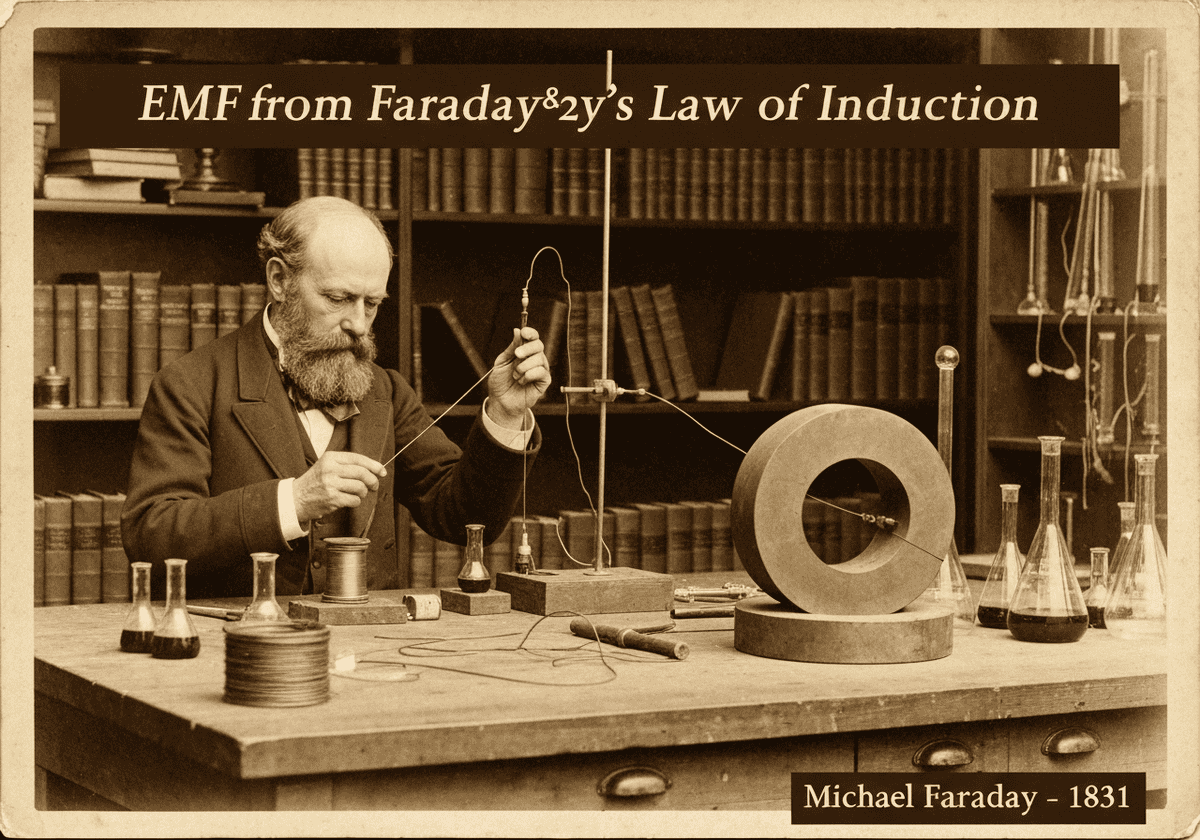
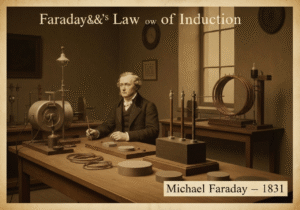
A primary source of electromotive force is electromagnetic induction, described by Faraday’s law. It states that a time-varying magnetic flux \(\Phi_B\) through a circuit loop induces an EMF (\(\mathcal{E}\)). The magnitude of the EMF is proportional to the rate of change of the flux, given by the equation \(\mathcal{E} = – \frac{d\Phi_B}{dt}\). This principle is the foundation for electric generators, transformers, and inductors.
Faraday’s law of induction reveals a deep connection between electricity and magnetism. It describes how a changing magnetic environment can create an electric field. This induced electric field is non-conservative, meaning its line integral around a closed path is non-zero, and this integral is precisely the induced EMF. The mathematical formulation, one of Maxwell’s equations, is \(\oint_C \mathbf{E} \cdot d\mathbf{l} = – \frac{d}{dt} \int_S \mathbf{B} \cdot d\mathbf{A}\), where \(\mathbf{E}\) is the induced electric field, \(\mathbf{B}\) is the magnetic field, and the integral is taken over a closed loop \(C\) bounding a surface \(S\). The negative sign, formalized by Lenz’s Law, indicates that the induced EMF creates a current whose magnetic field opposes the original change in magnetic flux, a manifestation of the conservation of energy.
This phenomenon can be produced in two ways: by changing the magnetic field strength over time (e.g., in a transformer) or by moving the circuit loop through a non-uniform magnetic field or changing its orientation (e.g., in a generator). The ability to generate a voltage and drive a current without a direct chemical source was a revolutionary discovery. It enabled the conversion of mechanical energy into electrical energy on a large scale, paving the way for the modern electrical grid and the widespread use of electricity. Every time we use electricity from a wall outlet, we are relying on EMF generated according to Faraday’s law in a power plant’s generator.
UNESCO Nomenclature: 2205
– Electricity and Magnetism
Precursors
- Hans Christian Ørsted’s discovery that electric currents create magnetic fields
- André-Marie Ampère’s formulation of the law of force between currents
- Development of the galvanometer for detecting electric currents
Applications
- electric generators
- transformers
- induction motors
- induction cooktops
- magnetic card readers
- dynamic microphones
Potential Innovations Ideas
Due to scrapping bot traffic, currently more than 40k per day, this content is reserved to community members.
> Login < or > Register < (100% free) to access this, so as all other restricted content and tools.
Related to: faraday’s law, induction, emf, magnetic flux, electric generator, transformer, maxwell’s equations, lenz’s law.