Product Design, Manufacturing & Innovation Resources
Home » Electron Transfer in Redox Reactions

Electron Transfer in Redox Reactions

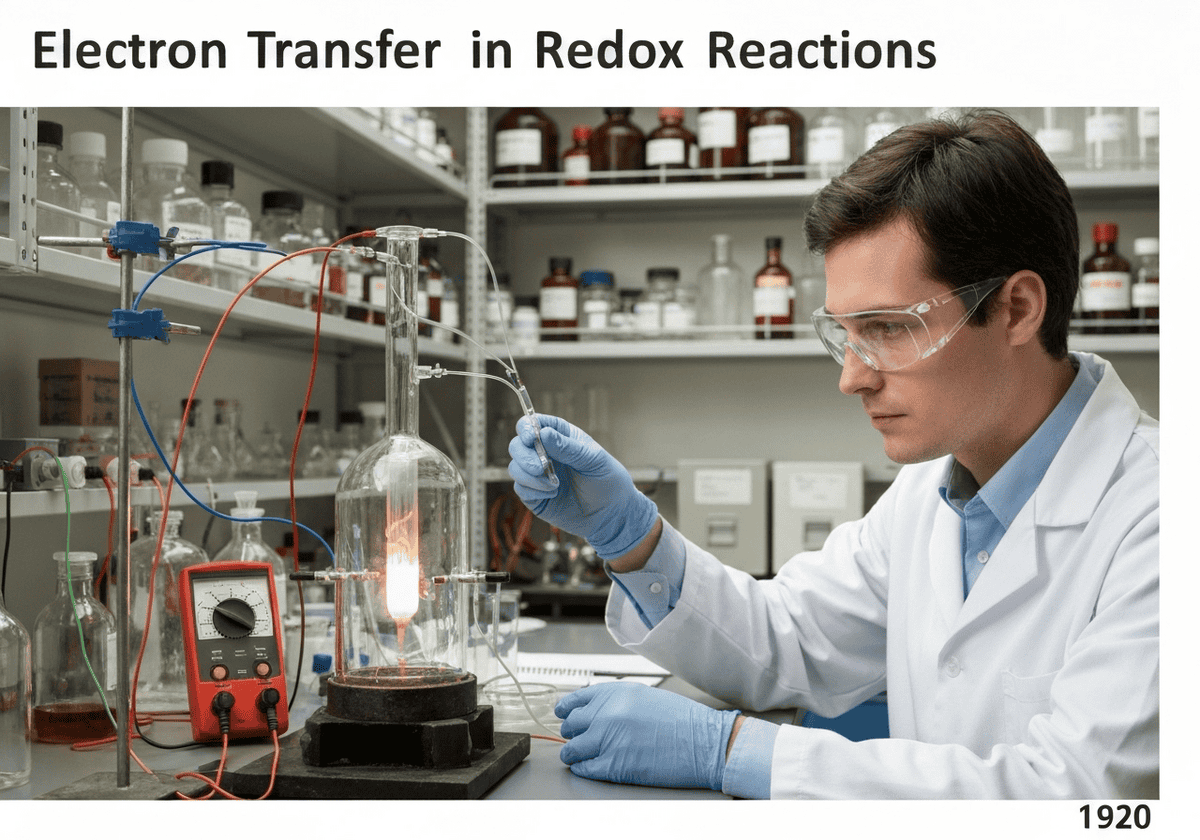
1920
Electrochemical cell experiment demonstrating electron transfer in redox reactions.

(generated image for illustration only)

Redox (reduction-oxidation) reactions involve a transfer of electrons between chemical species. One species undergoes oxidation (loses electrons), while another undergoes reduction (gains electrons). These two processes always occur simultaneously. The species that loses electrons is the reducing agent, and the one that gains electrons is the oxidizing agent. This fundamental concept underpins electrochemistry and many biological processes.

The concept of redox reactions evolved from early studies of combustion. Initially explained by the phlogiston theory, Antoine Lavoisier correctly identified the role of oxygen in combustion in the late 18th century, laying the groundwork for oxidation. However, the modern definition is centered on electron transfer, a concept that became clear only after the discovery of the electron by J.J. Thomson in 1897. The mnemonics ‘OIL RIG’ (Oxidation Is Loss, Reduction Is Gain) or ‘LEO the lion says GER’ (Lose Electrons Oxidation, Gain Electrons Reduction) are commonly used to remember the definitions.

In any redox reaction, the total number of electrons lost by the reducing agent must equal the total number of electrons gained by the oxidizing agent, adhering to the law of conservation of charge. For example, in the reaction of zinc metal with copper(II) ions, \(Zn(s) + Cu^{2+}(aq) rightarrow Zn^{2+}(aq) + Cu(s)\), zinc atoms are oxidized to zinc ions by losing two electrons, while copper(II) ions are reduced to copper metal by gaining two electrons. Here, zinc is the reducing agent and copper(II) is the oxidizing agent. This simple principle is foundational to countless natural and industrial processes, from the rusting of iron to the generation of electricity in a battery.

UNESCO Nomenclature: 2202
– Electrochemistry

Type

Abstract System

Disruption

Revolutionary

Usage

Widespread Use

Precursors

  • phlogiston theory of combustion
  • antoine lavoisier’s oxygen theory of combustion
  • discovery of the electron by j.j. thomson
  • development of atomic theory

Applications

  • batteries
  • corrosion prevention
  • metallurgy (smelting)
  • cellular respiration
  • photosynthesis
  • chemical synthesis

Patents:

NA

Potential Innovations Ideas

Due to scrapping bot traffic, currently more than 40k per day, this content is reserved to community members.
> Login < or > Register < (100% free) to access this, so as all other restricted content and tools.

Related to: redox, oxidation, reduction, electron transfer, oxidizing agent, reducing agent, electrochemistry, chemical reaction.

Historical Context

Electron Transfer in Redox Reactions

1916
1917
1918
1920
1920
1921
1922
1915-11
1916
1918
1919-05-29
1920
1920
1921
1924

(if date is unknown or not relevant, e.g. "fluid mechanics", a rounded estimation of its notable emergence is provided)

Related Invention, Innovation & Technical Principles

Full size images and downloads are only available, 100% free, for registered members.

> Login <