Product Design, Manufacturing & Innovation Resources
Home » Electrochemiluminescence (ECL)

Electrochemiluminescence (ECL)

1960
  • David M. Hercules
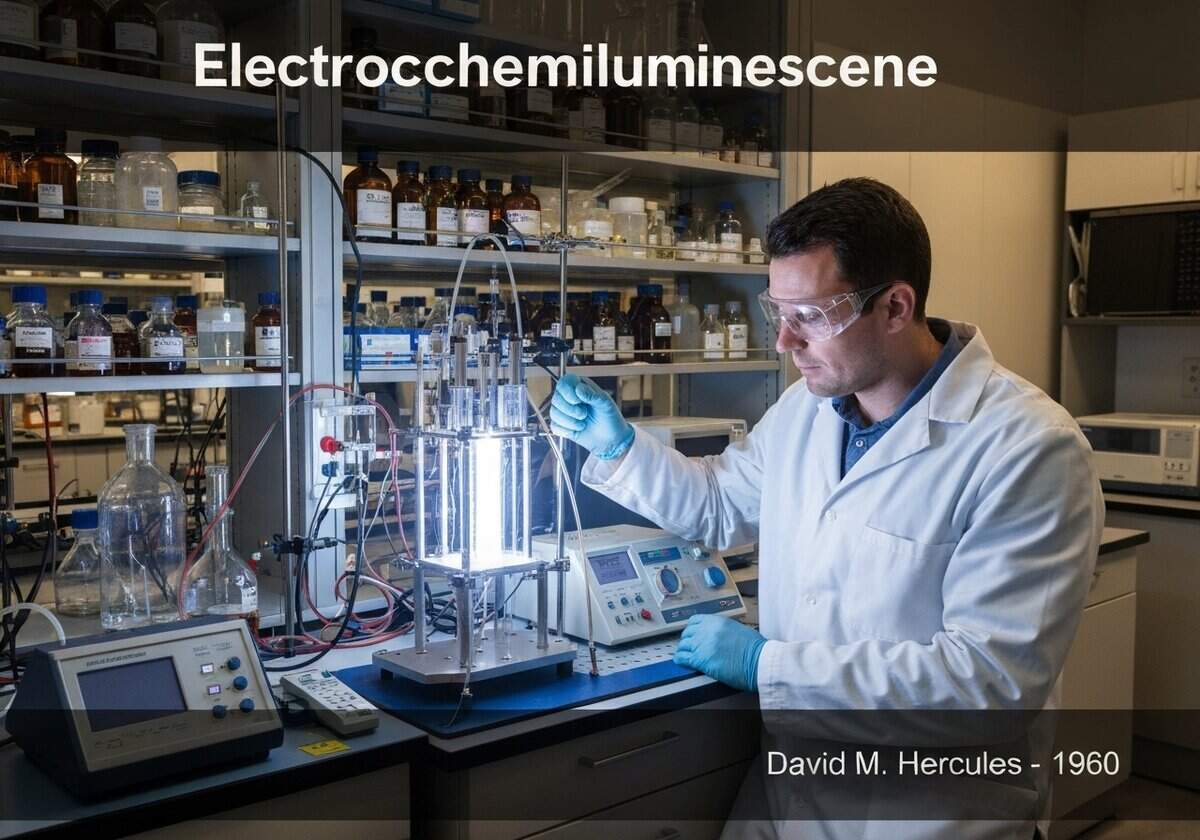
Electrochemiluminescence experiment in a laboratory setting with a scientist and electrochemical equipment.

(generated image for illustration only)

Electrochemiluminescence, or electrogenerated chemiluminescence (ECL), is a process where light is produced from chemical reactions initiated at an electrode surface. Species generated electrochemically undergo a high-energy electron transfer reaction to form an excited state that emits light upon relaxation. It combines the analytical advantages of chemiluminescence (low background, high sensitivity) with the precise control of an electrochemical trigger.
In a typical ECL system, a stable precursor molecule, such as a ruthenium(II) complex like \(Ru(bpy)_3^{2+}\), is used. When a voltage is applied to an electrode in a solution containing this complex and a co-reactant (e.g., tripropylamine, TPA), both species are oxidized at the electrode surface. The oxidized TPA loses a proton and an electron to become a highly reducing radical intermediate. This radical then transfers an electron to the oxidized ruthenium complex, \(Ru(bpy)_3^{3+}\), in a highly exothermic reaction. This electron transfer is so energetic that it promotes the resulting \(Ru(bpy)_3^{2+}\) to an electronically excited state, \([Ru(bpy)_3^{2+}]^*\). This excited state then relaxes to the ground state, emitting a photon of light at approximately 620 nm. The key advantage of ECL is its temporal and spatial control. The reaction only occurs when the voltage is applied and only at the electrode surface, which dramatically reduces background noise and allows for highly sensitive detection, often down to the attomolar level. This makes it a powerful tool in modern bioanalytical assays.

UNESCO Nomenclature: 2202
– Physical chemistry

Type

Chemical Process

Disruption

Incremental

Usage

Widespread Use

Precursors

  • discovery of chemiluminescence
  • development of potentiostats and modern electrochemistry
  • synthesis of stable organometallic complexes (e.g., ruthenium bipyridine)
  • understanding of electron transfer reactions (Marcus theory)

Applications

  • immunoassays and DNA probe assays in clinical diagnostics
  • high-throughput screening in drug discovery
  • food and water safety testing
  • detection of biological warfare agents
  • research in molecular biology

Patents:

  • US4849333
  • US5238808

Potential Innovations Ideas

Due to scrapping bot traffic, currently more than 40k per day, this content is reserved to community members.
> Login < or > Register < (100% free) to access this, so as all other restricted content and tools.

Related to: electrochemiluminescence, ECL, electrode, immunoassay, ruthenium, tripropylamine, bioassay, analytical chemistry, electrochemistry, diagnostics.

Historical Context

Electrochemiluminescence (ECL)

1960
1960
1960
1960
1960
1960
1960-05-16
1960
1960
1960
1960
1960
1960
1960
1961

(if date is unknown or not relevant, e.g. "fluid mechanics", a rounded estimation of its notable emergence is provided)

Related Invention, Innovation & Technical Principles

Full size images and downloads are only available, 100% free, for registered members.

> Login <