Electrochemical Potential and Thermodynamic Equilibrium
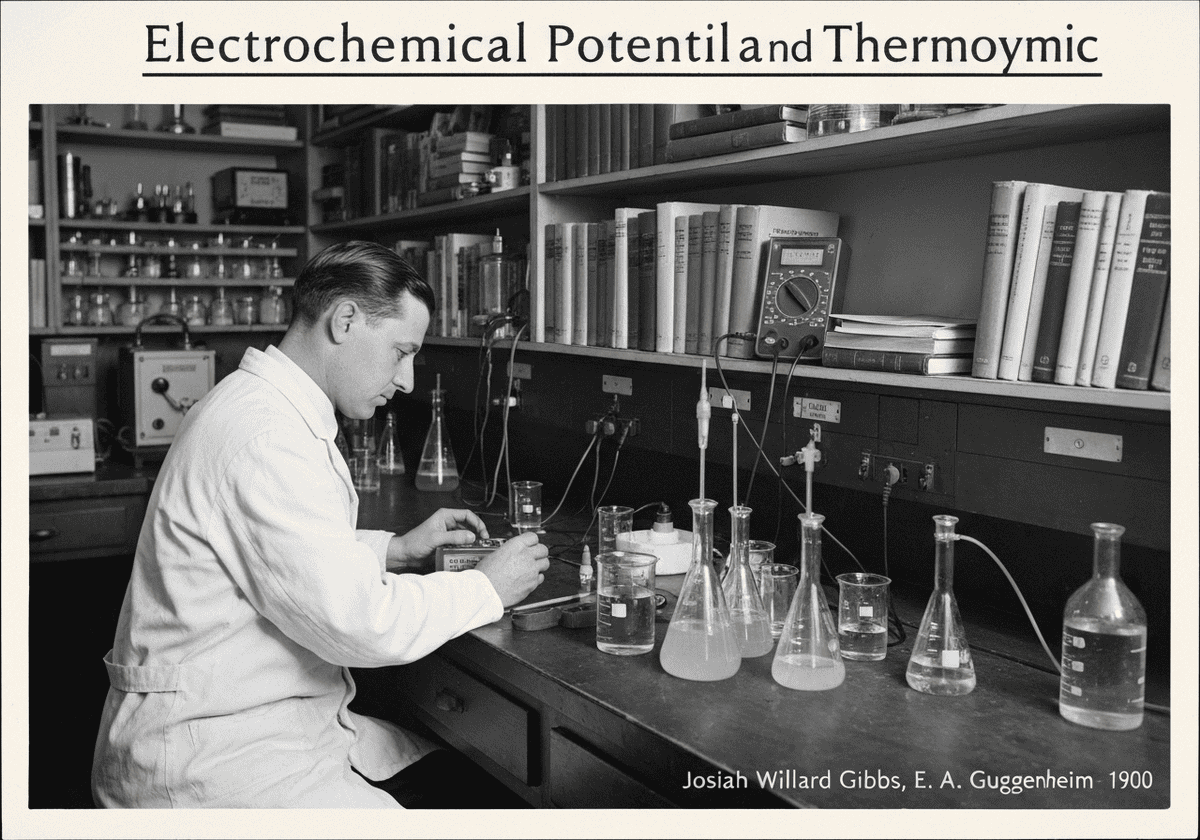
1900
- Josiah Willard Gibbs
- E. A. Guggenheim
In a system at thermodynamic equilibrium, the electrochemical potential, \(\bar{\mu}_i\), for any given charged species `i` must be uniform throughout all phases. If a gradient exists (\(\nabla \bar{\mu}_i \neq 0\)), ions will spontaneously move from regions of higher potential to lower potential, creating a current or flux, until this gradient is eliminated and equilibrium is re-established.
The principle of uniform electrochemical potential at equilibrium is a direct consequence of the Second Law of Thermodynamics, which states that a system will spontaneously evolve towards a state of minimum Gibbs free energy. Since the electrochemical potential is the partial molar Gibbs free energy for a charged species, any gradient in this potential represents an opportunity for the system’s total free energy to decrease through the movement of that species.
This movement, or flux, continues until the electrochemical potential is constant everywhere accessible to the species. At this point, the net force on the ions is zero, and there is no further net movement. This equilibrium is dynamic, not static; individual ions may still move, but the flux in one direction is perfectly balanced by the flux in the opposite direction.
A classic example is the Donnan equilibrium, which occurs across a semipermeable membrane that is permeable to some ions but not others (like large proteins). Small, permeable ions will redistribute themselves across the membrane to balance their electrochemical potentials. This results in an unequal distribution of both concentration and electric potential, creating a stable membrane potential at equilibrium. This same principle governs the behavior of p-n junctions in semiconductors, where electrons and holes diffuse until the electrochemical potential (Fermi level) is constant across the junction, creating a built-in electric field.
UNESCO Nomenclature: 2209
– Physical chemistry
Precursors
- the concept of chemical equilibrium by claude louis berthollet
- the laws of thermodynamics, particularly the concept of entropy and free energy
- josiah willard gibbs’s definition of chemical potential
- rudolf clausius’s work on entropy
Applications
- predicting the direction of ion flow across cell membranes
- determining the equilibrium voltage of a battery (electromotive force)
- modeling charge distribution at electrode-electrolyte interfaces (electrical double layer)
- understanding semiconductor p-n junction behavior at equilibrium
- designing electrochemical sensors
Potential Innovations Ideas
Due to scrapping bot traffic, currently more than 40k per day, this content is reserved to community members.
> Login < or > Register < (100% free) to access this, so as all other restricted content and tools.
Related to: thermodynamic equilibrium, ion flux, gradient, second law of thermodynamics, gibbs free energy, donnan equilibrium, spontaneous process, electrodiffusion.