Product Design, Manufacturing & Innovation Resources
Home » Developmental Constraint

Developmental Constraint

1979
  • Stephen Jay Gould
  • Richard Lewontin
  • Pere Alberch
  • Rupert Riedl
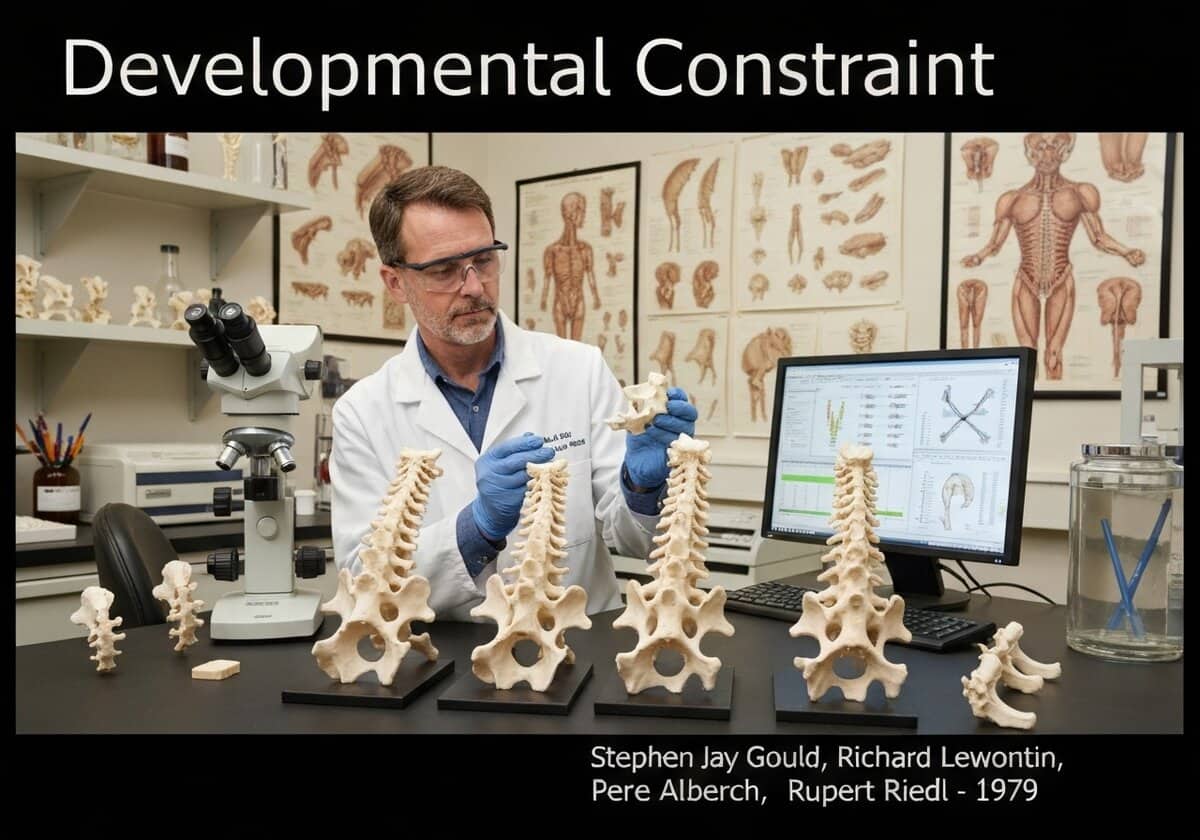
Cervical vertebrae samples from mammals in a laboratory for evolutionary biology research.

(generated image for illustration only)

Developmental constraint refers to biases on the production of phenotypic variation due to the properties of developmental systems. Not all conceivable variations are possible because the intricate network of developmental processes limits the “allowable” evolutionary paths. For example, the number of cervical vertebrae in mammals is almost always seven, suggesting a strong developmental constraint against variation in this trait.

The concept of developmental constraint was a key part of the critique of the ‘pan-adaptationist’ view of the Modern Synthesis, which sometimes treated organisms as infinitely malleable by natural selection. Gould and Lewontin’s famous 1979 paper, ‘The Spandrels of San Marco and the Panglossian Paradigm,’ argued that many features of an organism are not specific adaptations but are necessary byproducts of its developmental architecture, much like the spandrels in a cathedral are an inevitable consequence of placing a dome on rounded arches.

Constraints can arise from multiple sources. Physical constraints are due to the laws of physics and chemistry (e.g., diffusion limits cell size). Morphogenetic constraints arise from the processes of tissue and organ formation. Pleiotropic constraints occur when a single gene affects multiple traits; an advantageous mutation in one context might be disadvantageous in another, preventing its selection. The highly conserved number of seven cervical vertebrae in mammals (from giraffes to mice) is a classic example. While variation is possible (as seen in sloths), it is strongly associated with neonatal cancers and other defects, suggesting that the Hox genes patterning this region are so deeply integrated into other vital developmental networks that any changes are highly deleterious. Thus, development doesn’t just generate variation for selection to act upon; it also structures and limits that very variation.

UNESCO Nomenclature: 2411
– Evolution

Type

Abstract System

Disruption

Incremental

Usage

Widespread Use

Precursors

  • D’Arcy Thompson’s work on growth and form
  • critiques of pan-adaptationism
  • Ivan Shmalhausen’s work on stabilizing selection
  • C. H. Waddington’s concept of canalization
  • understanding of gene pleiotropy

Applications

  • explaining patterns of stasis in the fossil record
  • predicting which evolutionary pathways are more or less likely
  • understanding why certain congenital abnormalities are more common than others
  • informing models of morphological evolution
  • providing a non-adaptationist explanation for certain biological traits (spandrels)

Patents:

NA

Potential Innovations Ideas

Due to scrapping bot traffic, currently more than 40k per day, this content is reserved to community members.
> Login < or > Register < (100% free) to access this, so as all other restricted content and tools.

Related to: developmental constraint, Stephen Jay Gould, Spandrels, adaptationism, pleiotropy, HOX genes, evolutionary biology, modern synthesis, canalization, morphology.

Historical Context

Developmental Constraint

1970
1973
1975
1979
1983
1988
1990
1967
1970
1975
1977
1983
1987
1990
1990

(if date is unknown or not relevant, e.g. "fluid mechanics", a rounded estimation of its notable emergence is provided)

Related Invention, Innovation & Technical Principles

Full size images and downloads are only available, 100% free, for registered members.

> Login <