Product Design, Manufacturing & Innovation Resources
Home » Debye Force (Dipole-Induced Dipole Interaction)

Debye Force (Dipole-Induced Dipole Interaction)

1920
  • Peter Debye
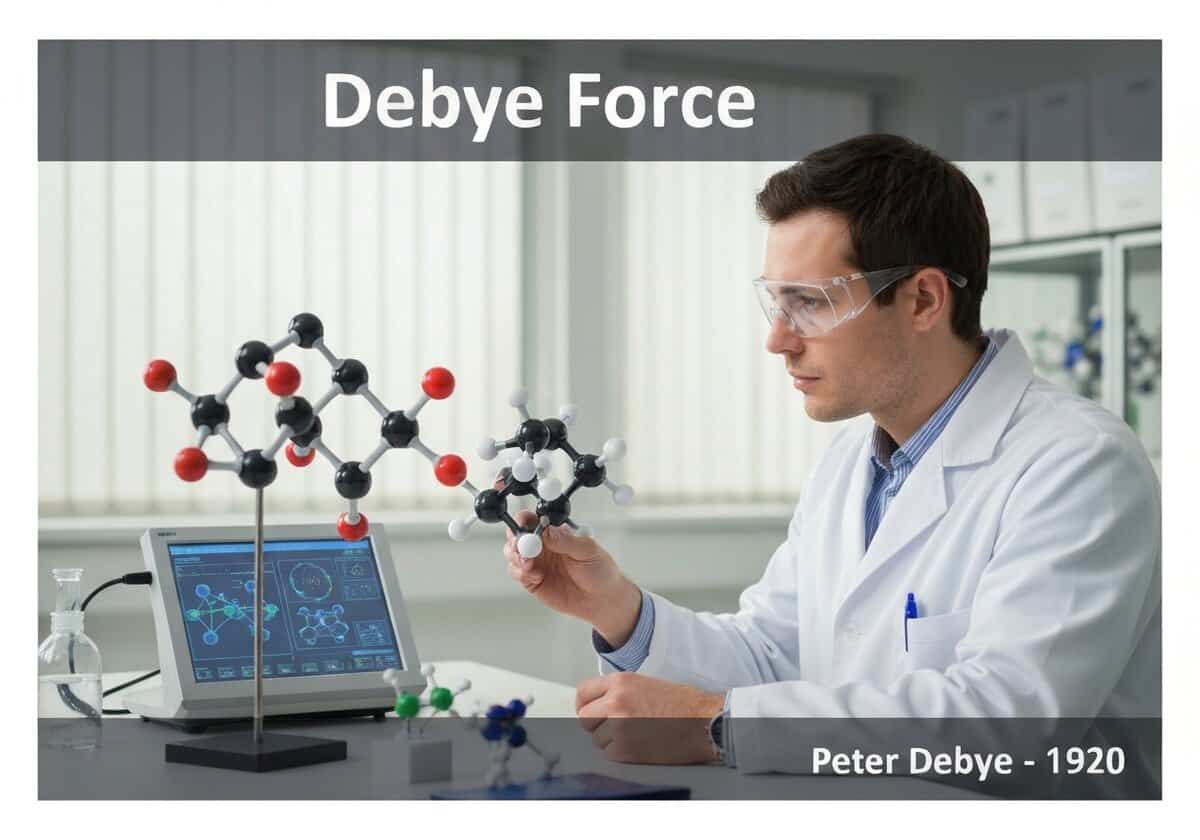
Laboratory experiment demonstrating Debye Force between polar and nonpolar molecules.

(generated image for illustration only)

An attractive intermolecular force between a polar molecule (with a permanent dipole) and a nonpolar molecule. The electric field from the permanent dipole distorts the electron cloud of the nonpolar molecule, inducing a temporary dipole in it. The two dipoles then attract each other. The interaction potential energy is \(V \propto -\frac{\alpha \mu^2}{r^6}\), where \(\alpha\) is polarizability and \(\mu\) is the permanent dipole moment.

The Debye force, also known as the induction force, explains how a polar molecule can attract a nonpolar one. A polar molecule possesses a permanent electric dipole, which creates an electric field in its vicinity. When a nonpolar molecule enters this field, its electron cloud is distorted—electrons are pushed away from the negative end of the dipole and pulled toward the positive end. This separation of charge creates a temporary, ‘induced’ dipole in the nonpolar molecule. The interaction is always attractive because the induced dipole is always oriented favorably with respect to the permanent dipole that created it.

Unlike the Keesom force, the Debye force is not dependent on temperature. This is because the induced dipole is created by the permanent dipole and follows its orientation instantaneously, so thermal tumbling of the permanent dipole does not average out the attraction. The strength of the Debye force depends on two factors: the magnitude of the permanent dipole moment (\(\mu\)) of the polar molecule and the polarizability (\(\alpha\)) of the nonpolar molecule. While generally weaker than dipole-dipole forces, Debye forces are essential for understanding the behavior of mixtures containing both polar and nonpolar components.

UNESCO Nomenclature: 2202
– Atomic and molecular physics

Type

Physical Law

Disruption

Incremental

Usage

Widespread Use

Precursors

  • Classical Electrodynamics and the concept of an electric field
  • The theory of the permanent electric dipole moment
  • The concept of atomic and molecular polarizability

Applications

  • explaining the solubility of nonpolar gases (like oxygen or nitrogen) in polar solvents (like water)
  • modeling interactions in mixtures of polar and nonpolar substances
  • understanding the formation of solvation shells around ions in solution
  • adhesion between polar and nonpolar surfaces

Patents:

NA

Potential Innovations Ideas

Due to scrapping bot traffic, currently more than 40k per day, this content is reserved to community members.
> Login < or > Register < (100% free) to access this, so as all other restricted content and tools.

Related to: Debye force, dipole-induced dipole, induction force, polarizability, permanent dipole, intermolecular force, nonpolar molecules, polar molecules, solvation, Van der Waals.

Historical Context

Debye Force (Dipole-Induced Dipole Interaction)

1917
1918
1920
1920
1921
1922
1924
1916
1918
1919-05-29
1920
1920
1921
1924
1924

(if date is unknown or not relevant, e.g. "fluid mechanics", a rounded estimation of its notable emergence is provided)

Related Invention, Innovation & Technical Principles

Full size images and downloads are only available, 100% free, for registered members.

> Login <