Product Design, Manufacturing & Innovation Resources
Home » Curie Temperature

Curie Temperature

1895
  • Pierre Curie
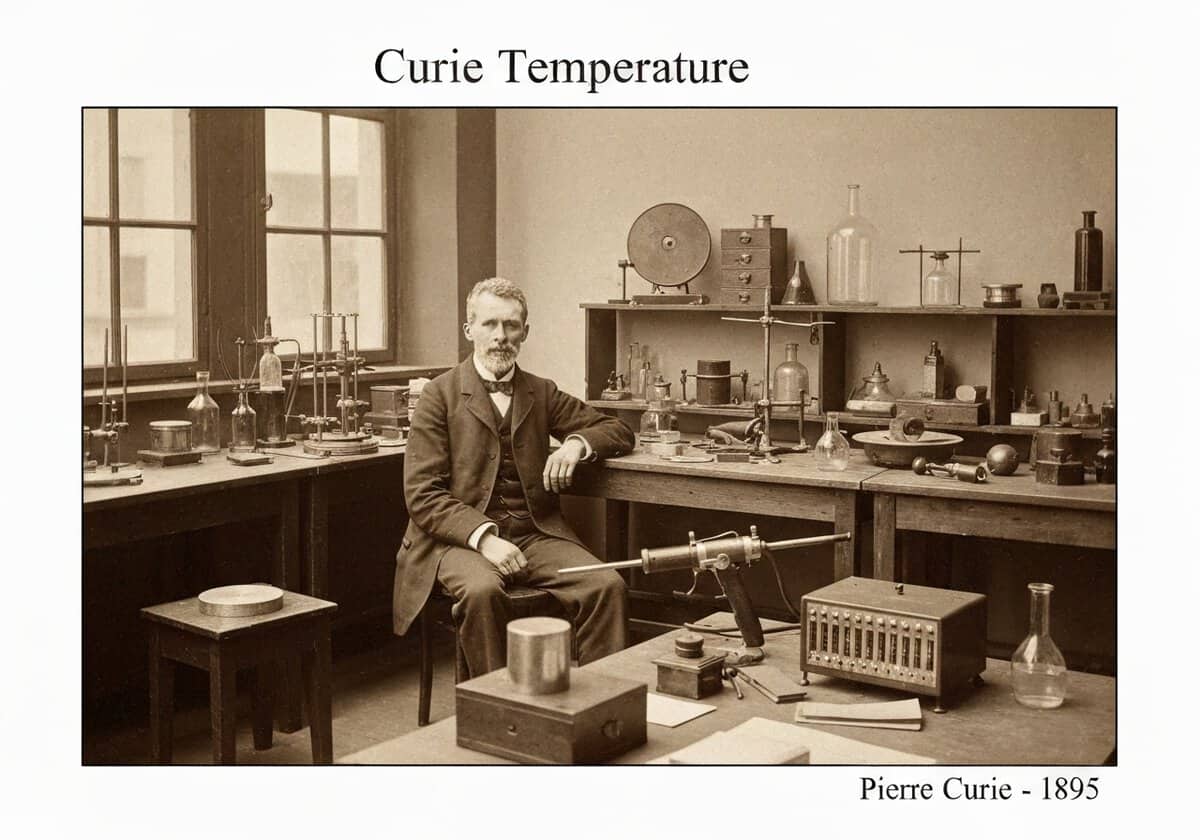
Laboratory scene with Pierre Curie studying magnetic properties in 1895.

(generated image for illustration only)

The Curie temperature (\(T_c\)), or Curie point, is the critical temperature above which certain materials lose their permanent magnetic properties. For ferromagnetic materials, they become paramagnetic above \(T_c\). This transition is a phase transition where thermal energy becomes strong enough to overcome the quantum mechanical exchange interactions that cause spontaneous magnetic ordering of atomic moments.

Pierre Curie discovered that a material’s magnetism changed at a specific temperature, a finding that was crucial for understanding the nature of magnetism. Below the Curie temperature (\(T_c\)), the exchange interaction dominates, forcing adjacent atomic magnetic moments to align, creating the spontaneous magnetization characteristic of ferromagnetism. As the temperature increases, thermal agitation causes the moments to fluctuate more randomly. At the Curie temperature, the thermal energy is sufficient to completely disrupt this long-range ordering. The material undergoes a second-order phase transition, and its spontaneous magnetization drops to zero. Above \(T_c\), the material is paramagnetic; an external magnetic field can still induce a weak alignment of the atomic moments, but this alignment disappears once the field is removed.

Each ferromagnetic material has a unique Curie temperature. For example, iron’s \(T_c\) is 770 °C (1043 K), cobalt’s is 1130 °C (1403 K), and nickel’s is 358 °C (631 K). This property is exploited in various technologies. For instance, magneto-optical discs use a laser to heat a small spot of magnetic material above its Curie point, allowing a weak magnetic field to change its magnetic orientation to write data. In paleomagnetism, the Curie temperature is fundamental for studying the Earth’s past magnetic field, as magnetic minerals in cooling volcanic rocks align with the Earth’s field and lock in that orientation as they cool below their \(T_c\).

UNESCO Nomenclature: 2211
– Solid state physics

Type

Physical Property

Disruption

Substantial

Usage

Widespread Use

Precursors

  • understanding of heat and temperature
  • early observations of magnets losing strength when heated
  • development of thermodynamics
  • atomic theory of matter

Applications

  • thermal demagnetization of materials
  • thermomagnetic data storage (magneto-optical discs)
  • temperature sensors
  • soldering guns with temperature control
  • paleomagnetism studies of earth’s history

Patents:

NA

Potential Innovations Ideas

Due to scrapping bot traffic, currently more than 40k per day, this content is reserved to community members.
> Login < or > Register < (100% free) to access this, so as all other restricted content and tools.

Related to: Curie temperature, Curie point, ferromagnetism, paramagnetism, phase transition, thermal energy, exchange interaction, Pierre Curie, magnetism, solid-state physics.

Historical Context

Curie Temperature

1890
1890
1895
1895
1896
1900
1900
1889
1890
1890
1895
1895
1899
1900
1900

(if date is unknown or not relevant, e.g. "fluid mechanics", a rounded estimation of its notable emergence is provided)

Related Invention, Innovation & Technical Principles

Full size images and downloads are only available, 100% free, for registered members.

> Login <