Product Design, Manufacturing & Innovation Resources
Home » Correlated Color Temperature (CCT)

Correlated Color Temperature (CCT)

1930
Laboratory technician measuring Correlated Color Temperature of LED light sources with a spectrometer.

(generated image for illustration only)

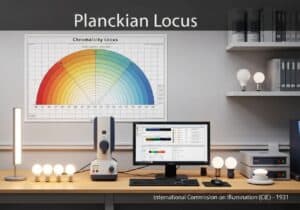
Correlated Color Temperature (CCT) is a metric for light sources that do not radiate as ideal black bodies, such as LEDs or fluorescent lamps. It is the temperature of the Planckian radiator whose color is perceived as most similar to the light source. This ‘closeness’ is determined by finding the point on the Planckian locus nearest to the source’s chromaticity coordinates.


The need for CCT arose with the advent of artificial light sources that produce light through means other than thermal radiation (incandescence). Plasmas in fluorescent tubes or electroluminescence in LEDs generate spectral power distributions (SPDs) that are often spiky and irregular, unlike the smooth, continuous spectrum of a black body. Consequently, their chromaticity coordinates rarely fall exactly on the Planckian locus.

To still provide a useful, single-number metric for the ‘warmth’ or ‘coolness’ of these sources, the concept of CCT was developed. The calculation involves finding the shortest distance from the light source’s (u,v) or (x,y) chromaticity coordinate to the Planckian locus. The temperature associated with that closest point on the locus is the CCT. Lines of constant CCT, known as isotemperature lines, are often drawn perpendicular to the locus on chromaticity diagrams. However, CCT alone does not describe the color rendering quality of a source; two sources with the same CCT can render colors very differently.

UNESCO Nomenclature: 2209
– Optics

Type

Metric

Disruption

Substantial

Usage

Widespread Use

Precursors

  • The concept of color temperature for black-body radiators
  • The Planckian locus in a standardized color space (CIE 1931)
  • Development of non-incandescent light sources (fluorescent lamps, LEDs) requiring a comparative metric

Applications

  • led lighting specifications (e.g., ‘3000K warm white’)
  • fluorescent lamp manufacturing and classification
  • architectural lighting design to create specific ambiances
  • human-centric lighting systems that vary CCT during the day
  • quality control in display manufacturing to ensure consistent white points

Patents:

NA

Potential Innovations Ideas

Due to scrapping bot traffic, currently more than 40k per day, this content is reserved to community members.
> Login < or > Register < (100% free) to access this, so as all other restricted content and tools.

Related to: CCT, correlated color temperature, Planckian locus, chromaticity, light source, LED, fluorescent, color rendering index, CRI, metamerism.

Historical Context

Correlated Color Temperature (CCT)

1927
1930
1930
1930
1931
1932
1936-01-01
1927
1930
1930
1930
1931
1932
1933
1937

(if date is unknown or not relevant, e.g. "fluid mechanics", a rounded estimation of its notable emergence is provided)

Related Invention, Innovation & Technical Principles

Full size images and downloads are only available, 100% free, for registered members.

> Login <