Product Design, Manufacturing & Innovation Resources
Home » CIE Whiteness Index (W_CIE)

CIE Whiteness Index (W_CIE)

1986
  • International Commission on Illumination (CIE)
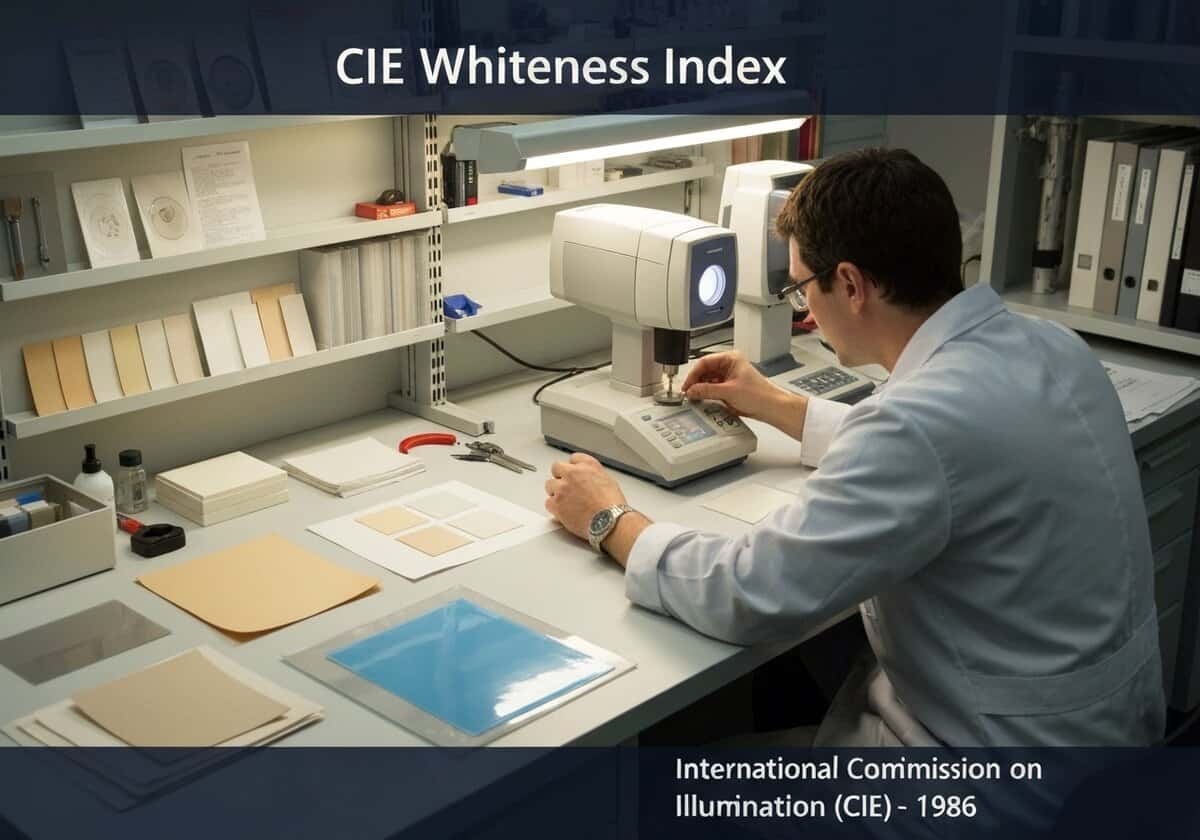
Laboratory technician measuring CIE Whiteness Index using spectrophotometer in optics.

(generated image for illustration only)

The CIE Whiteness Index is a standardized formula by the International Commission on Illumination to quantify the perception of whiteness. It is calculated from CIE tristimulus values (X, Y, Z) and the chromaticity coordinates (x, y) of the sample and a reference illuminant. The primary formula is \(W_{CIE} = Y + 800(x_n – x) + 1700(y_n – y)\).

The CIE Whiteness Index (W_CIE or W10 for the D65/10° observer) provides a single numerical value to represent how ‘white’ a material appears to a standard human observer under a specific illuminant. The formula, \(W_{CIE} = Y + 800(x_n – x) + 1700(y_n – y)\), is based on the idea that whiteness is a combination of high lightness (represented by the tristimulus value Y) and a specific chromaticity, typically a slightly bluish hue. In the formula, (x, y) are the chromaticity coordinates of the sample, and (x_n, y_n) are those of the perfect diffuser under the same illuminant. The coefficients 800 and 1700 were empirically determined to correlate with visual assessments of whiteness. The formula is valid for a specific range of chromaticities close to the neutral point. A companion value, the Tint Index (T_W or T10), is often calculated as \(T_{W,10} = 1000(x_n – x) – 650(y_n – y)\) to quantify the reddish or greenish deviation from a pure white. A positive T_W indicates a greenish tint, while a negative value indicates a reddish tint. The CIE standard specifies conditions for its use, including the illuminant (typically D65) and observer (2° or 10°). This index is crucial for industries where consistent appearance is vital, ensuring that products like paper, textiles, and plastics meet specific whiteness standards regardless of where they are manufactured or viewed.

UNESCO Nomenclature: 2209
– Optics

Type

Abstract System

Disruption

Substantial

Usage

Widespread Use

Precursors

  • CIE 1931 XYZ color space
  • Development of spectrophotometry
  • Gunter Wyszecki’s research on color difference formulas
  • Early whiteness formulas by Judd, MacAdam, and others

Applications

  • paper manufacturing quality control
  • textile industry for bleach and dye assessment
  • plastics and coatings formulation
  • paint and pigment production
  • dental materials shade matching

Patents:

NA

Potential Innovations Ideas

Due to scrapping bot traffic, currently more than 40k per day, this content is reserved to community members.
> Login < or > Register < (100% free) to access this, so as all other restricted content and tools.

Related to: whiteness index, CIE, colorimetry, tristimulus values, chromaticity, D65 illuminant, paper industry, textile quality, color science, appearance measurement.

Historical Context

CIE Whiteness Index (W_CIE)

1980
1984
1985
1986
1990
1994
1997
1980
1980
1984
1986
1986
1991
1995
2000

(if date is unknown or not relevant, e.g. "fluid mechanics", a rounded estimation of its notable emergence is provided)

Related Invention, Innovation & Technical Principles

Full size images and downloads are only available, 100% free, for registered members.

> Login <