Product Design, Manufacturing & Innovation Resources
Home » Biomimicry

Biomimicry

1997
  • Janine Benyus
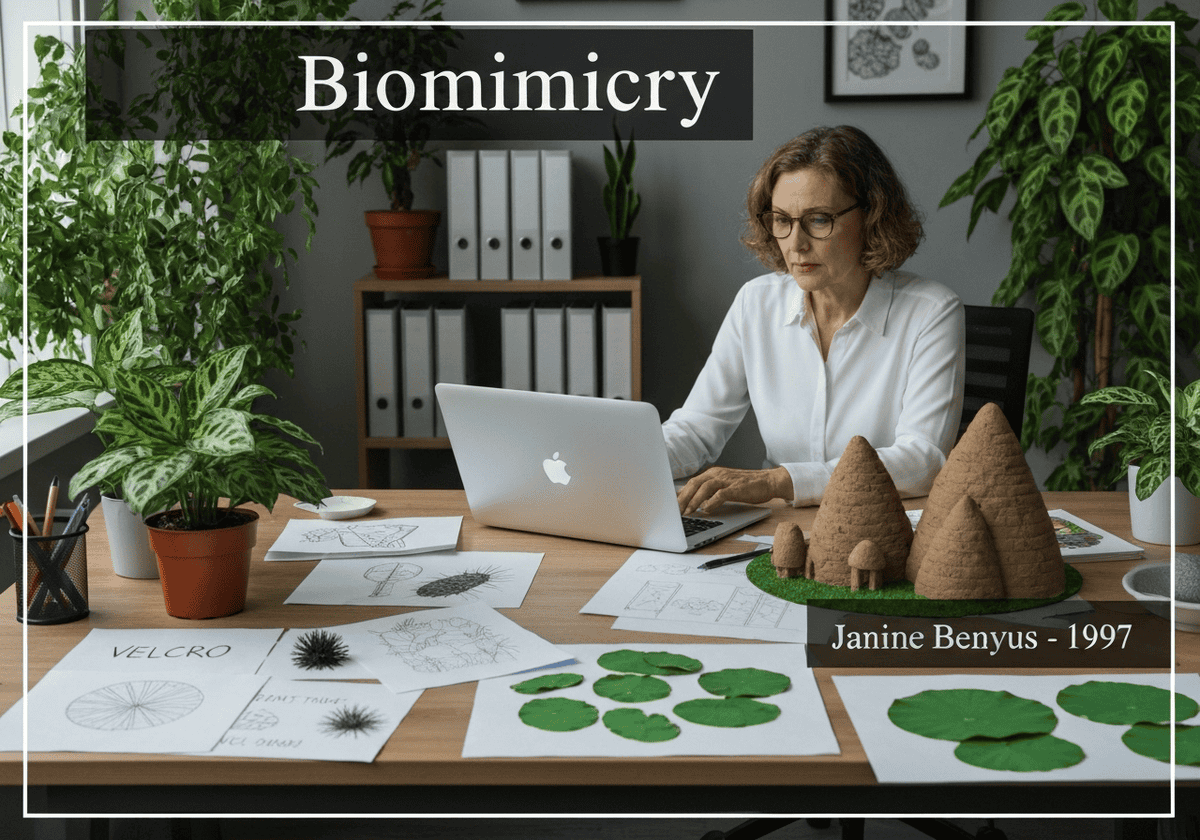
Biomimicry workspace with designs inspired by nature for sustainable solutions.

(generated image for illustration only)

Biomimicry is an innovation approach that seeks sustainable solutions to human challenges by emulating nature’s time-tested patterns and strategies. The core idea is that nature, through 3.8 billion years of evolution, has already solved many of the problems we are grappling with. It involves observing and learning from the designs and processes of organisms and ecosystems to create more sustainable designs.
Biomimicry operates on three essential levels. The first is mimicking natural form. This involves studying a specific shape or structure in nature and using it in a design. For example, the bumpy leading edge of a humpback whale’s flipper inspired more efficient and stable fan blades and wind turbine designs. This is often the most straightforward application of biomimicry.

The second level is mimicking natural process, which involves imitating a natural method of making something. An example is the study of how spiders produce silk, a material stronger than steel by weight, at ambient temperature and pressure using water as a solvent. Replicating this process could revolutionize materials manufacturing, making it far less energy-intensive and toxic.

The third and most complex level is mimicking natural ecosystems. This involves studying how components in an ecosystem interact and applying these principles to human systems. For instance, the concept of industrial ecology, where the waste of one industrial process becomes the feedstock for another, mimics the nutrient cycling found in natural ecosystems where there is no waste. This level of biomimicry aims to create industries and cities that function as elegantly and efficiently as a mature forest or coral reef.

The practice of biomimicry is guided by a set of “Life’s Principles,” which are recurring patterns and strategies found across species that have survived and thrived on Earth. These principles include concepts like “use life-friendly chemistry,” “be resource efficient,” and “adapt to changing conditions.”

UNESCO Nomenclature: 2406
– Biology

Type

Abstract System

Disruption

Substantial

Usage

Widespread Use

Precursors

  • Leonardo da Vinci’s studies of bird flight to design flying machines
  • The Wright brothers’ observations of birds to develop wing-warping for aircraft control
  • The field of bionics, which emerged in the mid-20th century
  • Indigenous knowledge systems that have long observed and learned from nature

Applications

  • velcro, inspired by the burrs of the burdock plant
  • sharklet technologies, a surface texture mimicking shark skin to inhibit bacterial growth
  • eastgate centre in zimbabwe, a building with a cooling system inspired by termite mounds
  • shinkansen “bullet” train’s nose cone, redesigned based on a kingfisher’s beak to reduce sonic booms
  • lotus-effect paints and surfaces that are self-cleaning, inspired by the lotus leaf

Patents:

NA

Potential Innovations Ideas

Due to scrapping bot traffic, currently more than 40k per day, this content is reserved to community members.
> Login < or > Register < (100% free) to access this, so as all other restricted content and tools.

Related to: biomimicry, janine benyus, nature-inspired design, innovation, sustainability, bio-utilization, ecosystem, engineering.

Historical Context

Biomimicry

1988
1990
1990
1997
2000
2008
1987
1990
1990
1990
1997
2000

(if date is unknown or not relevant, e.g. "fluid mechanics", a rounded estimation of its notable emergence is provided)

Related Invention, Innovation & Technical Principles

Full size images and downloads are only available, 100% free, for registered members.

> Login <