Product Design, Manufacturing & Innovation Resources
Home » Bioluminescence

Bioluminescence

1890
  • Raphaël Dubois
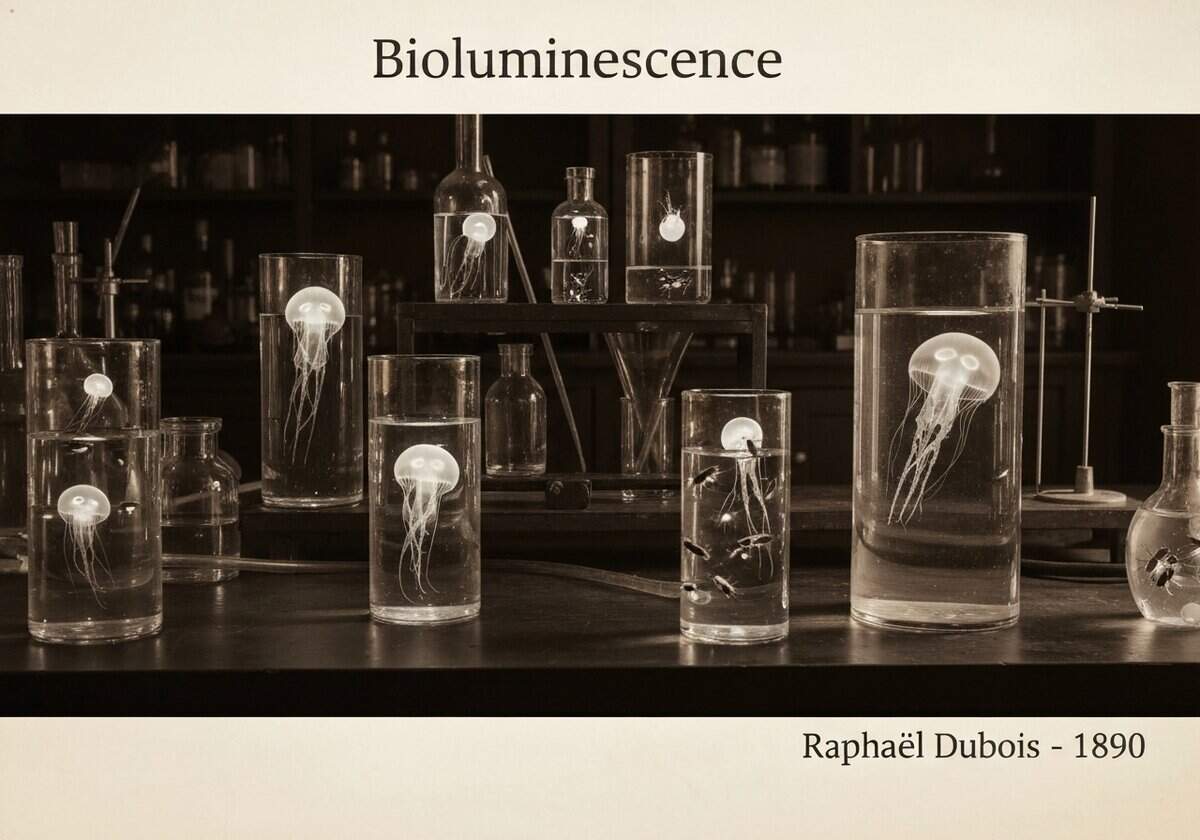
Bioluminescent organisms in a laboratory setting for biochemical research.

(generated image for illustration only)

Bioluminescence is the production and emission of light by a living organism. It is a naturally occurring form of chemiluminescence where energy is released by a chemical reaction in the form of light emission. The primary reaction involves a light-emitting pigment, a luciferin, and an enzyme, a luciferase, which catalyzes the reaction, typically with oxygen as a co-reactant.

Bioluminescence has evolved independently many times across various branches of life, from bacteria and fungi to insects and deep-sea fish. The underlying chemistry, while diverse, generally follows a common pattern. An enzyme (luciferase) acts on a substrate (luciferin) to produce an excited-state intermediate. For example, in fireflies, the luciferase enzyme catalyzes the reaction of firefly luciferin with adenosine triphosphate (ATP) and magnesium to form luciferyl adenylate. This complex then reacts with molecular oxygen to create a highly unstable peroxide intermediate, which decomposes to oxyluciferin in an excited state and releases AMP. The excited oxyluciferin then emits a photon, producing the characteristic yellow-green glow. The high efficiency of many bioluminescent systems (quantum yields can approach 1) means that almost all the energy is released as light, with very little heat, earning it the name ‘cold light’. This efficiency and the specificity of the enzyme-substrate reaction have made luciferase systems invaluable tools in biotechnology, particularly as reporter genes to study gene expression and protein function.

UNESCO Nomenclature: 2302
– Biochemistry

Type

Biological Process

Disruption

Substantial

Usage

Widespread Use

Precursors

  • observation of glowing organisms (e.g., fireflies, glowing wood) throughout history
  • development of enzymology and understanding of enzyme-substrate interactions
  • isolation and characterization of organic molecules
  • advances in genetics and molecular biology allowing for gene cloning (for reporter assays)

Applications

  • reporter genes in molecular biology (luciferase assay)
  • biomedical imaging of cellular processes and disease progression in living animals
  • environmental monitoring for toxicity (e.g., bacterial assays)
  • development of new lighting technologies
  • drug discovery and screening

Patents:

NA

Potential Innovations Ideas

Due to scrapping bot traffic, currently more than 40k per day, this content is reserved to community members.
> Login < or > Register < (100% free) to access this, so as all other restricted content and tools.

Related to: bioluminescence, luciferin, luciferase, living organism, light emission, firefly, ATP, reporter gene, cold light, biochemistry.

Historical Context

1890
1955
1980
1880
1897
1970

(if date is unknown or not relevant, e.g. "fluid mechanics", a rounded estimation of its notable emergence is provided)

Related Invention, Innovation & Technical Principles

Full size images and downloads are only available, 100% free, for registered members.

> Login <