Product Design, Manufacturing & Innovation Resources
Home » Binder Jetting

Binder Jetting

1993
  • Ely Sachs
  • Michael Cima
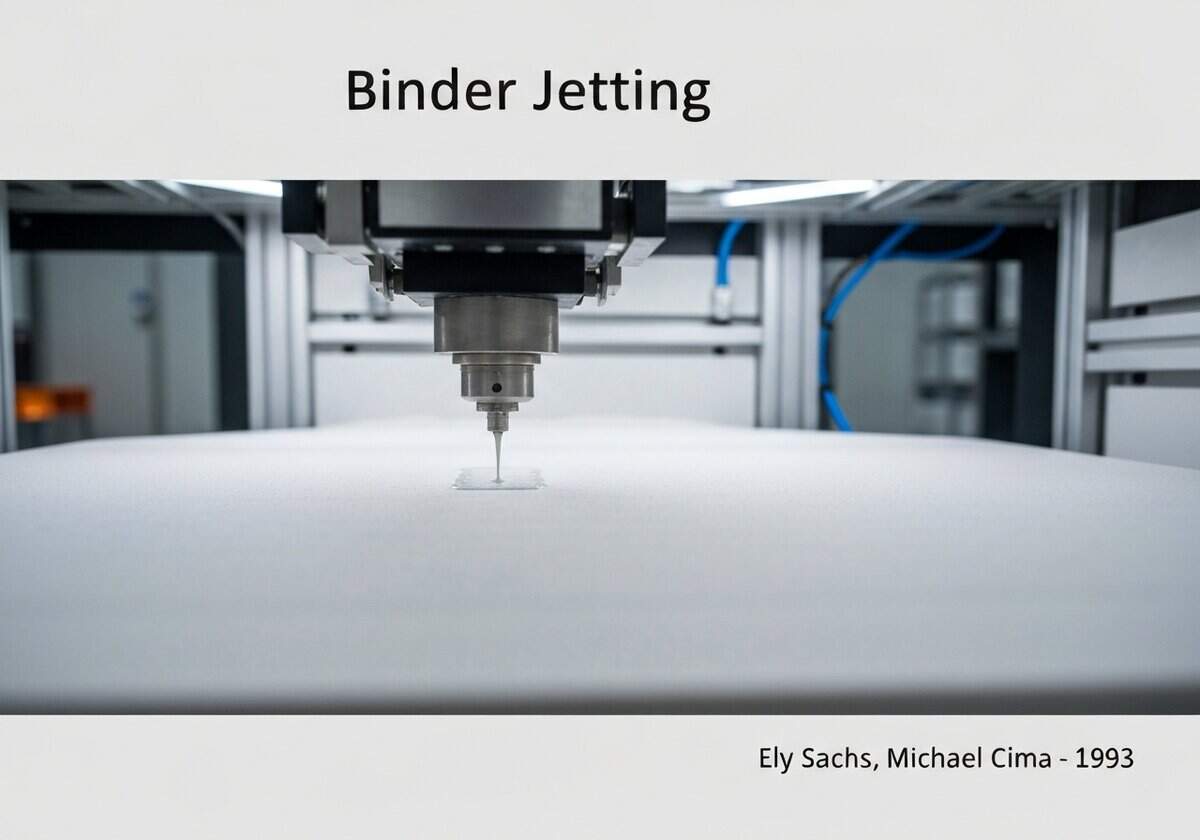
Binder jetting machine applying binding agent in additive manufacturing.

(generated image for illustration only)

Binder jetting is an additive manufacturing process where a liquid binding agent is selectively deposited onto a powder bed using an inkjet-style print head. The print head moves across a layer of powder, depositing binder droplets to join particles together. The build platform then lowers, a new layer of powder is spread, and the process repeats layer-by-layer.


The primary advantage of binder jetting is its speed and scalability, as the inkjet deposition process is typically faster than laser-based methods. It also operates at room temperature, which avoids the thermal stresses and warping common in high-temperature processes. This makes it suitable for a wide range of materials, including sand, metals, ceramics, and polymers. After printing, the part exists in a fragile ‘green state,’ held together only by the binder. It must be carefully excavated from the surrounding loose powder. For metal and ceramic parts, a crucial post-processing step is required to achieve final density and strength. This typically involves sintering in a furnace to burn out the binder and fuse the material particles, a process that causes significant and predictable shrinkage. Alternatively, the green part can be infiltrated with a lower-melting-point metal, such as bronze, to fill the pores and create a dense composite. A unique feature is the ability to incorporate color into the binder, allowing for the creation of full-color 3D models directly from the printer.

UNESCO Nomenclature: 3313
– Industrial technology

Type

Manufacturing Process

Disruption

Substantial

Usage

Widespread Use

Precursors

  • inkjet printing technology developed in the 1970s
  • powder metallurgy for processing powdered materials
  • computer-aided design (cad) for creating digital blueprints
  • traditional sand casting techniques used in foundries
  • development of specialized chemical binding agents

Applications

  • full-color prototypes and architectural models using gypsum powder
  • large sand casting molds and cores for industrial foundries
  • production of metal parts via subsequent sintering or infiltration
  • manufacturing of complex ceramic components
  • high-speed, large-scale part production

Patents:

  • US 5204055 A

Potential Innovations Ideas

Due to scrapping bot traffic, currently more than 40k per day, this content is reserved to community members.
> Login < or > Register < (100% free) to access this, so as all other restricted content and tools.

Related to: binder jetting, 3dp, additive manufacturing, powder bed, inkjet, binder, green part, sintering, infiltration, sand casting.

Historical Context

Binder Jetting

1990
1991
1992
1993
1994
1997
1998
1990
1990
1992
1992
1993-07-22
1996
1998
1999

(if date is unknown or not relevant, e.g. "fluid mechanics", a rounded estimation of its notable emergence is provided)

Related Invention, Innovation & Technical Principles

Full size images and downloads are only available, 100% free, for registered members.

> Login <