Product Design, Manufacturing & Innovation Resources
Home » Bézier Curves

Bézier Curves

1968
  • Pierre Bézier
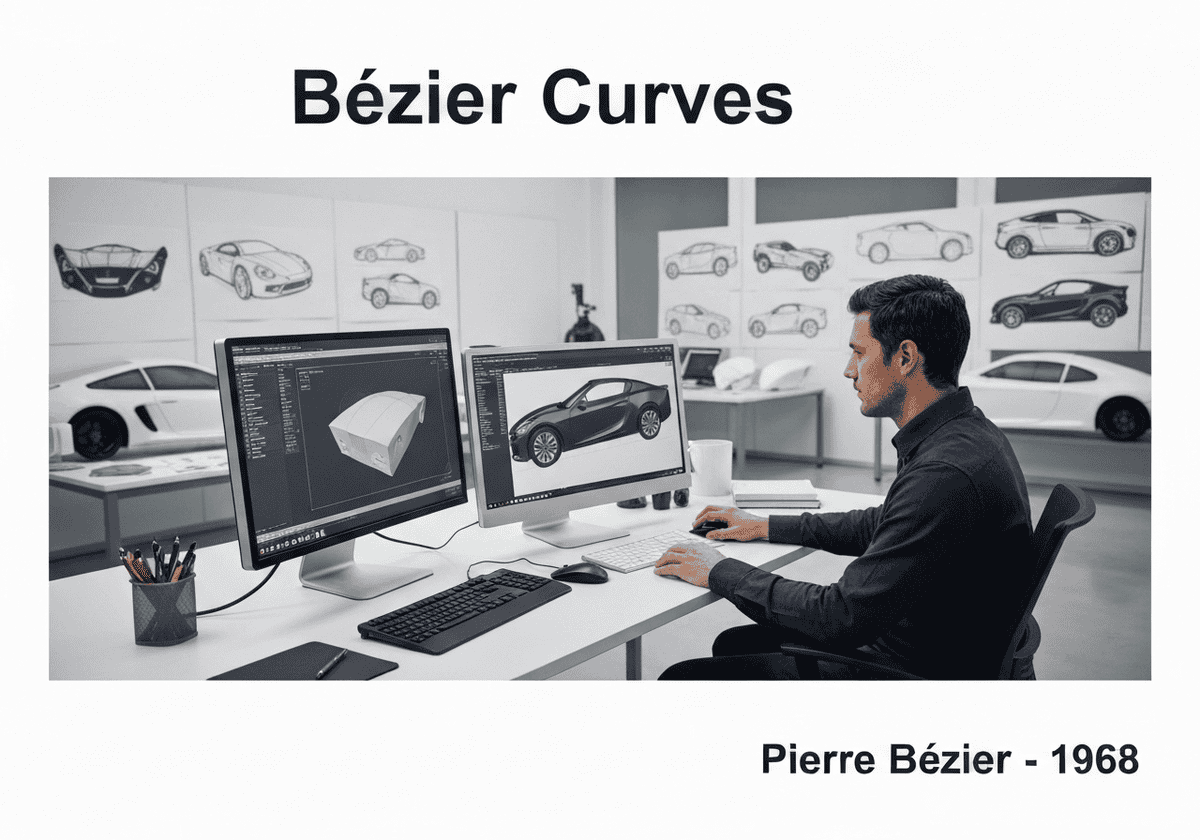
Automotive design studio with designer using CAD software to create Bézier curves for car bodies.

(generated image for illustration only)

Developed by French engineer Pierre Bézier for Renault in the 1960s, UNISURF was one of the first true 3D CAD/CAM systems. Its core innovation was the use of what are now known as Bézier curves and surfaces. These are parametric curves defined by a set of control points, allowing for the intuitive and mathematical creation of complex freeform shapes for car bodies.


Prior to UNISURF, designing the complex, flowing surfaces of a car body was a manual, labor-intensive process involving physical clay models and templates. Pierre Bézier’s work at Renault aimed to translate this physical design process into a mathematical and computational framework. The result was UNISURF (Unification of Surfaces), a system that allowed designers to define and manipulate freeform surfaces on a computer. The mathematical foundation of this system was the Bézier curve. A Bézier curve is a parametric curve defined by a set of control points. For a cubic Bézier curve, four points are used: two endpoints that the curve passes through, and two intermediate control points that define the curve’s shape and tangent directions. The curve itself does not typically pass through these intermediate points, but they act as ‘handles’ that designers can intuitively manipulate to sculpt the curve’s shape.

This concept was extended to surfaces, creating Bézier surfaces (or patches) defined by a grid of control points. By stitching these patches together with specific continuity conditions (e.g., G0 for position, G1 for tangency), complex and smooth surfaces like a car’s hood or fender could be modeled precisely. The mathematical representation is a polynomial function, for a cubic Bézier curve it is \(B(t) = (1-t)^3 P_0 + 3(1-t)^2 t P_1 + 3(1-t) t^2 P_2 + t^3 P_3\), for \(t in [0, 1]\). This mathematical rigor allowed the design data to be used directly for manufacturing (CAM), such as programming CNC milling machines to create dies. This tight integration of design and manufacturing was a hallmark of UNISURF and a major step forward for industrial production.

UNESCO Nomenclature: 2208
– Mathematics

Type

Software/Algorithm

Disruption

Foundational

Usage

Widespread Use

Precursors

  • de casteljau’s algorithm (a similar, earlier method for defining curves)
  • polynomial interpolation methods
  • early developments in numerical control (nc) machining
  • the need for precise surface definition in automotive and aerospace industries

Applications

  • automotive body design
  • aerospace fuselage and wing design
  • vector graphics (adobe illustrator, inkscape)
  • computer font technology (truetype, postscript)
  • industrial design of consumer products

Patents:

NA

Potential Innovations Ideas

Due to scrapping bot traffic, currently more than 40k per day, this content is reserved to community members.
> Login < or > Register < (100% free) to access this, so as all other restricted content and tools.

Related to: bézier curve, bézier surface, unisurf, pierre bézier, cad, cam, freeform surface modeling, computational geometry.

Historical Context

Bézier Curves

1962
1963
1964
1968
1970
1970
1975
1961
1962
1963
1965
1970
1970
1974-11-15
1980

(if date is unknown or not relevant, e.g. "fluid mechanics", a rounded estimation of its notable emergence is provided)

Related Invention, Innovation & Technical Principles

Full size images and downloads are only available, 100% free, for registered members.

> Login <