Product Design, Manufacturing & Innovation Resources
Home » Bayesian Inference

Bayesian Inference

1812
  • Pierre-Simon Laplace
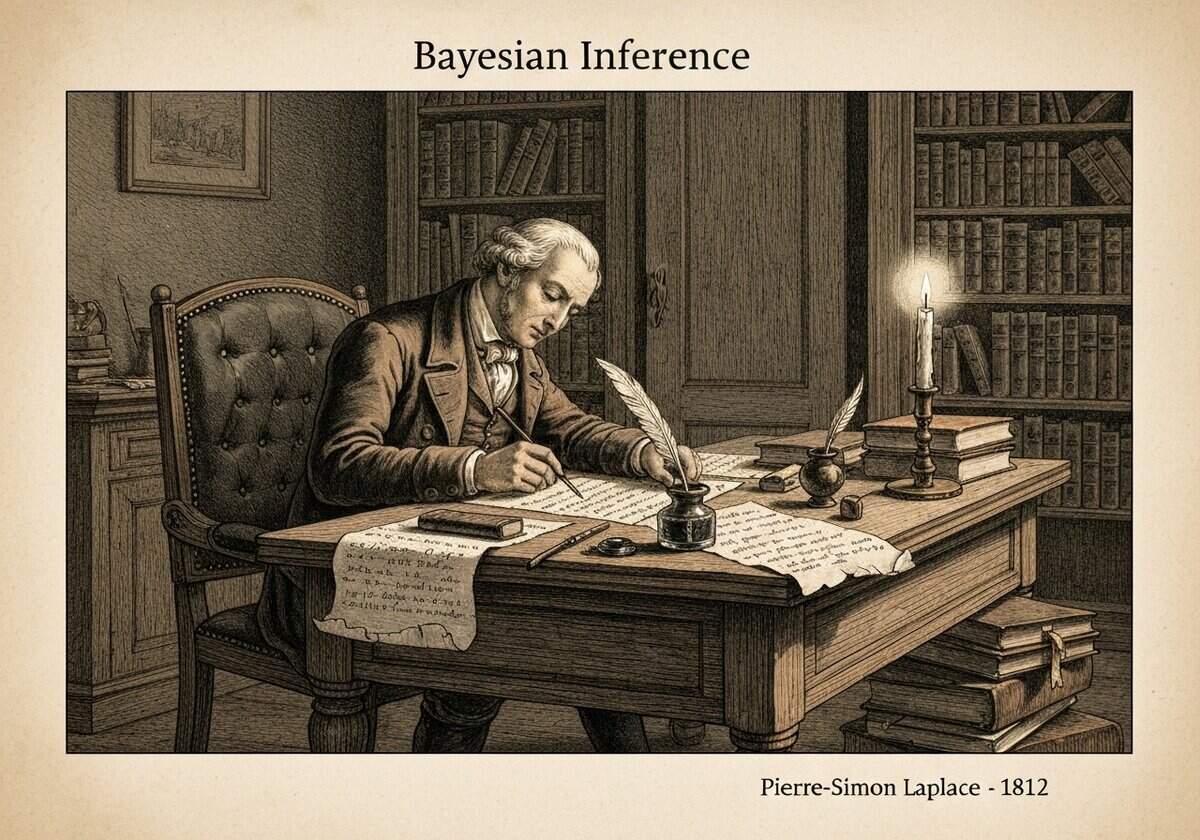
19th-century scholar calculating Bayesian inference at a wooden desk with parchment.

(generated image for illustration only)

Bayesian inference is a statistical method where Bayes’ theorem is used to update the probability for a hypothesis as more evidence or information becomes available. It is a central tenet of Bayesian statistics. The core idea is expressed as: posterior probability is proportional to the product of the prior probability and the likelihood, \(p(\theta|D) \propto p(D|\theta)p(\theta)\), where \(\theta\) is the parameter and D is the data.

Bayesian inference treats model parameters as random variables about which we can have beliefs. The process begins with a ‘prior’ probability distribution, \(p(\theta)\), which encapsulates our knowledge or uncertainty about a parameter \(\theta\) before observing any data. When data \(D\) is collected, its probability of occurring given the parameter, known as the ‘likelihood’ \(p(D|\theta)\), is calculated. Bayes’ theorem then combines the prior and the likelihood to produce the ‘posterior’ distribution, \(p(\theta|D)\). This posterior distribution represents our updated knowledge about the parameter after accounting for the data.

This approach fundamentally differs from frequentist inference, which assumes parameters are fixed, unknown constants and calculates the probability of data given these parameters. Bayesian inference, in contrast, provides a probability distribution for the parameters themselves, which allows for direct probabilistic statements about them, such as ‘there is a 95% probability that the parameter lies in this range.’ This interpretability is a key advantage. The main historical challenge was computational; calculating the posterior often requires solving complex integrals, a problem largely overcome in the late 20th century with the advent of powerful computers and algorithms like MCMC.

UNESCO Nomenclature: 1208
– Statistics

Type

Abstract System

Disruption

Foundational

Usage

Widespread Use

Precursors

  • Bayes’ Theorem
  • Probability theory
  • Development of likelihood theory by R.A. Fisher

Applications

  • Parameter estimation in scientific models
  • A/B testing in web development and marketing
  • Phylogenetic tree reconstruction in biology
  • Uncertainty quantification in complex systems
  • Image reconstruction and signal processing
  • Artificial intelligence and expert systems

Patents:

NA

Potential Innovations Ideas

Due to scrapping bot traffic, currently more than 40k per day, this content is reserved to community members.
> Login < or > Register < (100% free) to access this, so as all other restricted content and tools.

Related to: Bayesian inference, posterior distribution, prior distribution, likelihood function, statistical modeling, parameter estimation, uncertainty, evidence, belief updating, MCMC.

Historical Context

Bayesian Inference

1758
1777
1799
1812
1822
1827
1829
1750
1763-12-23
1780
1805
1822
1822
1828
1848

(if date is unknown or not relevant, e.g. "fluid mechanics", a rounded estimation of its notable emergence is provided)

Related Invention, Innovation & Technical Principles

Full size images and downloads are only available, 100% free, for registered members.

> Login <