Product Design, Manufacturing & Innovation Resources
Home » Avogadro Constant

Avogadro Constant

1909
  • Jean Baptiste Perrin
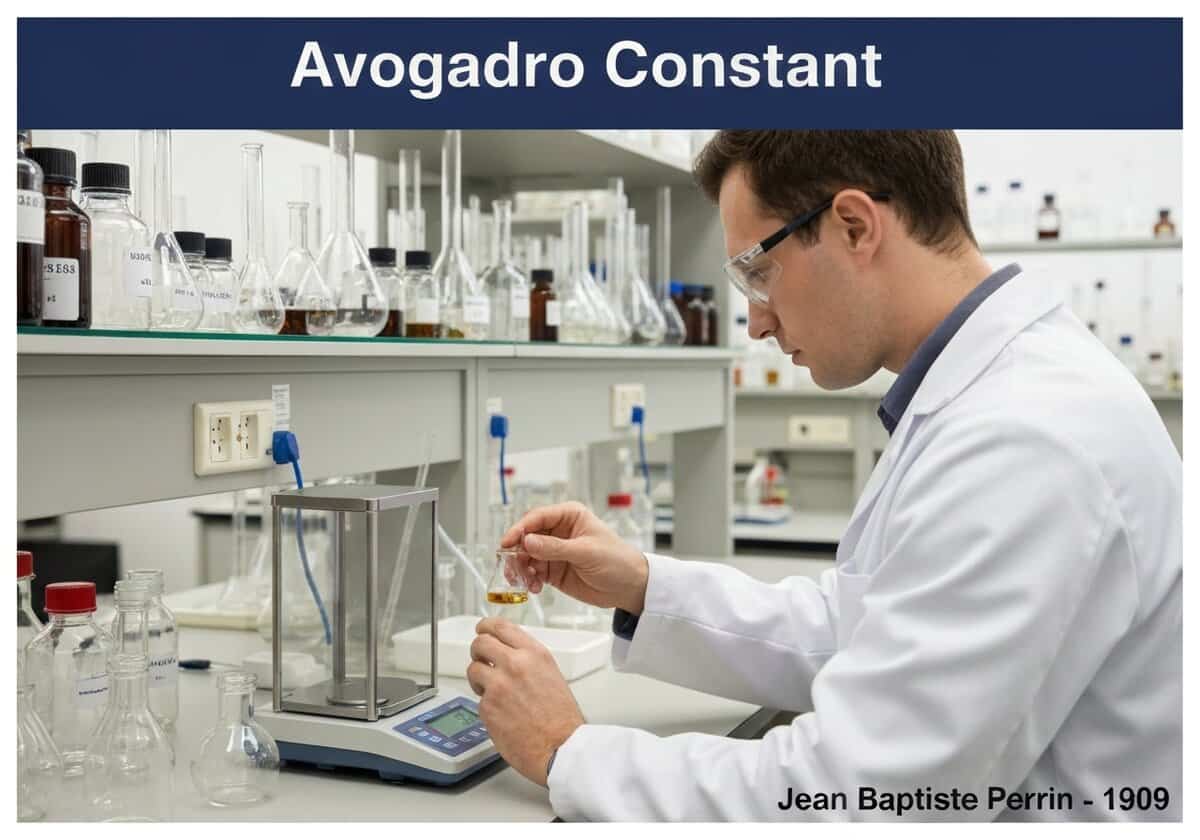
Chemist measuring substance mass in a laboratory for physical chemistry applications.

(generated image for illustration only)

The Avogadro constant, \(N_A\), represents the number of constituent particles (atoms, molecules, ions) in one mole of a substance. It is a fundamental physical constant with an exact, defined value of \(6.02214076 \times 10^{23} text{ mol}^{-1}\). This constant provides the essential link between the macroscopic scale of moles and the microscopic world of individual particles, underpinning quantitative chemistry.

While Amedeo Avogadro proposed the principle that led to the mole concept, he never determined the value of the constant that bears his name. The first scientist to estimate the number of particles in a given volume of gas was Johann Josef Loschmidt in 1865, based on the kinetic theory of gases. For this reason, the constant is sometimes referred to as the Loschmidt constant in German-speaking countries, although that term now typically refers to the number of particles per unit volume.

The name ‘Avogadro’s number’ or ‘Avogadro constant’ was coined by French physicist Jean Perrin in 1909. Perrin’s experiments on Brownian motion—the random movement of particles suspended in a fluid—provided a more accurate determination of its value and earned him the 1926 Nobel Prize in Physics. For over a century, the value was refined through various experimental methods. However, on May 20, 2019, as part of the redefinition of SI base units, the Avogadro constant was assigned a fixed, exact numerical value. This act fundamentally changed the definition of the mole, which is now defined as containing exactly \(6.02214076 times 10^{23}\) elementary entities, rather than being based on the number of atoms in 12 grams of carbon-12.

UNESCO Nomenclature: 2209
– Physical chemistry

Type

Abstract System

Disruption

Foundational

Usage

Widespread Use

Precursors

  • avogadro’s law (1811)
  • kinetic theory of gases
  • johann josef loschmidt’s work on estimating molecular size (1865)
  • albert einstein’s theoretical work on brownian motion (1905)

Applications

  • calculating the mass of a single atom or molecule
  • determining the number of particles in a given mass of a substance
  • fundamental calculations in physical chemistry and solid-state physics
  • calibration in mass spectrometry
  • dosimetry in radiation physics

Patents:

NA

Potential Innovations Ideas

Due to scrapping bot traffic, currently more than 40k per day, this content is reserved to community members.
> Login < or > Register < (100% free) to access this, so as all other restricted content and tools.

Related to: Avogadro constant, Avogadro’s number, mole, NA, jean perrin, si units, fundamental constant, physical chemistry, loschmidt constant, particle count.

Historical Context

Avogadro Constant

1902
1902
1907
1909
1910
1911-04-08
1913
1900-12-14
1902
1904
1907
1909
1910
1912
1915

(if date is unknown or not relevant, e.g. "fluid mechanics", a rounded estimation of its notable emergence is provided)

Related Invention, Innovation & Technical Principles

Full size images and downloads are only available, 100% free, for registered members.

> Login <