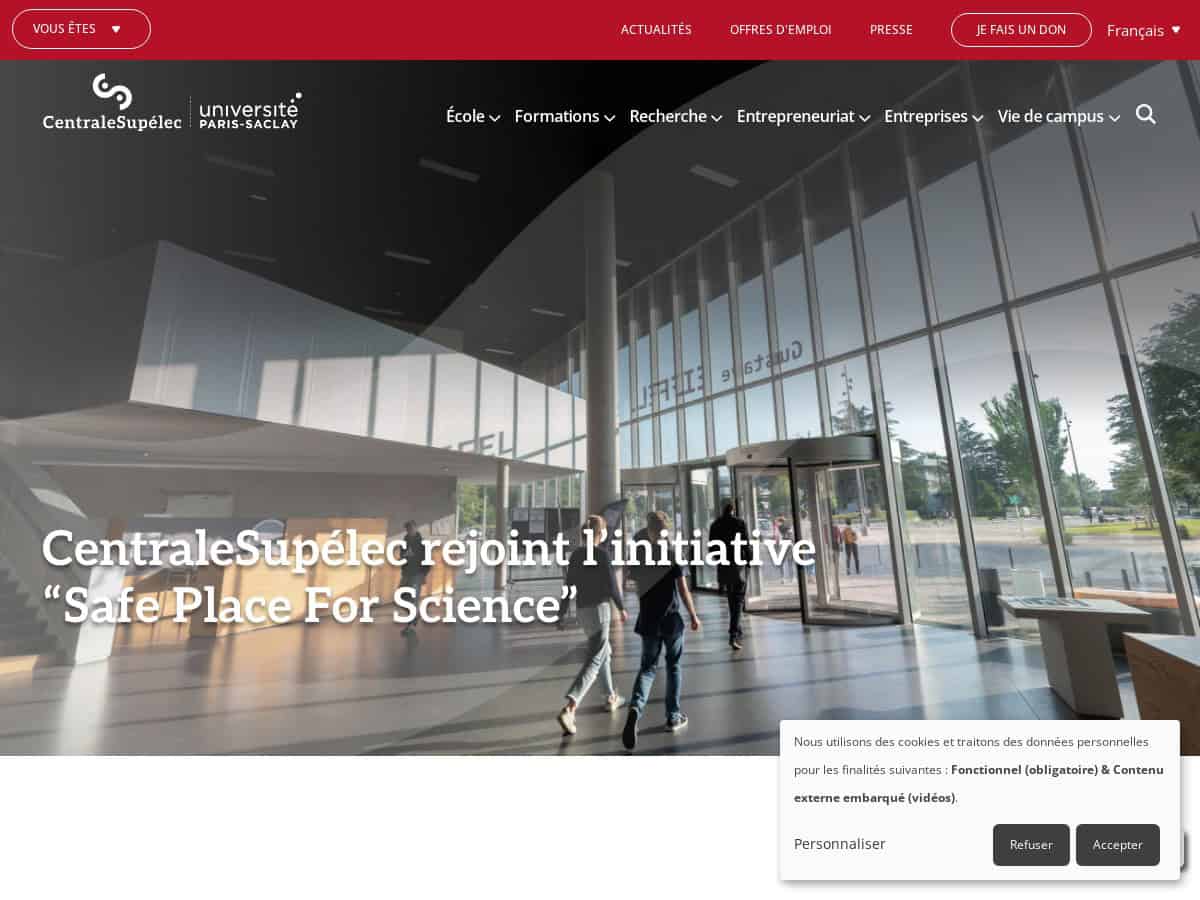
Address: 3 rue Joliot-Curie, 91190 Gif-sur-Yvette, Île-de-France, France
Engineering (Generalist; Energy; Computer Science), Information Sciences, Applied Physics
CentraleSupélec was created in 2015 from the merger of École Centrale Paris (founded 1829) and Supélec (founded 1894). It is a leading public institution in engineering and information sciences.
CentraleSupélec is a generalist engineering school created in 2015 by the merger of the École Centrale Paris and Supélec. It has about 4,300 students and 2,200 staff, with roughly 30 percent of the students from abroad. The main campus is in Gif-sur-Yvette on the Saclay plateau, with further campuses in Metz and Rennes, and the school is a member of Université Paris-Saclay.
The two parents have long histories. Centrale was founded in 1829 as the École centrale des arts et manufactures, and its graduates include Gustave Eiffel, Armand Peugeot and André Michelin, three people who shaped French industry. Supélec started in 1894 as the École supérieure d’électricité, to train specialists for the electrical industry. The merged school keeps both identities, and graduates are known as centraliens.
The curriculum is broad. Students study mathematics, physics, computer science, mechanics, economics and management in the first two years, then choose a specialisation such as energy, digital systems, aerospace, biotechnology, data science or finance. The engineer degree takes three years after the preparatory classes. A large share of the education is project-based, and students work in teams on problems proposed by companies.
Research is run through laboratories with CNRS and other partners, in fields such as computer science and artificial intelligence, energy, electronics and signal processing, materials and mechanics. The school is also known for its double-degree agreements with universities abroad, which allow students to spend a year in Europe, North America or Asia and return with two diplomas.
Fees for the engineer degree are higher than at public universities and rise for non-EU students, but scholarships and apprenticeship options exist. Admission is selective, with entry through the competitive exams after the preparatory classes, a dedicated international route and master’s programmes. About 50,000 people have graduated from the school and its predecessors.
Domains taught:
Aerospace, AI and Machine Learning, Automation, Bioengineering, Chemistry, Civil Engineering, Computer Vision, Data Analytics, Ecology and Sustainability, Electrical and Electronics, Engineering, Fluid Dynamics, Manufacturing, Materials, Mathematics, Mechanical Engineering, Nanotechnologies, Optics, Physics, Process Control, Project Management, Robotics, Signal Processing, Software Engineering, Statistics, Structural Engineering, Telecommunications, Thermodynamics
Diplomas*:
Doctor, Graduate Certificate, Master
Status:
Public
Partnerships:
Part of Université Paris-Saclay. T.I.M.E. network, CESAER, 5G IA. Partnerships with many international universities and companies like EDF, Safran, Thales.
Research:
Energy systems, Communication systems, Computer science & AI, Industrial engineering, Physics & Materials science.
Think of X - École Polytechnique when aerospace, nanotechnologies and optics is the priority: it covers military and bioinformatics as well, and has almost the same size, at about 4,600 students.
On content, Mines Paris - PSL and this school are close, as both teach aerospace, nanotechnologies and fluid dynamics; it is far smaller, with about 1,300 students against roughly 4,300 here, and is also a public institution.
Both schools build their programmes around aerospace, nanotechnologies and optics, and Institut Polytechnique de Paris is the one to compare first within the country, since it does not run the graduate certificate programmes found here and covers bioinformatics as well.
In terms of fields, École Normale Supérieure Paris-Saclay is the nearest neighbour, with aerospace, nanotechnologies and optics again at the core; it also offers bachelor's programmes and covers bioinformatics and industrial design as well.
Also strong in aerospace, optics and signal processing, ISAE-SUPAERO makes a sensible second look at home; it is also a public institution, and runs the same master's, doctoral and graduate certificate programmes.
Most Similar Schools Abroad
Kyushu Institute of Technology in Japan shares the aerospace, nanotechnologies and optics orientation of this school, and it is slightly larger, at about 6,000 students against roughly 4,300 here, and is also a public institution.
A foreign alternative with a similar emphasis on nanotechnologies, optics and signal processing is University of Electro-Communications in Japan, and it also offers bachelor's programmes and covers ergonomics and UX and bioinformatics as well.
In Switzerland, EPFL teaches much the same core subjects, aerospace, nanotechnologies and signal processing, and it covers metrology and bioinformatics as well, and is larger, enrolling about 12,000 students against roughly 4,300 here.
If this school is on your list for aerospace, nanotechnologies and optics, Huazhong University of Science and Technology in China deserves a comparison, because it also offers bachelor's programmes and covers transportations and bioinformatics as well.
Looking internationally, Karlsruher Institut für Technologie in Germany is where aerospace, nanotechnologies and optics get a comparable treatment; it is far larger, with about 23,000 students against roughly 4,300 here, and is also a public institution.
*our own picks (our criteria: a mix between domains, diploma delivered, reputation and size), but obviously too many criteria for an apple-to-apple ranking.
FAQ
Where is CentraleSupélec?
The main campus is at 3 rue Joliot-Curie in Gif-sur-Yvette, on the Saclay plateau. Other campuses are in Metz and Rennes.
How large is it?
About 4,300 students and 2,200 staff, with around 30 percent of students from abroad.
How was CentraleSupélec created?
In 2015, by the merger of the École Centrale Paris and Supélec.
When were the parent schools founded?
Centrale in 1829 and Supélec in 1894.
What kind of school is it?
A generalist engineering school offering the engineer degree, master's programmes and doctoral programmes.
What can students specialise in?
Energy, digital systems, aerospace, biotechnology, data science and finance, among others.
How selective is admission?
French candidates usually enter after preparatory classes through competitive exams. International students apply through a dedicated route.
What does it cost?
Fees for the engineer degree are higher than at public universities and rise for non-EU students. Scholarships and apprenticeship options exist.
Are there double degrees?
Yes. The school has agreements with universities abroad that allow students to earn two diplomas.
Who are famous alumni?
Gustave Eiffel, Armand Peugeot and André Michelin studied at Centrale.
Artificial Intelligence (AI), Energy, Engineering, Information Technology (IT), Project Management, Robotics, Sustainable Development
*: without any judgment of the quality, readers are strongly encouraged to check the official status of the exact diploma envisioned as many universities have a mix of recognized diplomas, not recognized, “co-delivered,” “equivalent to”, “some pathways” (…), can change over time, and can be named differently from one country to another.
**: international reputation: is based on some criteria that do not mean much in some domains or specialties (number of researchers, of scientific publications, on budget ….). Our approximate 1-4 scale:
known locally
known locally and internationally
is listed in some of the world university’s classifications
is listed among the 20 firsts in some of world university’s classifications
***: estimated numbers, based on online sources and/or feedbacks. The numbers can vary greatly depending on school organisation (ex.: school is part of a group, it employs internal staff or external consultants or has public staff without employing them …). Refer to all the links provided to have accurate and updated numbers.
Innovation.world is not affiliated with this school/university. We recommend to contact them directly on their website for any special request.
To complete or correct any information here or share your opinion, please comment below or > send us a direct message <.