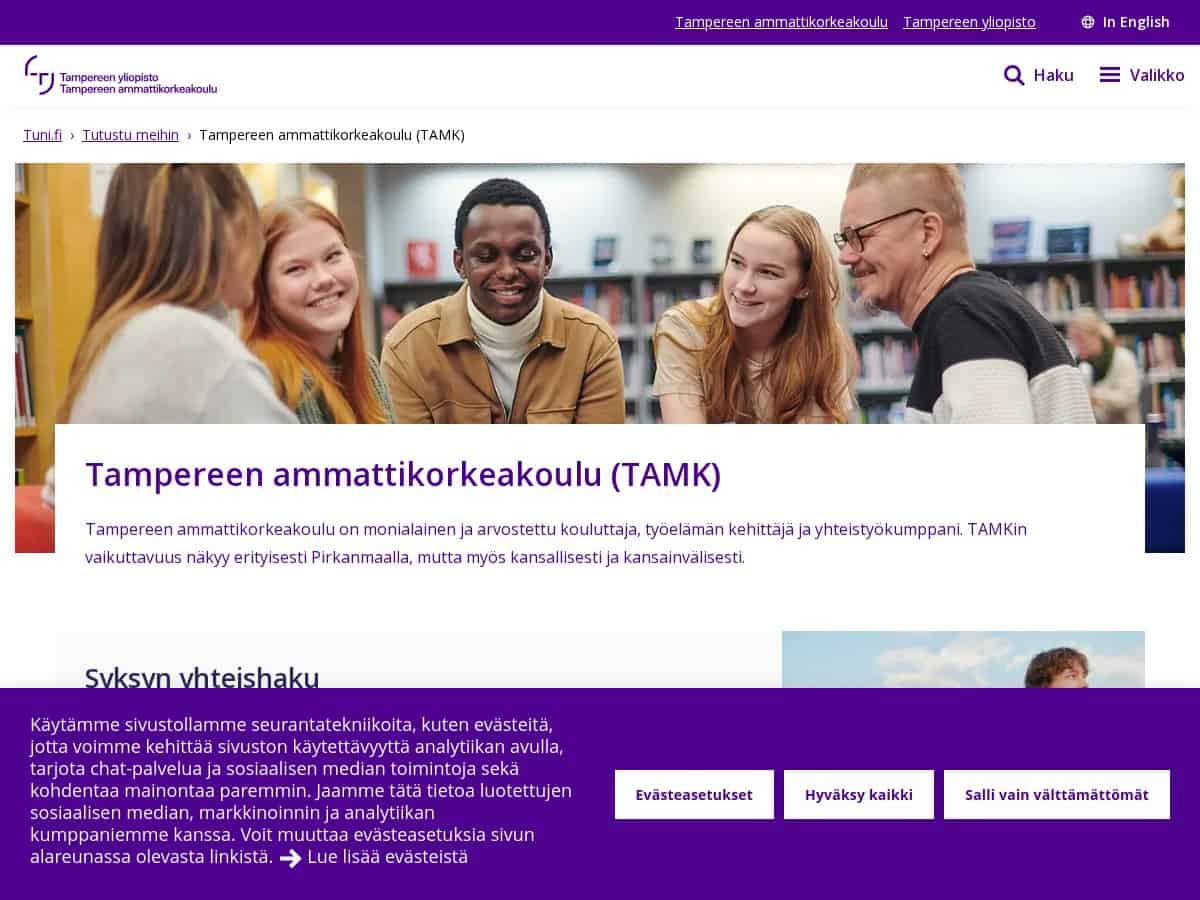
TAMK is one of the largest universities of applied sciences in Finland and is part of the Tampere Universities community alongside Tampere University. It focuses on professionally-oriented higher education that combines theoretical knowledge with strong practical skills.
Tampere University of Applied Sciences, TAMK, has about 10,000 students and 700 staff and is part of the Tampere Universities community together with Tampere University. It focuses on practical professional education, and its degrees take three and a half to four years and include internships and thesis projects with companies. The main address is Kuntokatu 3, in the Kauppi area near the Tampere University hospital, and shared services make it easy for students to use facilities of both institutions.
Engineering and technology are the strongest fields. Programmes cover mechanical engineering, software development, environmental engineering, electrical and automation engineering, and construction, and the nearby industrial heritage of Tampere provides a rich set of partner companies. Other schools offer degrees in business, health care and social services, which gives students a wide choice and opportunities for mixed projects.
Applied research is carried out in cooperation with regional firms, in particular in machine automation, digital manufacturing, sustainable construction and health technology. The Tampere region has many manufacturers of heavy machinery, paper machines and electronics, and the university of applied sciences supplies graduates to them. Companies often propose projects and thesis topics, and students receive guidance from teachers and from company mentors.
Tuition is free for EU and EEA students, and non-EU students pay fees for degree programmes in English. Several programmes in technology and business are taught in English, while others require Finnish. Applications are normally made through the national admissions portal, and English programmes open in January.
Tampere has lower rents than Helsinki, a lively student scene and strong rail links to the capital. The city has plenty of saunas, lakeside paths and cultural events through the year. About 50,000 people have graduated from TAMK and its predecessors, and many are now project managers and engineers in Finnish industry.
Domains taught:
Automation, Civil Engineering, Ecology and Sustainability, Electrical and Electronics, Industrial Design, Mechanical Engineering, Software Engineering
Diplomas*:
Bachelor, Master, MBA
Status:
Public
Partnerships:
Deeply integrated with the Tampere region’s industrial and business life, offering students extensive opportunities for practical training, projects, and thesis work with local companies.
Research:
TAMK’s applied research and development activities are focused on solving practical problems in areas like sustainable urban development, wellbeing technology, and digital solutions for industry.
Famous Alumnis:
N/A
International recognition**:
Number of staff***:
700
Current students***:
10000
Foreign students***:
10%
Cumulative former students***:
50000
Pros
Strong practical orientation with excellent lab facilities, part of a larger university community providing resources and collaboration opportunities, high graduate employability in the region.
Cons
The dual structure of the Tampere Universities community can sometimes be confusing; focus is on applied skills rather than theoretical research.
Best For
Individuals looking for a hands-on, industry-relevant engineering education in a major industrial city in Finland.
For students who like the industrial design, civil engineering and automation focus of this institution but want another option nearby, Metropolia University of Applied Sciences fits well: it is larger, enrolling about 16,500 students against roughly 10,000 here, and is also a public institution.
Turku University of Applied Sciences works in much the same fields, chiefly mechanical engineering, electrical and electronics and software engineering, and it covers logistics and manufacturing as well, and has almost the same size, at about 10,000 students.
For students who like the industrial design, ecology and sustainability and mechanical engineering focus of this institution but want another option nearby, LUT University fits well: it also offers doctoral programmes and covers chemistry and data analytics as well.
Where this university leans on ecology and sustainability and software engineering, University of Turku does the same, and it is larger, enrolling about 21,900 students against roughly 10,000 here, and is also a public institution.
Think of University of Oulu when ecology and sustainability and software engineering is the priority: it covers chemistry and telecommunications as well, and is slightly larger, at about 13,000 students against roughly 10,000 here.
Most Similar Schools Abroad
National Technological University in Argentina pursues a similar profile in industrial design, civil engineering and mechanical engineering, and it covers telecommunications and engineering as well, and is far larger, with about 90,000 students against roughly 10,000 here.
If this university is on your list for civil engineering, electrical and electronics and software engineering, British Columbia Institute of Technology in Canada deserves a comparison, because it covers marine science and aerospace as well, and is far larger, with about 48,000 students against roughly 10,000 here.
UCL University College offers an international parallel to this institution, with industrial design, civil engineering and automation as common ground; it is also a public institution and also offers associate degree programmes.
Looking internationally, VIA University College in Denmark is where industrial design, civil engineering and mechanical engineering get a comparable treatment; it is larger, enrolling about 18,500 students against roughly 10,000 here, and is also a public institution.
Beyond national borders, Halmstad University stands out as a comparable school for industrial design, ecology and sustainability and mechanical engineering; it covers telecommunications and robotics as well, and has almost the same size, at about 11,000 students.
*our own picks (our criteria: a mix between domains, diploma delivered, reputation and size), but obviously too many criteria for an apple-to-apple ranking.
FAQ
Where is TAMK?
The main address is Kuntokatu 3 in Tampere, Finland.
How large is TAMK?
About 10,000 students and 700 staff.
How is TAMK related to Tampere University?
Both are part of the Tampere Universities community, which shares campuses and some services.
What can you study at TAMK?
Mechanical engineering, software development, environmental engineering, electrical and automation engineering, construction, business, health care and social services.
How long are the degrees?
Bachelor degrees take three and a half to four years.
Are programmes available in English?
Yes, several programmes in technology and business are taught in English. Others require Finnish.
Is tuition free?
Yes for students from the EU and EEA. Non-EU students pay fees for degree programmes in English.
When do you apply?
Applications for English-taught programmes are normally made in January through the national admissions portal.
Do students work with companies?
Yes. Internships and thesis projects with regional companies are part of the degrees.
Is Tampere cheaper than Helsinki?
Yes, rents are lower, and rail links to the capital take about 90 minutes.
Design for Sustainability, Digital Twin, Environmental Engineering, Lean Manufacturing, Mechanical Engineering, Project Management, Research and Development, Sustainable Development
*: without any judgment of the quality, readers are strongly encouraged to check the official status of the exact diploma envisioned as many universities have a mix of recognized diplomas, not recognized, “co-delivered,” “equivalent to”, “some pathways” (…), can change over time, and can be named differently from one country to another.
**: international reputation: is based on some criteria that do not mean much in some domains or specialties (number of researchers, of scientific publications, on budget ….). Our approximate 1-4 scale:
known locally
known locally and internationally
is listed in some of the world university’s classifications
is listed among the 20 firsts in some of world university’s classifications
***: estimated numbers, based on online sources and/or feedbacks. The numbers can vary greatly depending on school organisation (ex.: school is part of a group, it employs internal staff or external consultants or has public staff without employing them …). Refer to all the links provided to have accurate and updated numbers.
Innovation.world is not affiliated with this school/university. We recommend to contact them directly on their website for any special request.
To complete or correct any information here or share your opinion, please comment below or > send us a direct message <.