Product Design, Manufacturing & Innovation Resources
Maison » pH

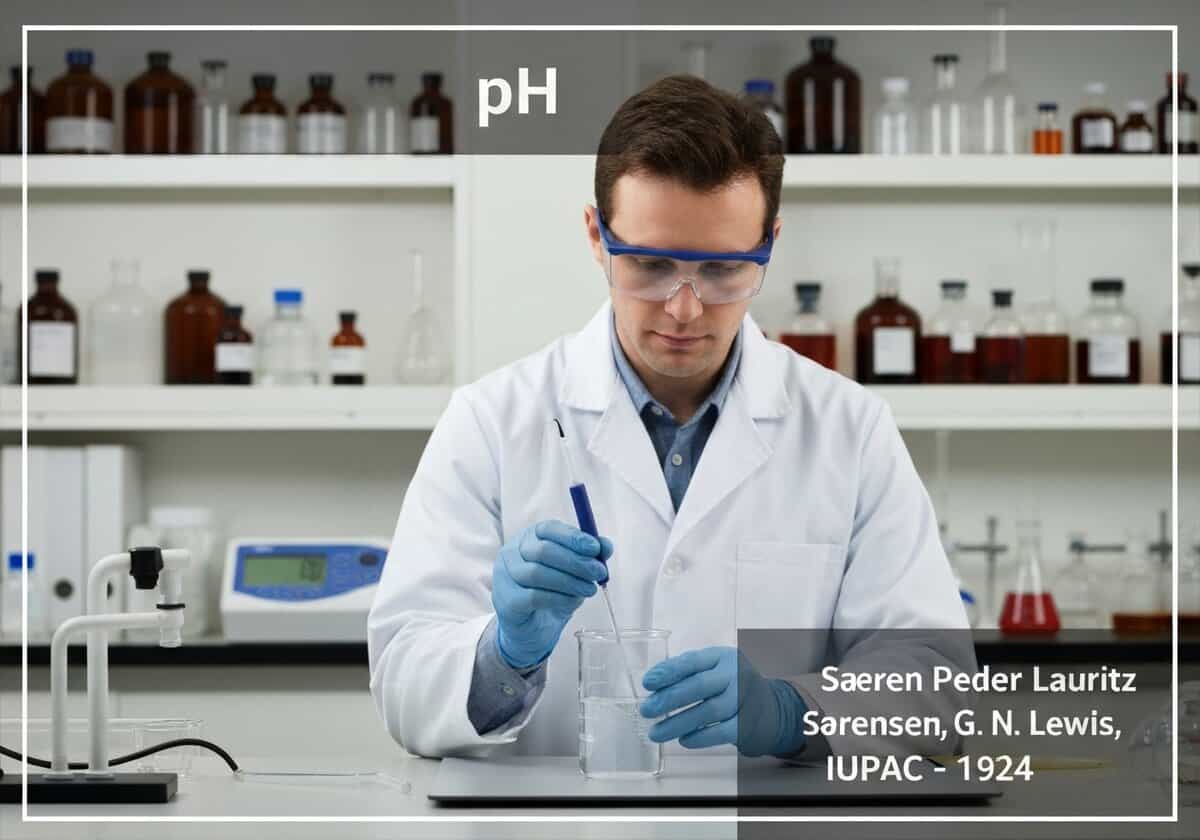
pH

1924
  • Søren Peder Lauritz Sørensen
  • G. N. Lewis
  • IUPAC
Mesure du pH en laboratoire à l'aide d'un appareil de mesure numérique en chimie analytique.

(Image générée à titre d'illustration uniquement)

pH is formally defined as the negative decimal logarithm of the hydrogen ion activity, [latex]a_{H^+}[/latex]. The formula is [latex]pH = -\log_{10}(a_{H^+})[/latex]. Activity is the effective concentration of hydrogen ions, accounting for intermolecular forces, and is dimensionless. For dilute solutions, activity is approximately equal to the molar concentration of [latex]H^+[/latex] ions, simplifying the calculation.

The modern definition of pH using hydrogen ion activity ([latex]a_{H^+}[/latex]) is a refinement of Sørensen’s original 1909 proposal, which used hydrogen ion concentration. The activity is related to concentration ([latex]c[/latex]) by the activity coefficient ([latex]\gamma_{H^+}[/latex]): [latex]a_{H^+} = \gamma_{H^+} \cdot c/c^0[/latex], where [latex]c^0[/latex] is the standard concentration (1 mol/L). In dilute solutions, [latex]\gamma_{H^+}[/latex] approaches 1, and activity approximates concentration. However, in more concentrated solutions, ionic interactions reduce the effective concentration, making the activity-based definition more accurate.

Because the activity of a single ion cannot be measured independently, the UICPA has established an operational definition. This definition relies on a primary standard reference cell and a series of certified standard buffer solutions with assigned pH values. A practical pH measurement compares the potential of an electrode in the sample solution to its potential in these standard buffers, effectively calibrating the measurement against the established scale. This ensures consistency and comparability of pH values measured worldwide.

UNESCO Nomenclature: 2201
– Chimie analytique

Taper

Système abstrait

Perturbation

Fondamentaux

Usage

Utilisation généralisée

Précurseurs

  • Arrhenius theory of acids and bases
  • law of mass action by Guldberg and Waage
  • concept of chemical activity by G. N. Lewis
  • development of logarithmic scales
  • Sørensen’s initial concentration-based pH scale

Applications

  • water quality monitoring
  • soil testing in agriculture
  • clinical diagnostics (blood gas analysis)
  • food and beverage production
  • synthèse chimique
  • pharmaceutical formulation

Brevets:

NA

Idées d'innovations potentielles

  • real-time cellular pH monitoring using nano-sensors
  • automated pH control systems for bioreactors
  • smart soil sensors for precision agriculture
  • portable sensors for monitoring sweat pH for health diagnostics
  • pH-responsive drug delivery systems
  • advanced corrosion monitoring systems in industrial pipelines
  • ocean acidification tracking buoys with high-precision pH probes
  • on-chip électrophorèse systems with integrated pH gradients
  • self-calibrating pH meters for long-term unattended deployment
  • AI-driven water treatment plants that optimize chemical dosing based on real-time pH data
Related to: pH, hydrogen ion activity, logarithm, electrochemistry, analytical chemistry, IUPAC, concentration, aqueous solution, acidity, pOH.

Contexte historique

PH

1920
1921
1924
1924
1925
1926
1927
1920
1921
1922
1924
1925
1926
1926
1927

(si la date est inconnue ou non pertinente, par exemple « mécanique des fluides », une estimation arrondie de son émergence notable est fournie)

10e année anniversaire

Les images en pleine résolution et les téléchargements sont uniquement disponibles, et 100% gratuits, pour les membres inscrits.