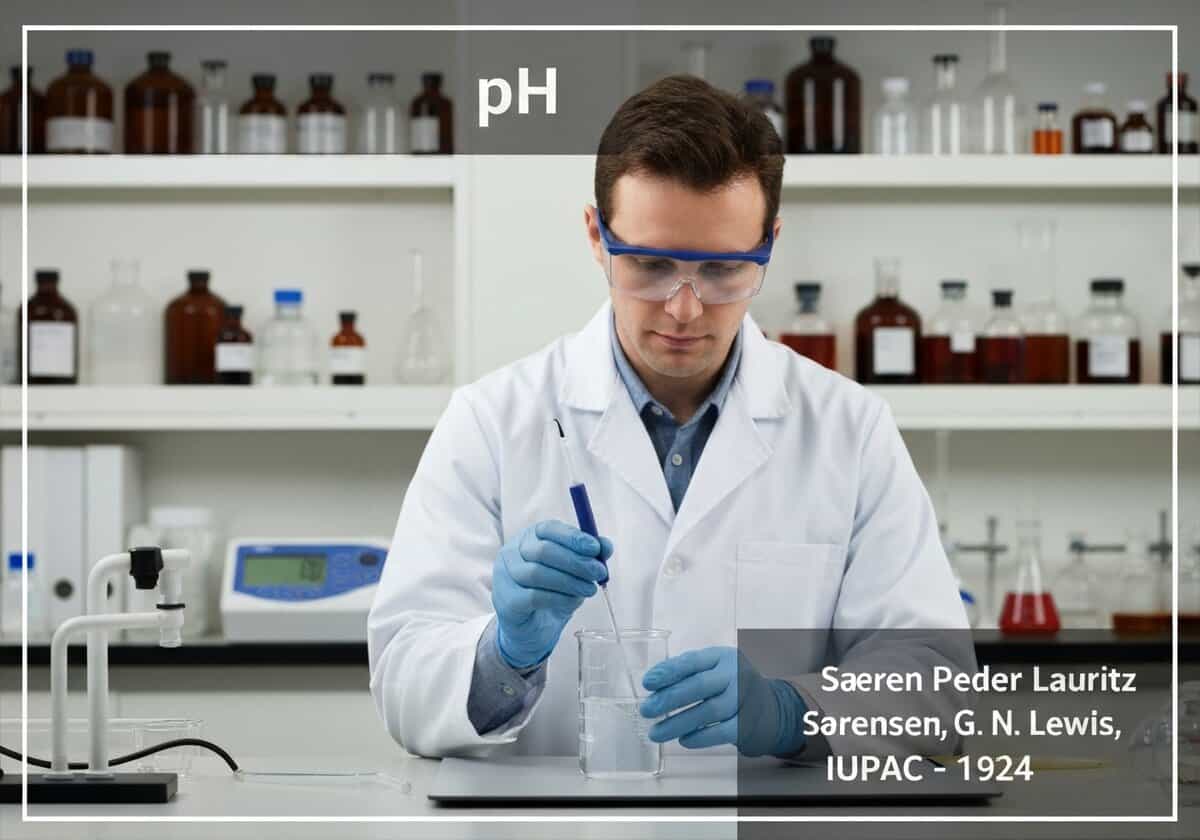
pH는 수소 이온 활성도[latex]a_{H^+}[/latex]의 음의 십진 로그 값으로 정식 정의됩니다. 공식은 [latex]pH = -log_{10}(a_{H^+})[/latex]입니다. 활성도는 분자간 힘을 고려한 수소 이온의 유효 농도이며, 무차원량입니다. 묽은 용액의 경우, 활성도는 [latex]H^+[/latex] 이온의 몰 농도와 거의 같으므로 계산이 간단해집니다.
(설명을 위한 생성된 이미지입니다)
pH는 수소 이온 활성도[latex]a_{H^+}[/latex]의 음의 십진 로그 값으로 정식 정의됩니다. 공식은 [latex]pH = -log_{10}(a_{H^+})[/latex]입니다. 활성도는 분자간 힘을 고려한 수소 이온의 유효 농도이며, 무차원량입니다. 묽은 용액의 경우, 활성도는 [latex]H^+[/latex] 이온의 몰 농도와 거의 같으므로 계산이 간단해집니다.
The modern definition of pH using hydrogen ion activity ([latex]a_{H^+}[/latex]) is a refinement of Sørensen’s original 1909 proposal, which used hydrogen ion concentration. The activity is related to concentration ([latex]c[/latex]) by the activity coefficient ([latex]gamma_{H^+}[/latex]): [latex]a_{H^+} = gamma_{H^+} cdot c/c^0[/latex], where [latex]c^0[/latex] is the standard concentration (1 mol/L). In dilute solutions, [latex]gamma_{H^+}[/latex] approaches 1, and activity approximates concentration. However, in more concentrated solutions, ionic interactions reduce the effective concentration, making the activity-based definition more accurate.
Because the activity of a single ion cannot be measured independently, the IUPAC has established an operational definition. This definition relies on a primary standard reference cell and a series of certified standard buffer solutions with assigned pH values. A practical pH measurement compares the potential of an electrode in the sample solution to its potential in these standard buffers, effectively calibrating the measurement against the established scale. This ensures consistency and comparability of pH values measured worldwide.
현재 하루 4만 건이 넘는 봇 트래픽을 차단하기 위해 이 콘텐츠는 커뮤니티 회원만 이용할 수 있습니다.
> 로그인 < 또는 >등록 < 이 콘텐츠를 비롯한 모든 제한된 콘텐츠와 도구는 (100% 무료로) 이용할 수 있습니다.
PH
(날짜를 알 수 없거나 관련이 없는 경우, 예를 들어 "유체역학"의 경우, 주목할 만한 등장 시기를 대략적으로 추정하여 제공합니다.)

고화질 이미지 및 다운로드는 등록된 회원에게만 100% 무료로 제공됩니다.
> 로그인 <