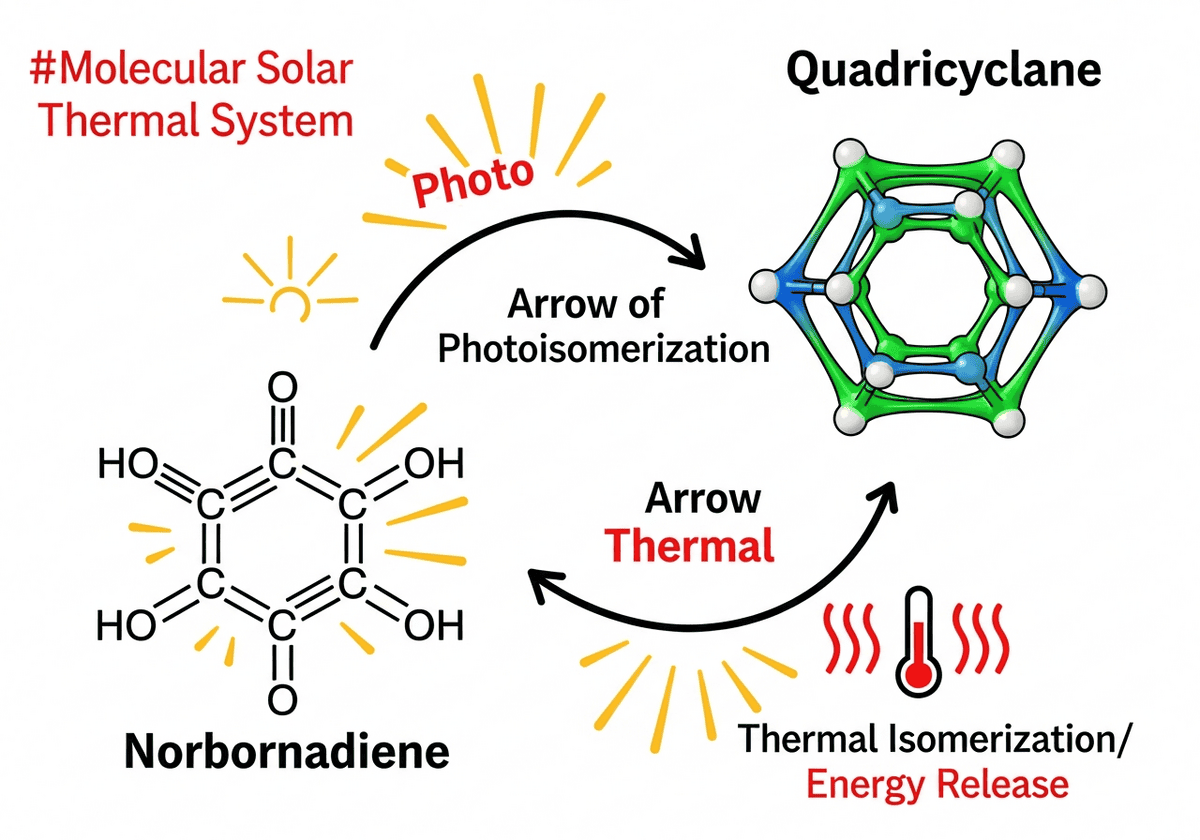

Les systèmes solaires thermiques moléculaires (MOST) stockent l'énergie solaire directement dans les liaisons chimiques de molécules photosensibles, notamment le couple norbornadiène-quadricyclane, par photoisomérisation réversible. Les photons incidents excitent la molécule, la faisant passer d'un état fondamental stable à un isomère de valence contraint de haute énergie, qui conserve l'énergie stockée — potentiellement pendant des mois — jusqu'à ce qu'un catalyseur déclenche la réaction inverse, libérant ainsi de la chaleur à la demande.
Les performances du système dépendent du rendement quantique, du coefficient d'extinction molaire adapté au spectre solaire, de la densité d'énergie par molécule, de la barrière d'énergie d'activation de l'isomérisation inverse et de la résistance à la fatigue à long terme lors de cycles répétés. La fonctionnalisation moléculaire par l'ajustement des substituants et l'utilisation de liaisons conjuguées, les photoréacteurs à flux continu et la conception guidée par la théorie de la fonctionnelle de la densité (DFT) constituent les principaux axes de recherche actuels.
Cette page regroupe les publications les plus récentes évaluées par des pairs et les brevets accordés dans le domaine des matériaux, de la catalyse et de l'intégration de systèmes MOST :
La plupart des systèmes stockent la lumière solaire à l'intérieur des liaisons d'une molécule et la libèrent sous forme de chaleur à la demande. Le stockage de chaleur conventionnel est comparé sur stockage d'énergie thermique et matériaux à changement de phaseLa capture de photons est activée. panneaux solairesLes commutateurs moléculaires apparaissent également dans l'électronique moléculaire.
Voici notre dernière sélection de publications et de brevets internationaux en anglais sur les systèmes solaires thermiques moléculaires (MOST), issus de nombreuses revues scientifiques en ligne, classés et axés sur le norbornadiène-quadricyclane, la photoisomérisation, l'isomérisation inverse, les molécules de stockage d'énergie, les carburants solaires, le stockage photochimique de l'énergie, les isomères de valence, les systèmes cycliques contraints, les barrières d'énergie d'activation, les réactions inverses catalytiques, les catalyseurs homogènes, les catalyseurs hétérogènes, le rendement quantique, l'adaptation de l'absorptance, le coefficient d'extinction molaire, la densité d'énergie par molécule, les réactions de cycloaddition, la libération photocatalytique, les réactions inverses thermiques, la fonctionnalisation moléculaire, l'ajustement des substituants, les ponts conjugués, le stockage moléculaire en couches minces, les systèmes de stockage en phase liquide, les photoréacteurs à flux continu, l'adaptation du spectre solaire, la sensibilisation triplet, la modélisation moléculaire DFT, la résistance à la fatigue cyclique, le stockage d'énergie en circuit ouvert et les systèmes solaires thermiques moléculaires.
Bacterial spores as green and efficient biological-inorganic hybrid phosphors
Patent published on the 2026-11-19 in US under Ref US20260365916 by TEMASEK LIFE SCIENCES LABORATORY LTD [SG] (Cheong Shen-Yi Ian, Sundaresan Ajitha)
Abstract: Rare earth elements (REEs) are raw materials of high importance for modern technologies such as light emitting diodes (LEDs), solar panels, and photovoltaic cells. These materials are associated with geopolitical supply risks, environmental concerns and recycling challenges. Increasing the efficiency of their performance, simplifying the manufacture, and recycling of lanthanide-based phosphors are key pillars for addressing these challenges. This study introduces Bacillus and Clostridium bacteri[...]
Our summary: This study presents Bacillus and Clostridium bacterial spores as effective biological materials for sequestering lanthanides and functioning as phosphors. The use of an antenna molecule and co-dopants enhances the luminescent output and quantum yield of the spores. This approach offers a sustainable solution to the challenges associated with rare earth elements by improving efficiency and simplifying recycling.
bacterial spores, lanthanide phosphors, quantum yield, environmental sustainability
Patent
Method of producing an agent for reducing linear drag in the pipeline transport of liquid hydrocarbons
Patent published on the 2026-11-19 in WO under Ref WO2026240676 by LIMITED LIABILITY CO DELTA P [RU] (Rubleva Elena Vitalievna [ru], Sayapina Marina Aleksandrovna [ru])
Abstract: The invention relates to the field of inorganic and organic chemistry, and may be used in the pipeline transport of oil and petroleum products. The technical result of the claimed invention consists in producing a reagent that provides a reduction in the drag of a turbulent flow of liquid hydrocarbons in pipelines and, as a result, increases the throughput capacity of a pipeline and reduces the cost of transporting liquid hydrocarbons. This technical result is achieved by the proposed method of [...]
Our summary: This invention produces a reagent that reduces linear drag in the pipeline transport of liquid hydrocarbons. It utilizes ultra-high-molecular-weight poly-α-olefins created through bulk polymerization of C6-C16 α-olefin monomers. The method enhances pipeline throughput and lowers transportation costs by optimizing reaction conditions and catalyst use.
drag reduction, pipeline transport, poly-α-olefins, turbulent flow
Patent
A process for preparing hexene
Patent published on the 2026-11-18 in EP under Ref EP4840841 by BASF SE [DE] (Lejkowski Michael [de], Pfeiffer Daniel [de], Schwarz Jonas Luca [de], Delgado Nirvana [de])
Abstract: The present invention relates to a process for preparing hexene. The present invention in particular relates to a process for preparing hexene based on alcohol conversion process, more particularly on an alcohol conversion process based on a Guerbet reaction. The present invention in particular relates to a process for preparing hexene based an alcohol conversion process using bio-ethanol and employing a homogeneous catalyst, wherein 1-butanol as a product of said alcohol conversion process is f[...]
Our summary: The invention describes a process for preparing hexene through an alcohol conversion method. It specifically utilizes a Guerbet reaction with bio-ethanol and a homogeneous catalyst. The process results in the formation of 1-butanol as a product.
hexene, alcohol conversion, Guerbet reaction, homogeneous catalyst
Patent
Heterogeneous catalysts
Patent published on the 2026-11-12 in US under Ref US20260355729 by DOW GLOBAL TECHNOLOGIES LLC [US] (Bédard Anne-Catherine [us], Hosseininasab Valiallah [us], Dinca Mircea [us], Payne Michael Tyrel [us], Bour James [us])
Abstract: Embodiments of the present disclosure are directed towards a heterogenous catalyst composition of formed from using a crystalline porous metal-organic framework (MOF) which reacts in an inverse electron-demand Diels-Alder reaction with a phosphorous ligand to produce a heterogeneous catalyst precursor. The heterogeneous catalyst precursor then reacts with a Group VIII transition metal catalyst precursor compound to form the heterogeneous catalyst composition that can be used for the hydroformyla[...]
Our summary: The disclosure describes a heterogeneous catalyst composition using a crystalline porous metal-organic framework. It reacts in an inverse electron-demand Diels-Alder reaction with a phosphorous ligand to create a catalyst precursor. This precursor then combines with a Group VIII transition metal to form a catalyst for hydroformylation of olefins.
Heterogeneous catalysts, metal-organic frameworks, Diels-Alder reaction, hydroformylation
Patent
Nanoparticles of blue light-emitting material having a perovskite-like structure and improved photoluminescent quantum yield, and method of preparing
Patent published on the 2026-11-12 in US under Ref US20260357133 by IUCF HYU IND UNIV COOPERATION FOUNDATION HANYANG UNIV [KR] (Im Won Bin [kr], Noolu Srinivasa Manikanta Viswanath [kr], Samanta Tuhin [kr], Jang Sung Woo [kr])
Abstract: Nanoparticles of a blue light-emitting material represented by Chemical Formula 1, which has an emission peak wavelength in a range of 380 nm to 500 nm, upon being excited by an excitation source of 250 nm to 400 nm, and an average particle size of less than 1 micrometer, and a method of preparing the nanoparticles of the blue light-emitting material are provided: Chemical Formula 1: [0000] AMXin Chemical Formula 1, A includes Li, Na, K, Rb, Cs, Mg, Ca, Sr, Ba, or a combination thereof, M includ[...]
Our summary: The content describes blue light-emitting nanoparticles with a perovskite-like structure. These nanoparticles exhibit improved photoluminescent quantum yield and have a specific emission peak wavelength. A method for preparing these nanoparticles is also provided.
Nanoparticles, Photoluminescence, Perovskite, Quantum Yield
Patent
Photoacoustic imaging compounds and methods of use
Patent published on the 2026-11-12 in WO under Ref WO2026236250 by LIFE TECHNOLOGIES CORP [US] (Levitz Andrew [us])
Abstract: Photoacoustic imaging compounds, compositions, and methods of use are provided. The compounds comprise substituted xanthene chromophores, including substituted rhodol and rhodamine compounds, having one or more aromatic or heteroaromatic quenching moieties and exhibiting high photoacoustic brightness, low quantum yield, and absorbance in the visible to near-infrared region. In some embodiments, the compounds comprise or are linked to a cartilage-targeting moiety, such as a cationic or quaternary[...]
Our summary: The content discusses compounds for photoacoustic imaging that include substituted xanthene chromophores. These compounds can target cartilage and generate acoustic signals for imaging. Methods and kits for assessing cartilage integrity and defects are also provided.
photoacoustic imaging, xanthene chromophores, cartilage-targeting moiety, acoustic signal detection
Patent
Synthesis, Properties and Application of Novel 2-Substituted Benzothiazole-Based Oxime Esters
Published on 2026-01-30 by Monika Dzwonkowska-Zarzycka, Alicja Balcerak-Wo?niak, Janina Kabatc-Borcz @MDPI
Abstract: The paper focuses on the synthesis and characterization of the spectroscopic and electrochemical properties of novel oxime esters. Six benzothiazole-based compounds were synthesized using a simple three-step procedure. The chemical structure of novel oxime esters was confirmed by Nuclear Magnetic Resonance spectroscopy (1H and 13C NMR), as well as FT-IR spectroscopy and elemental analysis. The melting point of these compounds was also determined. The spectroscopic properties were studied in 10 s[...]
Our summary: The paper presents the synthesis and characterization of novel benzothiazole-based oxime esters. Spectroscopic and electrochemical properties were analyzed, confirming their potential as Type I photoinitiators. Preliminary studies indicate their effectiveness in initiating light-induced polymerization.
Benzothiazole, Oxime Esters, Spectroscopy, Photoinitiators
Publication
Next-Generation Carbon-Based Quantum Dots for Healthcare and Beauty Applications
Published on 2026-01-29 by Muhammad Noor Nordin, Nur Farhana Shahrul Azhar, Nurhakimah Norhashim, Ili Farhana Mohamad Ali Nasri, Noor Hafidzah Jabarullah @MDPI
Abstract: Carbon quantum dots (CQDs) have attracted intense research interest due to their unique physicochemical properties and broad application potential. CQDs are a new class of ultrasmall fluorescent carbon nanoparticles (<10 nm) that exhibit bright photoluminescence, broad excitation spectra, high quantum yields (QYs), and excellent photostability. Structurally, they consist of graphitic sp2/sp3-hybridized carbon with amorphous or nanocrystalline cores. Unlike conventional semiconductor q[...]
Our summary: Carbon quantum dots (CQDs) are ultrasmall fluorescent nanoparticles with unique physicochemical properties. They offer a safer alternative to traditional semiconductor quantum dots for biomedical and cosmetic uses. This review highlights recent advancements in CQD synthesis and their potential applications in wound healing and beauty formulations.
Carbon Quantum Dots, Healthcare Applications, Photoluminescence, Green Chemistry
Publication