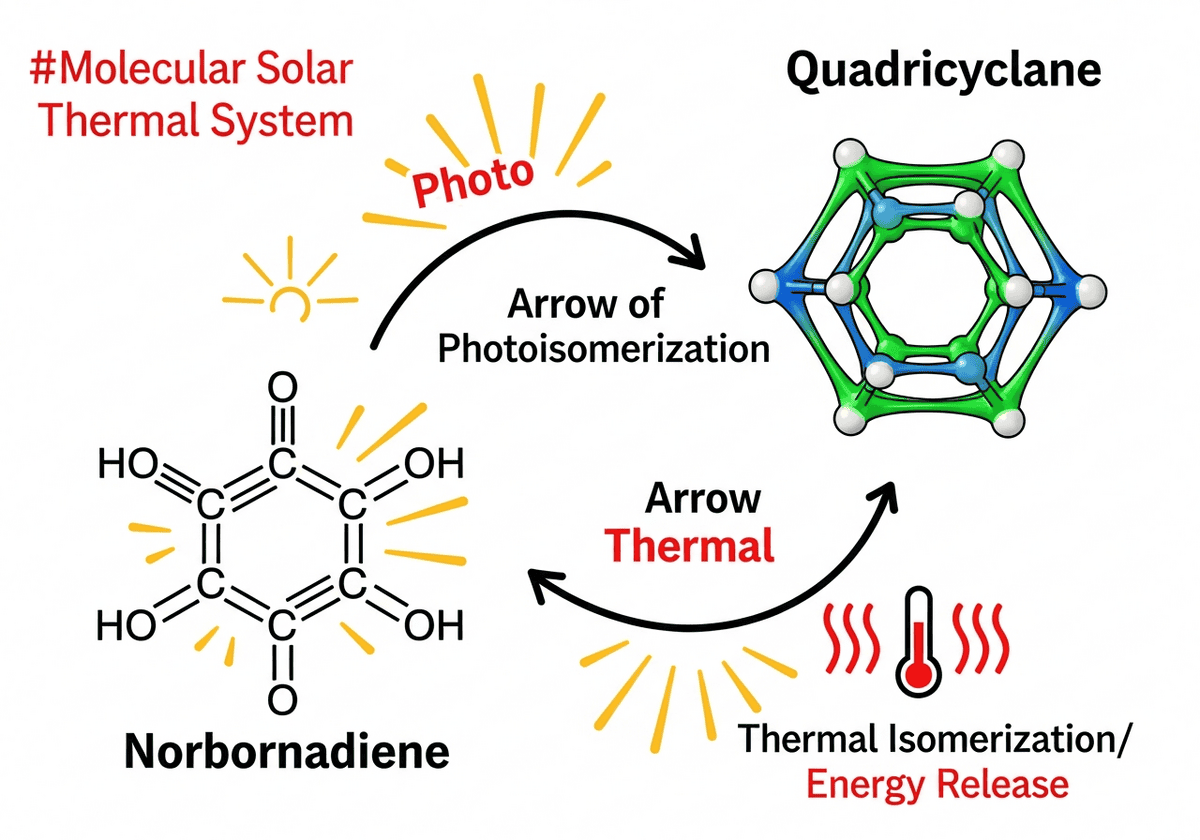

Molecular Solar Thermal (MOST) systems store solar energy directly within the chemical bonds of photoswitchable molecules, most prominently the norbornadiene-quadricyclane couple, through reversible photoisomerization. Incident photons drive the molecule from a stable ground state to a strained high-energy valence isomer, which retains stored energy — potentially for months — until a catalytic trigger initiates the back-reaction, releasing heat on demand.
Le prestazioni del sistema dipendono dalla resa quantica, dal coefficiente di estinzione molare corrispondente allo spettro solare, dalla densità di energia per molecola, dalla barriera energetica di attivazione dell'isomerizzazione inversa e dalla resistenza alla fatica a lungo termine attraverso cicli ripetuti. La funzionalizzazione molecolare tramite la regolazione dei sostituenti e i linker coniugati, i fotorreattori a flusso continuo e la progettazione guidata dalla DFT definiscono le attuali frontiere della ricerca.
Questa pagina raccoglie le pubblicazioni più recenti sottoposte a revisione paritaria e i brevetti concessi relativi alla maggior parte dei materiali, alla catalisi e all'integrazione di sistemi:
Questa è la nostra ultima selezione di pubblicazioni e brevetti mondiali in inglese sul Sistema Termico Solare Molecolare (MOST), tra numerose riviste scientifiche online, classificate e focalizzate su Norbornadiene-quadriciclano, fotoisomerizzazione, isomerizzazione inversa, molecola di accumulo di energia, combustibile solare, accumulo di energia fotochimica, isomero di valenza, sistema ad anello tensionato, barriera di energia di attivazione, reazione inversa catalitica, catalizzatore omogeneo, catalizzatore eterogeneo, resa quantica, corrispondenza di assorbanza, coefficiente di estinzione molare, densità di energia per molecola, reazione di cicloaddizione, rilascio fotocatalitico, reazione inversa termica, funzionalizzazione molecolare, regolazione dei sostituenti, linker coniugato, accumulo molecolare a film sottile, sistema di accumulo in fase liquida, fotorreattore a flusso continuo, corrispondenza dello spettro solare, sensibilizzazione di tripletto, modellazione molecolare DFT, cicli di resistenza alla fatica, accumulo di energia a circuito aperto e sistema termico solare molecolare.
Kits and methods for controlled primer grafting
Patent published on the 2026-10-01 in WO under Ref WO2026206967 by ILLUMINA INC [US] (Xi Weixian [us], Shen Fei [us])
Abstract: A kit includes a flow cell and three different fluids. The flow cell includes a substrate; and a polymeric hydrogel having surface azide groups and being attached to the substrate. The first fluid includes a first liquid carrier and a linking molecule including first and second alkynes. The second fluid includes a second liquid carrier and a plurality of barcoded primers. The third fluid includes a third liquid carrier and a plurality of azide terminated capture primers. A related method compris[...]
Our summary: The kit enables controlled primer grafting using a flow cell with azide-functionalized hydrogel. It includes three fluids: one with linking molecules, another with barcoded primers, and a third with azide-terminated capture primers. The method utilizes azide alkyne cycloaddition to attach capture primers to the flow cell.
primer grafting, flow cell, azide alkyne cycloaddition, barcoded primers
Patent
Composition, optical member, color conversion member, light absorption member, light source unit, display, lighting device, and compound
Patent published on the 2026-09-24 in WO under Ref WO2026197047 by TORAY IND INC [JP] (Sakaino Hirotoshi [jp], Hayaasa Manami [jp])
Abstract: The present invention addresses the problem of achieving improvements in both color reproducibility and durability of a composition and an optical member used for a light source unit, a display, and a lighting device, and in particular, the problem of achieving both light emission with high color purity or selective light absorption with a narrow wavelength range, and a high level of durability at high temperatures. To solve this problem, provided is a composition comprising components (A), (B) [...]
Our summary: The invention improves color reproducibility and durability for optical members in light source units and displays. It features a composition with organic pigment compounds and specific chemical components. These components enhance light emission purity and selective light absorption while maintaining high durability at elevated temperatures.
composition, optical member, color reproducibility, durability
Patent
Synthesis, Properties and Application of Novel 2-Substituted Benzothiazole-Based Oxime Esters
Published on 2026-01-30 by Monika Dzwonkowska-Zarzycka, Alicja Balcerak-Wo?niak, Janina Kabatc-Borcz @MDPI
Abstract: The paper focuses on the synthesis and characterization of the spectroscopic and electrochemical properties of novel oxime esters. Six benzothiazole-based compounds were synthesized using a simple three-step procedure. The chemical structure of novel oxime esters was confirmed by Nuclear Magnetic Resonance spectroscopy (1H and 13C NMR), as well as FT-IR spectroscopy and elemental analysis. The melting point of these compounds was also determined. The spectroscopic properties were studied in 10 s[...]
Our summary: The paper presents the synthesis and characterization of novel benzothiazole-based oxime esters. Spectroscopic and electrochemical properties were analyzed, confirming their potential as Type I photoinitiators. Preliminary studies indicate their effectiveness in initiating light-induced polymerization.
Benzothiazole, Oxime Esters, Spectroscopy, Photoinitiators
Next-Generation Carbon-Based Quantum Dots for Healthcare and Beauty Applications
Published on 2026-01-29 by Muhammad Noor Nordin, Nur Farhana Shahrul Azhar, Nurhakimah Norhashim, Ili Farhana Mohamad Ali Nasri, Noor Hafidzah Jabarullah @MDPI
Abstract: Carbon quantum dots (CQDs) have attracted intense research interest due to their unique physicochemical properties and broad application potential. CQDs are a new class of ultrasmall fluorescent carbon nanoparticles (<10 nm) that exhibit bright photoluminescence, broad excitation spectra, high quantum yields (QYs), and excellent photostability. Structurally, they consist of graphitic sp2/sp3-hybridized carbon with amorphous or nanocrystalline cores. Unlike conventional semiconductor q[...]
Our summary: Carbon quantum dots (CQDs) are ultrasmall fluorescent nanoparticles with unique physicochemical properties. They offer a safer alternative to traditional semiconductor quantum dots for biomedical and cosmetic uses. This review highlights recent advancements in CQD synthesis and their potential applications in wound healing and beauty formulations.
Carbon Quantum Dots, Healthcare Applications, Photoluminescence, Green Chemistry
Publication
The Integration of a Metal Active Site and Photosensitive Unit
Published on 2026-01-19 by Haoyue Sun, Yu Yang, Yanchang Liu, Dongxue Yang, Yichang Liu, Zaicheng Sun @MDPI
Abstract: Metallaphotoredox catalysis merges the powerful bond-forming abilities of transition metal catalysis with unique electron or energy transfer pathways accessible in photoexcited states, injecting new vitality into organic synthesis. However, most transition metal catalysts cannot be excited by visible light. Thus, prevalent metallaphotoredox catalytic systems require dual catalysts: a transition metal catalyst and a separate photosensitizer. This leads to inefficient electron transfer between the[...]
Our summary: This content discusses the integration of metal active sites and photosensitive units in metallaphotoredox catalysis. It highlights the inefficiencies of dual catalyst systems and proposes single-atom site catalysts as a solution. The review emphasizes the benefits of this integration for enhancing photocatalytic efficiency and ease of catalyst reuse.
metallaphotoredox, single-atom catalysts, photocatalysis, electron transfer
Publication
Optimization of Biodiesel Production from Waste Cooking Oil Using a Construction Industry Waste Cement as a Heterogeneous and Reusable Catalyst
Published on 2026-01-14 by Jing Sun, Hongwei Chen, Hongjian Shen, Xiang Luo, Zezhou Lin, Honglei Zhang @MDPI
Abstract: Biodiesel, which is a blend of fatty acid methyl esters (FAME), has garnered significant attention as a promising alternative to petroleum-based diesel fuel. Nevertheless, the commercial production of biodiesel faces challenges due to the high costs associated with feedstock and the non-recyclable homogeneous catalyst system. To address these issues, a solid catalyst derived from construction industry waste cement was synthesized and utilized for biodiesel production from waste cooking oil (WCO)[...]
Our summary: This study explores the use of construction industry waste cement as a heterogeneous catalyst for biodiesel production from waste cooking oil. A maximum yield of 98.1% biodiesel was achieved under optimized conditions, demonstrating the catalyst s effectiveness and reusability. The research highlights a sustainable approach to biodiesel production, enhancing economic viability and environmental benefits.
Biodiesel, Waste Cooking Oil, Heterogeneous Catalyst, Transesterification
Publication
A Green Nanostructure for Marine Biosensing Applications
Published on 2025-08-01 by Ahmed Dawood, Mohsen Ghali, Laura Micheli, Medhat H. Hashem, Clara Piccirillo @MDPI
Abstract: Aquatic biomass—ranging from fish scales and crustacean shells to various algae species—offers an abundant, renewable source for carbon dot (CD) synthesis, aligning with circular economy principles. This review highlights recent studies for valorizing aquatic biomass into high-performance carbon-based nanomaterials—specifically aquatic biomass-based carbon dots (AB-CDs)—briefly summarizing green synthesis approaches (e.g., hydrothermal carb[...]
Our summary: This review discusses the synthesis of carbon dots from aquatic biomass for marine biosensing applications. It highlights green synthesis methods that reduce environmental impact and the unique properties of these carbon dots. The potential applications include detecting marine biotoxins, environmental monitoring, and drug delivery systems.
carbon dots, aquatic biomass, biosensing, green synthesis
Publication
Synthesis, Current Advances, and Challenges
Published on 2025-07-15 by Maya Yaghi, Sandra Chidiac, Sary Awad, Youssef El Rayess, Nancy Zgheib @MDPI
Abstract: Biodiesel, a renewable and environmentally friendly alternative to fossil fuels, has attracted significant attention due to its potential to reduce greenhouse gas emissions. However, high production costs and complex processing remain challenges. Heterogeneous catalysts have shown promise in overcoming these barriers by offering benefits, such as easy separation, reusability, low-cost raw materials, and the ability to reduce reaction times and energy consumption. This review evaluates key classe[...]
Our summary: This review discusses the potential of heterogeneous catalysts in biodiesel production. It evaluates key catalyst classes and their performance in transesterification and esterification processes. Challenges such as catalyst deactivation and feedstock variability are highlighted, emphasizing the need for optimization and standardized evaluation.
Biodiesel, Heterogeneous Catalysts, Transesterification, Production Efficiency
Publication