Product Design, Manufacturing & Innovation Resources
Maison » Homéomorphisme

Homéomorphisme

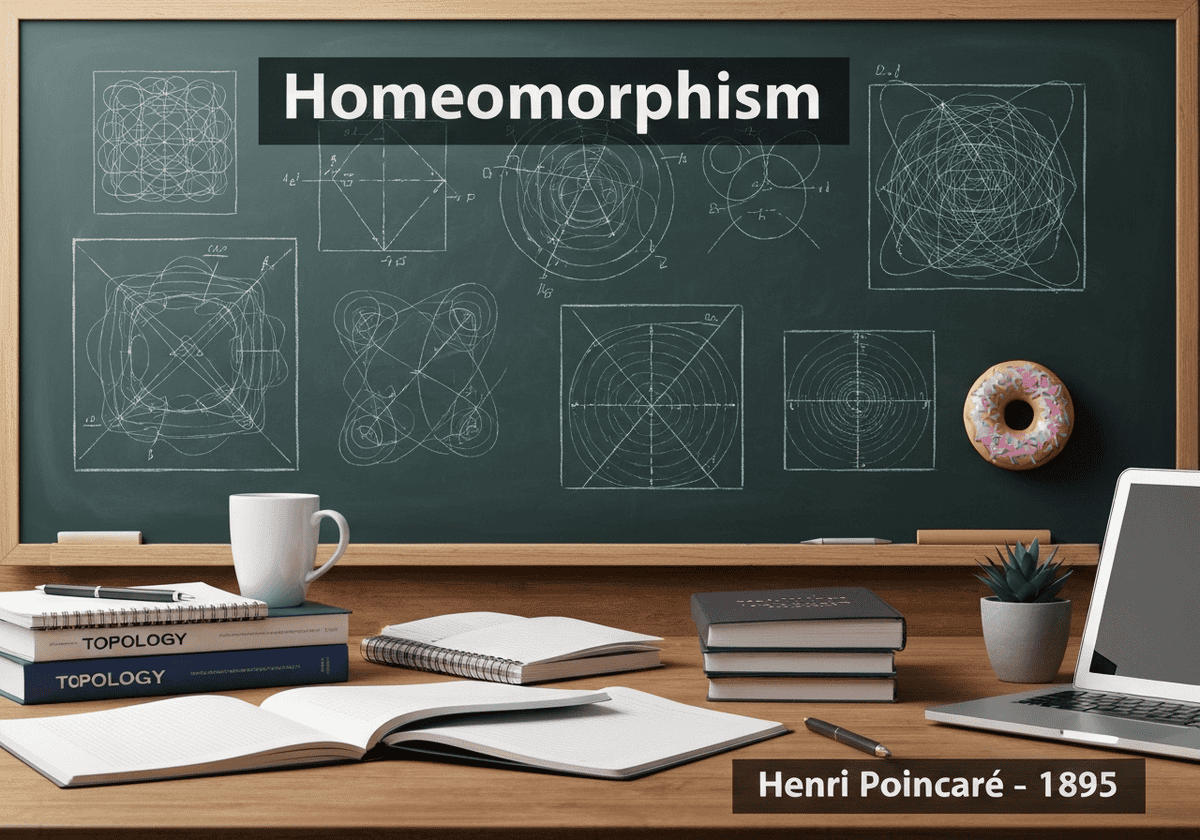
1895
  • Henri Poincaré
Mathematician's workspace showcasing homeomorphism with topological diagrams and deformation examples.

(Image générée à titre d'illustration uniquement)

Un homéomorphisme est une fonction continue entre deux espaces topologiques qui admet une fonction inverse continue. Deux espaces topologiques sont dits homéomorphes si une telle fonction existe. D'un point de vue topologique, les espaces homéomorphes sont identiques. Ce concept illustre l'idée qu'un objet peut être étiré, plié ou déformé pour devenir un autre sans se déchirer ni se coller, comme une tasse à café transformée en beignet.


More formally, a function [latex]f: X \to Y[/latex] between two topological spaces [latex](X, \tau_X)[/latex] and [latex](Y, \tau_Y)[/latex] is a homeomorphism if it is a bijection, it is continuous, and its inverse [latex]f^{-1}: Y \to X[/latex] is also continuous. The condition that the inverse must also be continuous is crucial. For example, the function [latex]f: [0, 2\pi) \to S^1[/latex] defined by [latex]f(t) = (\cos(t), \sin(t))[/latex] is a continuous bijection from a half-open interval to a circle, but its inverse is not continuous at the point (1,0), so it is not a homeomorphism. Homeomorphism is an equivalence relation on the class of all topological spaces. The resulting equivalence classes are called homeomorphism classes. The central problem in topology is to determine whether two given topological spaces are homeomorphic. To do this, topologists find topological invariants—properties of spaces that are preserved under homeomorphisms. If two spaces do not share an invariant, they cannot be homeomorphic. Examples of topological invariants include connectedness, compactness, and the fundamental group.

UNESCO Nomenclature: 1209
– Topology

Taper

Abstract System

Perturbation

Foundational

Usage

Utilisation généralisée

Précurseurs

  • Leonhard Euler’s work on graph theory and polyhedra
  • August Ferdinand Möbius’s discovery of the Möbius strip
  • Felix Klein’s Erlangen program
  • The development of continuous functions by Cauchy and Weierstrass

Applications

  • classification of geometric objects
  • knot theory
  • topological data analysis
  • computer graphics and 3d modeling
  • robotics and motion planning

Brevets:

NA

Idées d'innovations potentielles

  • shape-shifting materials that maintain functional properties across different forms
  • software for verifying the topological equivalence of 3d-printed object designs
  • ai systems for recognizing objects in images regardless of orientation or deformation
  • virtual reality environments with fluid, deformable objects
  • advanced prosthetics that can adapt their shape for different tasks
  • data compression algorithms that exploit topological similarities in datasets
  • architectural design tools for creating structurally sound, free-form buildings
  • flexible electronics that can be bent or stretched without breaking circuits
Related to: homeomorphism, continuous deformation, topological equivalence, donut, coffee mug, topological invariant, bijection, continuous function.

Contexte historique

Homéomorphisme

1850
1854
1854
1895
1899
1900
1911
1848
1850
1854
1884
1896
1900
1903
1914

(si la date est inconnue ou non pertinente, par exemple « mécanique des fluides », une estimation arrondie de son émergence notable est fournie)

10e année anniversaire

Les images en pleine résolution et les téléchargements sont uniquement disponibles, et 100% gratuits, pour les membres inscrits.