Address: 3 Nobel St., Skolkovo Innovation Center, Moscow, 121205, Russia
Data Science, Advanced Manufacturing, Energy Systems
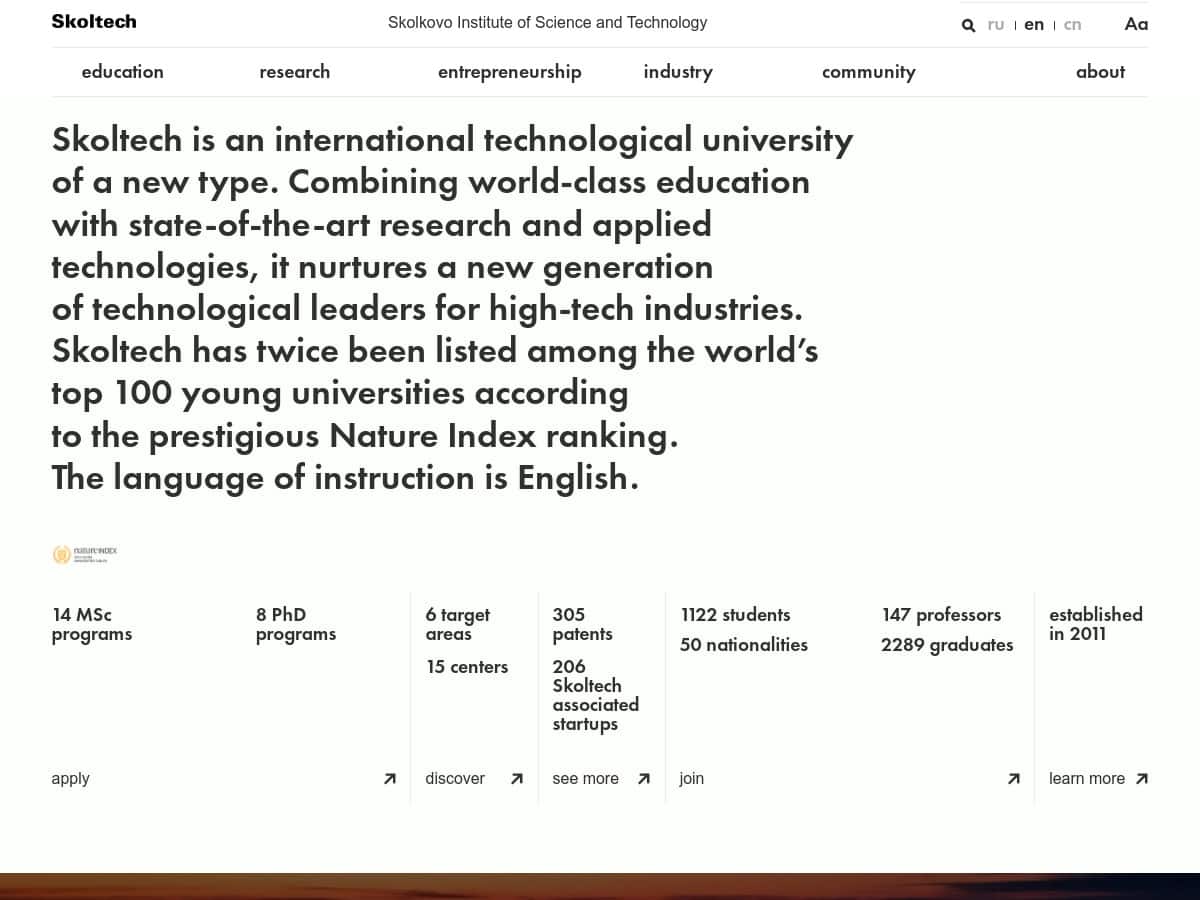
Skoltech, formally the Skolkovo Institute of Science and Technology, was set up in 2011 as a graduate research university in the Skolkovo innovation district near Moscow. Its creation followed a partnership agreement between the Skolkovo Foundation and the Massachusetts Institute of Technology, signed on 25 October 2011, which gave the new institute an American research university as its first academic partner.
Skoltech grants only graduate degrees: Master’s (MSc) and PhD programmes, taught in English. Research, teaching and innovation work is grouped in Centres for Research, Education and Innovation, alongside project centres. Master’s disciplines in the early years included data science, computational science and engineering, photonics and quantum materials, mathematical physics, biotechnology, space systems, materials science and petroleum engineering.
The campus in the Skolkovo Innovation Center won first prize in the University Campus category of the 2019 Prix Versailles. In 2021 the Nature Index ranked Skoltech 65th among the world’s young universities. Applicants should take current programme lists and numbers from the institute’s website.
Domains taught:
Aerospace, AI and Machine Learning, Life Sciences, Manufacturing, Materials, Software Engineering, Thermodynamics
Diplomas*:
Doctor, Master
Status:
Private
Partnerships:
Strong partnership with MIT; collaborations with international research institutions and high-tech companies; part of the Skolkovo Innovation Center ecosystem.
Research:
Cutting-edge research in AI, advanced materials, life sciences and biomedicine, energy transition, photonics, quantum technologies, and space science.
Famous Alumnis:
N/A
International recognition**:
Number of staff***:
300
Current students***:
1200
Foreign students***:
30%
Cumulative former students***:
2000
Pros
Modern, research-intensive, English-language instruction, strong international collaboration (historically), focus on innovation and startups.
Cons
Graduate-only programs, relatively new, relies on external funding and partnerships which can be variable.
Moscow Institute of Physics and Technology, a public institute in the Moscow Region, concentrates on theoretical physics, applied mathematics and computer science, a science-first profile that lines up with Skoltech's research orientation.
ITMO University is a public university in St. Petersburg listing computer science, optics and photonics as main fields, which makes it a natural comparison for applicants interested in technology-driven research.
Novosibirsk State University offers physics, mathematics and computer science as a public university in Siberia, and it is an alternative for students seeking research-heavy graduate education.
National Research Nuclear University in Moscow is public and combines nuclear physics, engineering physics and information technology, so it shares Skoltech's location in the capital and its technical emphasis.
Lomonosov Moscow State University is a public university in Moscow with physics, mathematics and chemistry as main fields, serving as a much broader option in the same city.
Most Similar Schools Abroad
Massachusetts Institute of Technology in the United States is a private university with engineering, computer science and physical sciences as main fields, and it was the founding academic partner of Skoltech.
California Institute of Technology in the United States is a small private institution focused on physics and astronomy, engineering and biology, comparable in its research-heavy character.
Okinawa Institute of Science and Technology Graduate University in Japan is a private graduate-only university in physics, chemistry, marine science and brain research, which matches Skoltech's graduate-level format.
Télécom Paris in France is a public engineering school for digital technologies, data science and AI, close to Skoltech's data science track.
*our own picks (our criteria: a mix between domains, diploma delivered, reputation and size), but obviously too many criteria for an apple-to-apple ranking.
FAQ
What kind of institution is Skoltech?
It is a research-focused graduate university founded in 2011 and located in Skolkovo, in the Moscow area. It awards MSc and PhD degrees but no undergraduate degrees.
Which partner helped to start the institute?
The Skolkovo Foundation signed a partnership agreement with the Massachusetts Institute of Technology on 25 October 2011, the date the university gives for its establishment.
In which language are the courses given?
Instruction is in English. Applicants should still check each programme page for entry tests and prerequisites.
How is research organised?
Work is grouped in Centres for Research, Education and Innovation and in project centres. Their number and topics change over time, so the current list is on the official site.
Has Skoltech received international recognition?
Its campus won the University Campus prize at the 2019 Prix Versailles, and the 2021 Nature Index placed it 65th among young universities worldwide. The institute's own about page lists both items.
What subjects can students choose?
Past Master's tracks included data science, biotechnology, space systems, materials science and petroleum engineering. The current catalogue, fees and scholarship information should be read from the official admissions pages.
*: without any judgment of the quality, readers are strongly encouraged to check the official status of the exact diploma envisioned as many universities have a mix of recognized diplomas, not recognized, “co-delivered,” “equivalent to”, “some pathways” (…), can change over time, and can be named differently from one country to another.
**: international reputation: is based on some criteria that do not mean much in some domains or specialties (number of researchers, of scientific publications, on budget ….). Our approximate 1-4 scale:
known locally
known locally and internationally
is listed in some of the world university’s classifications
is listed among the 20 firsts in some of world university’s classifications
***: estimated numbers, based on online sources and/or feedbacks. The numbers can vary greatly depending on school organisation (ex.: school is part of a group, it employs internal staff or external consultants or has public staff without employing them …). Refer to all the links provided to have accurate and updated numbers.
Innovation.world is not affiliated with this school/university. We recommend to contact them directly on their website for any special request.
To complete or correct any information here or share your opinion, please comment below or > send us a direct message <.