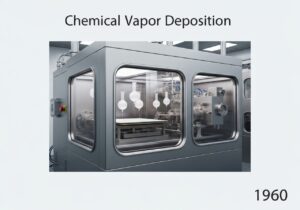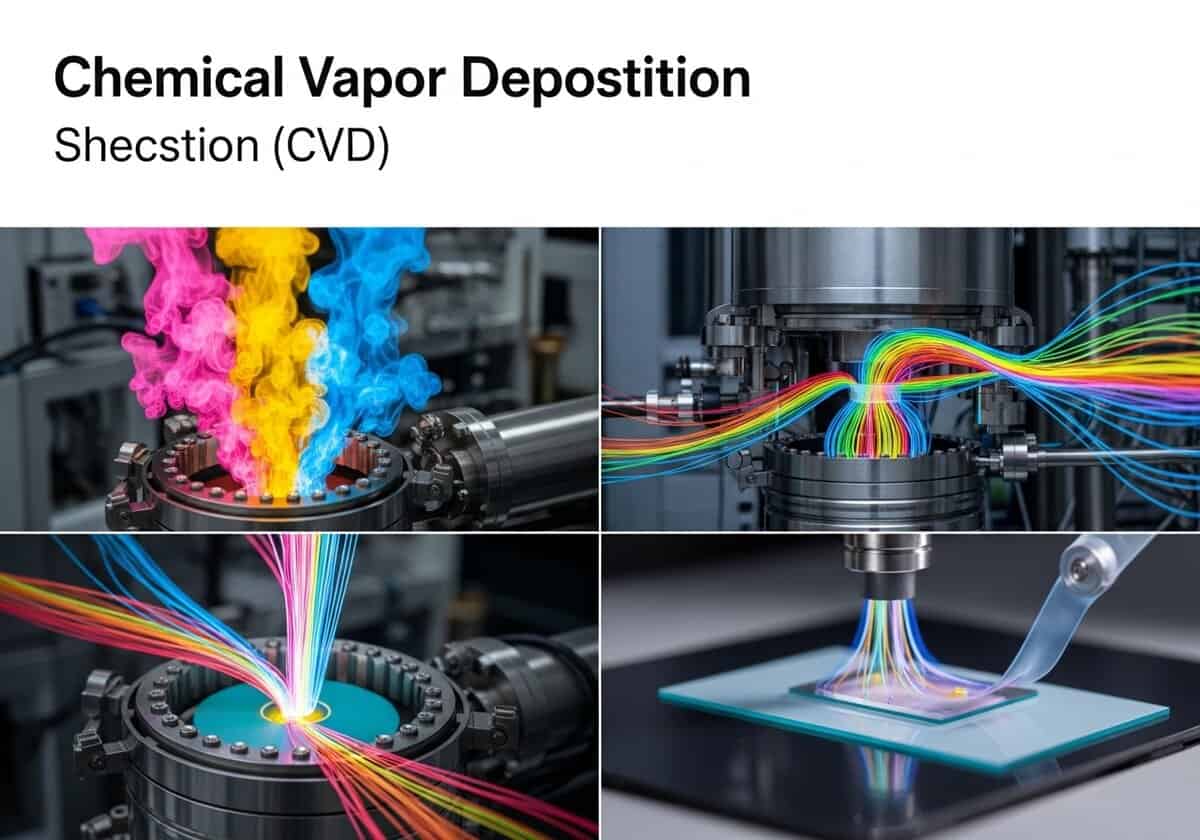
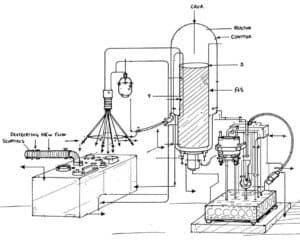
La deposición química en fase de vapor (CVD) es una importante técnica de fabricación de películas delgadas que implica reacciones químicas de precursores en fase de vapor sobre sustratos calentados para producir recubrimientos conformados de alta pureza con un control preciso del espesor y la composición. Este campo integra las interacciones entre la química de los precursores, la dinámica del flujo de gases, las reacciones superficiales y la gestión térmica en entornos de reactores especializados. Sus aplicaciones abarcan desde la fabricación de dispositivos semiconductores y recubrimientos protectores hasta la síntesis avanzada de materiales. Nuestra siguiente recopilación presenta las últimas publicaciones y patentes revisadas por pares, que reflejan los avances en el diseño de reactores, el desarrollo de precursores, la optimización de procesos y nuevas modalidades de CVD, como la CVD metalorgánica y la potenciada por plasma.
La CVD construye películas átomo por átomo a partir de gases reactivos. Esas películas se convierten en láminas en grafeno, barreras en recubrimientos superficiales y capas activas en semiconductoresLa epitaxia del carburo de silicio se analiza en el siguiente apartado: semiconductores de banda prohibida anchay películas absorbentes depositadas por vapor bajo perovskitas.
Esta es nuestra última selección de publicaciones y patentes mundiales en inglés sobre Deposición Química en Fase Vapor (CVD), entre muchas revistas científicas en línea, clasificadas y centradas en CVD, Deposición Química en Fase Vapor, deposición de películas finas, gas precursor, calentamiento del sustrato, velocidad de deposición, uniformidad de la película, dinámica del flujo de gas, reacciones superficiales, nucleación, mecanismo de crecimiento de la película, CVD térmico, CVD potenciado por plasma, CVD metalorgánico, deposición de capas atómicas, ALD, temperatura de deposición, gas portador, control del espesor de la película, conformalidad, presión de deposición, precursores químicos, morfología de la película, cinética de deposición, reacciones en fase gaseosa, difusión superficial, reactor de CVD y selectividad de la deposición.
Novel Aminoalkoxysilylamine Compound, Preparation Method Therefor, and Silicon-Containing Thin Film Deposition Composition Comprising Same
Patent published on the 2026-11-19 in US under Ref US20260366154 by DNF CO LTD [KR] (Kim Sung Gi [kr], Son Seung [kr], Cho Yu Jin [kr], Ryu Jiho [kr], Jang Se Jin [kr], Park Joong Jin [kr], Cho Jun Hee [kr], Park Gun Joo [kr])
Abstract: A aminoalkoxysilylamine compound, a method therefor, a silicon-containing thin film deposition composition including the compound, and a method for manufacturing a silicon-containing thin film using the composition. The aminoalkoxysilylamine compound according to the present disclosure is thermally stable and has high volatility and reactivity, and thus is very useful for stably manufacturing a silicon-containing thin film having excellent properties in a wide temperature range.[...]
Our summary: The document discusses a novel aminoalkoxysilylamine compound and its preparation method. It outlines a silicon-containing thin film deposition composition that includes this compound. The compound is noted for its thermal stability, high volatility, and reactivity, making it suitable for manufacturing high-quality silicon-containing thin films.
Aminoalkoxysilylamine, Thin film deposition, Silicon-containing composition, Thermal stability
Patent
Methods and compositions for the production of glyoxal
Patent published on the 2026-11-19 in US under Ref US20260366047 by SOLUGEN INC [US] (Sun Zhizeng [us], Fisher Brian F [us], Qian Shuai [us], Su Lynn H [us], Lee Toni M [us], Chakrabarti Gaurab [us], Hunt Sean [us])
Abstract: A chemoenzymatic process comprising contacting ethylene glycol with a biocatalyst in the presence of oxygen under conditions suitable for the formation of glycolaldehyde, glyoxal or combinations thereof. A method of producing glyoxal comprising contacting ethylene glycol with an oxidase selected from the group consisting of a copper radical oxidase, an alcohol oxidase, a glycerol oxidase, and combinations thereof in the presence of oxygen and a catalase under conditions suitable for the formatio[...]
Our summary: The content describes a process for producing glyoxal using ethylene glycol and a biocatalyst. It involves the oxidation of ethylene glycol in the presence of oxygen. The method allows for the formation of glycolaldehyde and glyoxal through specific oxidases and conditions.
glyoxal, ethylene glycol, biocatalyst, chemoenzymatic
Patent
Aromatic aldehyde catalytic reduction mixture
Patent published on the 2026-11-19 in US under Ref US20260364584 by UNIV IMAM ABDULRAHMAN BIN FAISAL [SA] (Elsharif Asma Mohammed Zamil [sa], Almarzooq Monerah Ahmed Hassan [sa])
Abstract: A nanohybrid material includes a plurality of gold nanohybrid particles having formula (I). The gold nanohybrid particles have a gold nanoparticle (AuNPs) core and a shell of at least one fatty acid derivative at least partially disposed around the AuNPs core. The AuNPs core has a cuboidal shape and an average particle size of 20 to 60 nanometers (nm). Each R1, and R2 are independently selected from the group consisting of a hydrogen atom, and a fatty acid hydrocarbon chain having 16 to 22 carbo[...]
Our summary: A nanohybrid material consists of gold nanoparticles with a cuboidal shape and a fatty acid derivative shell. The gold nanoparticles have an average size of 20 to 60 nanometers. The material is designed for catalytic reduction of aromatic aldehydes.
Aromatic aldehyde, catalytic reduction, gold nanoparticles, nanohybrid materials
Patent
Fluorine reduction is silicon-containing films
Patent published on the 2026-11-19 in US under Ref US20260366141 by LAM RES CORP [US] (Curtin Ian John [us], Agarwal Pulkit [us], Zhang Tao [us], Imade Mamoru [us], Bhandari Shiva Sharan [us], Agnew Douglas Walter [us])
Abstract: Methods of filling a gap with a dielectric material including using an inhibition plasma during deposition. The inhibition plasma increases a nucleation barrier of the deposited film. A passivation plasma may remove inhibitor species adsorbed on the surface or in the bulk of a deposited dielectric material.[...]
Our summary: Fluorine reduction involves silicon-containing films. An inhibition plasma is used to fill gaps with dielectric material by increasing the nucleation barrier. A passivation plasma can remove adsorbed inhibitor species from the surface or bulk of the dielectric material.
Fluorine reduction, silicon films, dielectric material, inhibition plasma
Patent
A robust icefill method to provide void free trench fill for logic and memory applications
Patent published on the 2026-11-19 in US under Ref US20260366142 by LAM RES CORP [US] (Agarwal Pulkit [us], Baker Jonathan Grant [us], Imade Mamoru [us], Bhandari Shiva Sharan [us], Petraglia Jennifer Leigh [us])
Abstract: Methods of filling a gap with a dielectric material including using an inhibition plasma during deposition. The inhibition plasma increases a nucleation barrier of the deposited film. The inhibition plasma selectively interacts near the top of the feature, inhibiting deposition at the top of the feature compared to the bottom of the feature, enhancing bottom-up fill.[...]
Our summary: The icefill method ensures void-free trench filling for logic and memory applications. It utilizes an inhibition plasma during deposition to enhance the nucleation barrier of the film. This selective interaction promotes bottom-up filling by inhibiting deposition at the top of the feature.
icefill method, dielectric material, inhibition plasma, bottom-up fill
Patent
Method for producing tricyclodecane dialdehyde, method for producing tricyclodecane dimethanol, and apparatus for producing tricyclodecane dialdehyde
Patent published on the 2026-11-19 in WO under Ref WO2026240190 by MITSUBISHI CHEMICAL CORP [JP] (Sunami Kazuaki [jp], Tashima Naoto [jp], Hinoishi Hiroki [jp])
Abstract: Provided are a method for producing tricyclodecane dialdehyde, a method for producing tricyclodecane dimethanol, and an apparatus for producing tricyclodecane dialdehyde. A method for producing tricyclodecane dialdehyde according to the present disclosure comprises subjecting dicyclopentadiene containing 5-500 mass ppm of 2-methyl-1,3-butadiene and/or 1,3-pentadiene to a hydroformylation reaction in the presence of a metal catalyst.[...]
Our summary: The document describes methods for producing tricyclodecane dialdehyde and dimethanol. It details a hydroformylation reaction involving dicyclopentadiene with specific impurities. An apparatus for producing tricyclodecane dialdehyde is also provided.
tricyclodecane, dialdehyde, dimethanol, hydroformylation
Patent
Exploring the effects of accelerated carbonation synergy on fly ash cement-based materials
Published on 2026-11-14 by @OXFORD
Abstract: AbstractThe construction sector is being pressured toward achieving carbon neutrality, which requires novel ways of carbon capture, utilization, and storage. Fly ash (FA) is often used as a substitute to lower the clinker factor but its low reactivity makes it difficult to be used in high-volume substitution. Carbonation curing is one of the promising methods to accelerate the strength development and to avoid CO2 emission, but synergistic effect between binder precarbonation and matrix curing i[...]
Our summary: This study investigates a dual carbonation process for fly ash cement-based materials to enhance strength and CO2 capture. Precarbonation creates nucleation seeds that improve hydration, but excessive processing can lead to microcracking. The method offers a scalable solution for precast concrete producers to utilize industrial waste effectively.
carbonation, fly ash, cement, microstructure
Publication
Phase-matching quantum key distribution with heralded single-photon sources and local detection
Published on 2026-11-06 by Shiya Zeng, Ruobin Zhao, Junyan Luo, Zhiwei Sun and Tingting Song @IOP SCIENCE
Abstract: Channel loss in long-distance phase-matching quantum key distribution (PM-QKD) amplifies vacuum emissions and dark counts, impairing parameter estimation and limiting secure transmission distance. In this paper, we propose a PM-QKD protocol based on heralded single-photon sources with local detection. In the key sifting stage, local heralding outcomes are filtered to suppress vacuum-dominated noise and enhance the single-photon fraction of the retained ensemble. A three-intensity decoy-state met[...]
Our summary: The paper proposes a PM-QKD protocol using heralded single-photon sources and local detection to enhance transmission distance. It employs a three-intensity decoy-state method for parameter estimation and noise suppression. Simulation results indicate significant improvements in key rate and performance compared to conventional protocols.
quantum key distribution, heralded single-photon sources, phase-matching, vacuum-event filtering
Publication