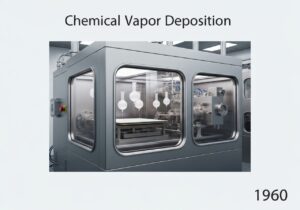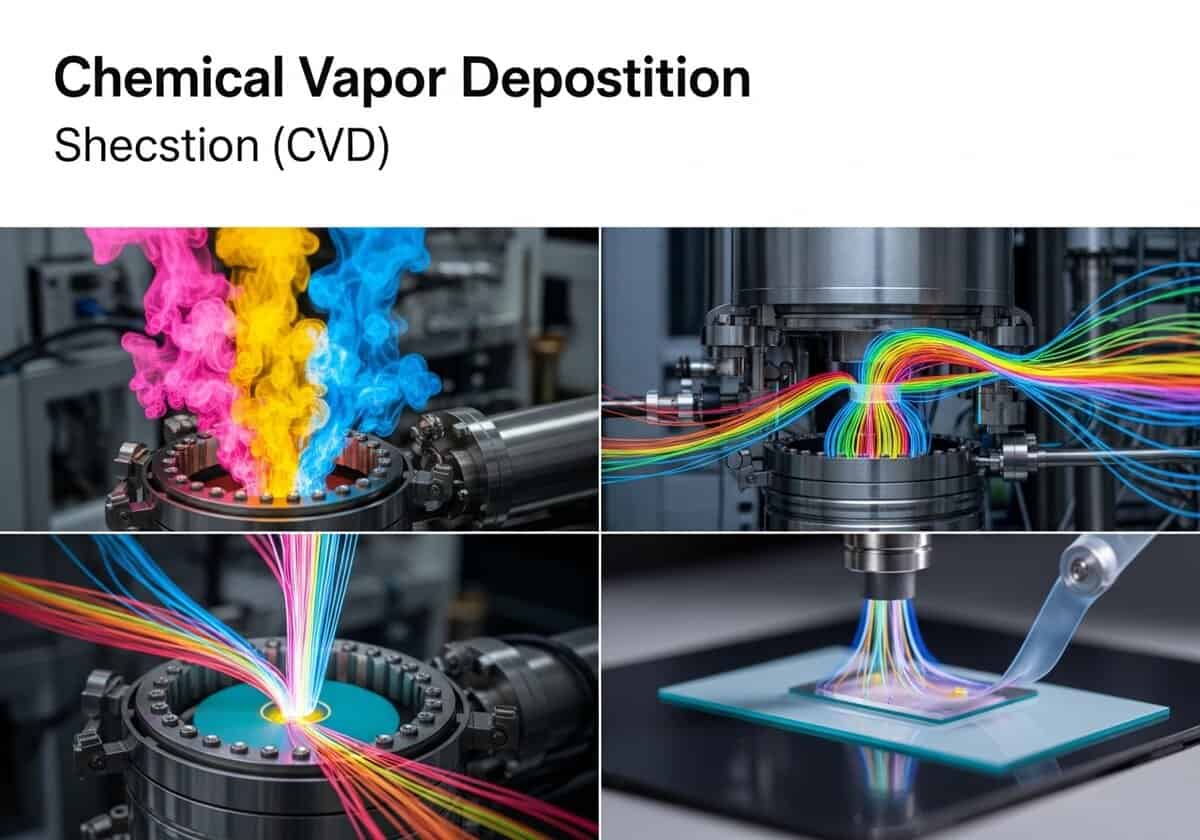
A deposição química de vapor (CVD) é uma importante técnica de deposição de filmes finos. filme A deposição química de vapor (CVD) é uma técnica de fabricação que envolve reações químicas de precursores em fase vapor sobre substratos aquecidos para produzir revestimentos conformes de alta pureza, com controle preciso sobre a espessura e a composição. Este domínio integra interações entre a química dos precursores, a dinâmica do fluxo de gás, as reações de superfície e o gerenciamento térmico em ambientes de reatores especializados. As aplicações abrangem desde a fabricação de dispositivos semicondutores e revestimentos protetores até a síntese de materiais avançados. A compilação a seguir apresenta as publicações e patentes mais recentes revisadas por pares, refletindo os avanços no projeto de reatores, desenvolvimento de precursores, otimização de processos e novas modalidades de CVD, como CVD aprimorada por plasma e CVD metalorgânica.
Esta é a nossa mais recente seleção de publicações e patentes mundiais em inglês sobre Deposição Química de Vapor (CVD), provenientes de diversos periódicos científicos online, classificadas e focadas em CVD, deposição química de vapor, deposição de filmes finos, gás precursor, aquecimento do substrato, taxa de deposição, uniformidade do filme, dinâmica do fluxo de gás, reações de superfície, nucleação, mecanismo de crescimento do filme, CVD térmica, CVD aprimorada por plasma, CVD metalorgânica, deposição de camada atômica (ALD), temperatura de deposição, gás de arraste, controle da espessura do filme, conformidade, pressão de deposição, precursores químicos, morfologia do filme, cinética de deposição, reações em fase gasosa, difusão superficial, reator de CVD e seletividade de deposição.
Improved acrylic acid production process with increased product purity
Patent published on the 2026-06-11 in WO under Ref WO2026122320 by ROHM AND HAAS CO [US] (Quiros Nelson I [us])
Abstract: A process for producing acrylic acid comprises feeding a stream comprising acrylic acid to a dehydration tower to produce an overhead stream comprising noncondensibles and lights and a bottoms stream comprising acrylic acid and Michael addition products of acrylic acid. At least a portion of the bottoms stream from the dehydration tower is fed to a finishing tower to distill the bottoms stream of the dehydration tower to produce an acrylic acid-rich stream comprising acrylic acid and organic car[...]
Our summary: The process enhances acrylic acid production with higher purity. It utilizes a dehydration tower and a finishing tower for separation. The final step involves crystallization to achieve glacial acrylic acid with minimal impurities.
acrylic acid, purification, distillation, crystallization
Patent
Methods for hydrogen sulfide scavenging
Patent published on the 2026-06-11 in US under Ref US20260158432 by HEXION INC (Lindeman Jeffrey [us], Kamoun Cyrille [us], Lefenfeld Michael [us])
Abstract: [0000] Disclosed is a process for scavenging HS from a process stream by contacting an HS-containing process stream with a scavenging composition containing 35 to 70 wt. % formaldehyde, 10 to 55 wt. % methanol, 5 to 20 wt. % water, and up to 10 wt. % additives, selected from a defoamer, a corrosion inhibitor, a scale inhibitor, a pH adjuster, or mixtures thereof. Scavenging compositions with such a formulation are also described.[...]
Our summary: A process is disclosed for scavenging hydrogen sulfide from a process stream. The scavenging composition consists of formaldehyde, methanol, water, and optional additives. The formulation aims to effectively reduce hydrogen sulfide levels in various applications.
hydrogen sulfide, scavenging composition, formaldehyde, methanol
Patent
Rigid carrier assemblies with conductive modifiers added to injection molding polymers for improved electrostatic discharge
Patent published on the 2026-06-04 in WO under Ref WO2026117766 by DAEWON SEMICONDUCTOR PACKAGING INDUSTRIAL CO [US] (Hermsmeier Brent Dae [us], Chung Sunna [us], Cho Kyung Hee [us], Cabornay Jilian [us], Hwang Yu Jin [us], Jentgen Jarrod [us], Jeong Sang Yoon [us], Lee Si Chang [us], Nemeckova Petra [us], Okoren Athens [us], Oh Se Don [us])
Abstract: A carrier assembly for semiconductor components can include a patterned tray composed of carbon nanotubes – having disentangled conductive modifiers – that substantially conforms to the pattern. By aligning the disentangled conductive modifiers (e.g., using a chemical vapor deposition process, sonication, and/or a strong magnet) in a vertical arrangement, more consistent and effective discharge of static electricity can be achieved. When semiconductor components are loaded into the patterned[...]
Our summary: Rigid carrier assemblies enhance electrostatic discharge in semiconductor components. Conductive modifiers are integrated into polymers using advanced techniques. Vertical alignment of these modifiers improves static electricity discharge efficiency.
conductive modifiers, electrostatic discharge, carbon nanotubes, injection molding
Patent
Binder composition with extended shelf-life
Patent published on the 2026-06-04 in US under Ref US20260152662 by PAROC GROUP OY [FI] (Chen Liang [us], Pettersson Charlotte Carita [fi], Mueller Gert [us], Zhang Xiujuan [us])
Abstract: A fibrous insulation product with an extended uncured shelf life is disclosed comprising a plurality of randomly oriented fibers and a binder composition at least partially coating the fibers. The binder composition has a complex modulus at ambient temperature of no greater than 0.0004 MPa at a binder solids content of between 65% and 85%. The binder composition is free of added formaldehyde and is applied to the fibers as an aqueous binder composition comprising at least 20% by weight of a reac[...]
Our summary: The disclosed fibrous insulation product features a binder composition with an extended uncured shelf life. The binder has a complex modulus of no greater than 0.0004 MPa and is free of added formaldehyde. It comprises a reactive diluent polyol and a polymeric crosslinking agent, ensuring effective coating of the fibers.
Binder composition, Fibrous insulation, Extended shelf-life, Aqueous binder
Patent
Substrate processing apparatus, substrate heating method, and method for producing semiconductor device
Patent published on the 2026-06-04 in WO under Ref WO2026115695 by KOKUSAI ELECTRIC CORP [JP] (Fujimori Hiroki [jp], Ueno Masaaki [jp])
Abstract: Provided is a technique for heating a substrate so as to equalize the temperature of the substrate. The present invention comprises a heat insulator including a heat storage material disposed in the vicinity of a substrate accommodated in a reaction container configured to be heated to a predetermined temperature, wherein the heat storage material is configured such that, when the melting point of the heat storage material is higher than the predetermined temperature, the heat storage material[...]
Our summary: The invention describes a substrate heating method to achieve uniform temperature distribution. It utilizes a heat insulator with a heat storage material near the substrate. The heat storage material changes state based on its melting point relative to the predetermined temperature.
substrate processing, substrate heating, semiconductor device, heat insulator
Patent
Tpu with low self-nucleation
Patent published on the 2026-06-04 in WO under Ref WO2026114869 by BASF SE [DE] (Poeselt Elmar [de], Schander Edgar [de], Schaefer Frank [de], Mattfeld Sascha [de], Uhlhorn Frank [de])
Abstract: The present invention relate to a thermoplastic polyurethane (TPU-1) obtained or obtainable from a polyol composition (PC) and an isocyanate composition (IC), wherein (TPU-1) is characterized by a specific crystallization behavior measured using dynamic scanning calorimetry (DSC) according to DIN EN ISO 11357-3:2013. The present invention furthermore is directed to a process for preparing an article from said thermoplastic polyurethane as well as the use of a thermoplastic polyurethane according[...]
Our summary: The invention describes a thermoplastic polyurethane (TPU-1) with low self-nucleation derived from specific polyol and isocyanate compositions. It features unique crystallization behavior as measured by dynamic scanning calorimetry. Additionally, the invention includes a method for producing articles from this TPU and its application in creating shaped articles, such as films.
TPU, self-nucleation, thermoplastic polyurethane, crystallization
Patent
Heralded linear optical generation of Dicke states
Published on 2026-04-30 by Minhyeok Kang, Jaehee Kim, William J Munro, Seungbeom Chin and Joonsuk Huh @IOP SCIENCE
Abstract: Entanglement is a fundamental feature of quantum mechanics and a key resource for quantum information processing. Among multipartite entangled states, Dicke states are distinguished by their permutation symmetry, which provides robustness against particle loss and enables applications for quantum communication and computation. Although Dicke states have been realized in various platforms, most optical implementations rely on postselection, which destroys the state upon detection and prevents its[...]
Our summary: This work presents a linear-optical heralded scheme for generating arbitrary Dicke states using photons. The approach leverages the permutation symmetry of Dicke states to simplify the generation process. This method offers a resource-efficient pathway for practical applications in quantum technologies.
Dicke states, quantum entanglement, linear optics, heralded generation
Publication
The Effect of Post-Heat Treatments on Microstructure and Mechanical Properties of a L-PBF CoCrNi–AlTi Medium-Entropy Alloy
Published on 2026-02-03 by Xiaojing Xiong, Xiaodong Nong, Libin Yu, Xianzhao Meng, Chunjia Mo, Yunjie Bi, Hui Ding @MDPI
Abstract: A CoCrNi-AlTi medium-entropy alloy was fabricated via laser powder bed fusion (L-PBF), and its microstructural evolution and mechanical response during aging at 500–900 °C for 1 h were systematically investigated. The as-built alloy exhibits a hierarchical microstructure consisting of elongated columnar grains and dislocation-rich cellular substructures, which is associated with an excellent strength–ductility combination (YS: 848 MPa, UTS: 1136 MPa, EF: 3[...]
Our summary: The study investigates the effects of post-heat treatments on the microstructure and mechanical properties of a CoCrNi-AlTi medium-entropy alloy fabricated via laser powder bed fusion. Aging at temperatures between 500-900 °C enhances hardness and tensile strength, with peak performance noted at 800 °C. The research highlights the role of L-PBF-induced defect structures in influencing precipitation behavior and the strength-ductility trade-off during heat treatment.
L-PBF, CoCrNi-AlTi, microstructure, mechanical properties
Publication