Product Design, Manufacturing & Innovation Resources
Hogar » HEPA and ULPA Filtration

HEPA and ULPA Filtration

1940
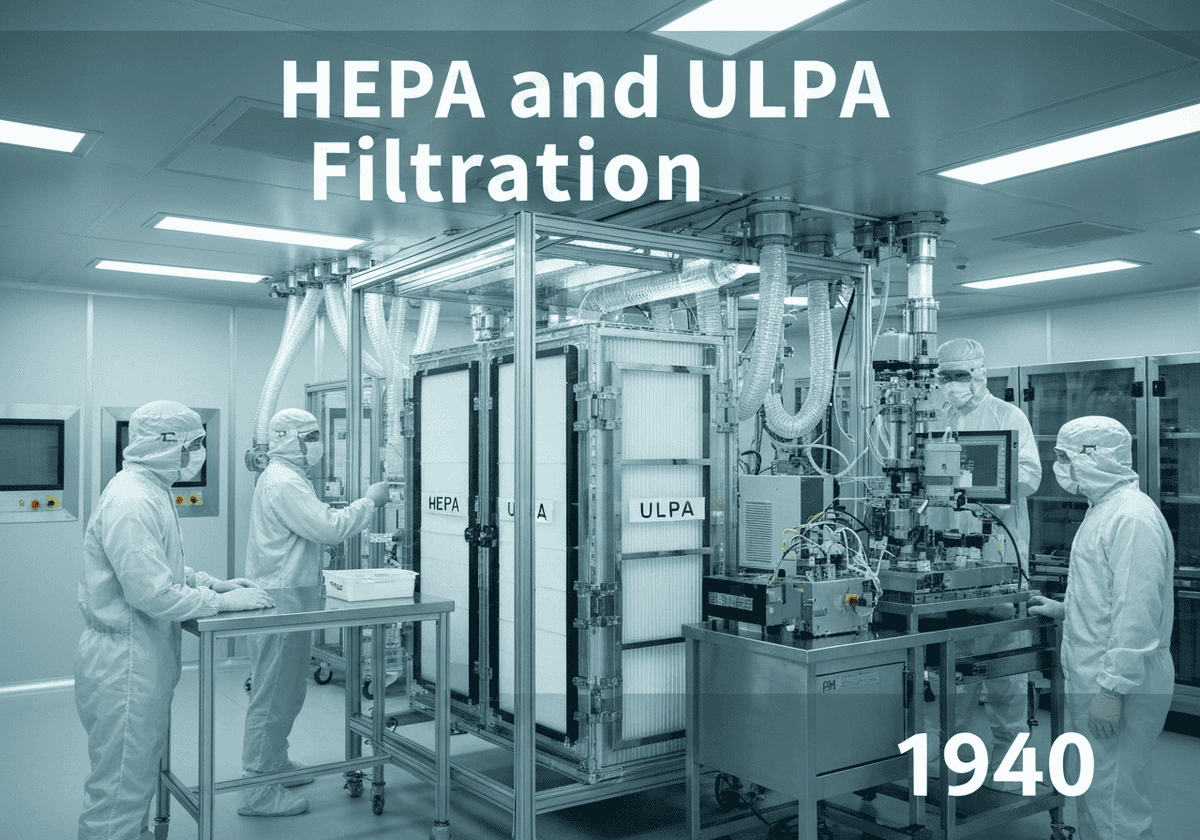
Sistema de filtración HEPA y ULPA en sala blanca para aplicaciones de ingeniería medioambiental.

(Imagen generada únicamente con fines ilustrativos)

Los filtros de aire de alta eficiencia para partículas (HEPA) y de aire con partículas ultrabajas (ULPA) son fundamentales. sala limpia components. A HEPA filter debe remove at least 99.97% of airborne particles 0.3 micrometers (µm) in diameter. An ULPA filter is even more efficient, removing 99.999% of particles 0.12 µm or larger. They work via a combination of interception, impaction, and diffusion.


La eficacia de los filtros HEPA y ULPA viene definida por su rendimiento en su tamaño de partícula más penetrante (MPPS). En el caso de los filtros HEPA, este tamaño suele ser de 0,3 µm. Las partículas más grandes que el MPPS quedan atrapadas principalmente por impacto inercial (colisionan con las fibras debido a su inercia) e interceptación (quedan atrapadas en las fibras al seguir la corriente de aire). Por el contrario, las partículas muy pequeñas (normalmente <0,1 µm) quedan atrapadas por difusión, donde su movimiento browniano aleatorio y errático hace que colisionen con las fibras del filtro. El tamaño de 0,3 µm representa un ‘valle’ en la eficiencia en el que ninguno de estos tres mecanismos es dominante, lo que lo convierte en el tamaño de partícula más difícil de capturar. Por lo tanto, la clasificación de un filtro se basa en su peor rendimiento en este MPPS.

ULPA filters are an extension of this technology, designed for even more stringent contamination control. They target an MPPS around 0.1-0.12 µm and achieve efficiencies of 99.999% or greater. These filters are constructed from a dense mat of randomly arranged borosilicate glass fibers. The air velocity, fiber diameter, and packing density are precisely controlled during manufacturing to achieve the desired performance. In a cleanroom, these filters are installed in terminal housings or as part of a fan-filter unit (FFU), and their seals are critical. Regular testing, such as Dispersed Oil Particulate (DOP) testing, is performed to verify the integrity of the filter media and the seal to ensure no contaminated air bypasses the filter.

UNESCO Nomenclature: 3307
- Ingeniería medioambiental

Tipo

Dispositivo físico

Ruptura

Fundacional

Uso

Uso generalizado

Precursores

  • research into gas masks during World War I
  • La necesidad del Proyecto Manhattan de filtrar partículas radiactivas.
  • advances in glass fiber manufacturing
  • understanding of aerosol physics and Brownian motion

Aplicaciones

  • cleanrooms for manufacturing and research
  • biological safety cabinets
  • hospital operating rooms and isolation units
  • nuclear facilities
  • high-end vacuum cleaners and air purifiers

Patentes:

NA

Ideas para posibles innovaciones

  • self-healing filter media that can repair minor punctures
  • filters with integrated sensors to monitor particle load and predict failure
  • graphene-based filter membranes for lower pressure drop and higher efficiency
  • rechargeable electrostatic filters that complement mechanical filtration
  • biodegradable filter materials to reduce environmental impact
  • catalytic filters that not only trap but also neutralize volatile organic compounds (VOCs)
  • nanofiber filters with tunable pore sizes for specific applications
  • smart filter systems that communicate with the building’s HVAC to optimize energy use
Relacionado con: HEPA, ULPA, filtración, filtro de aire, captura de partículas, control de contaminación, MPPS, tecnología de salas blancas.

Contexto histórico

HEPA and ULPA Filtration

1930
1930
1930
1940
1940
1940
1940
1930
1930
1930
1934
1940
1940
1940
1940

(Si la fecha es desconocida o no es relevante, por ejemplo "mecánica de fluidos", se proporciona una estimación redondeada de su aparición notable)

décimo año aniversario

Las imágenes en tamaño completo y las descargas solo están disponibles, de forma totalmente gratuita, para los miembros registrados.

> Acceso <