Product Design, Manufacturing & Innovation Resources
Hogar » Temperatura de color correlacionada (CCT)

Temperatura de color correlacionada (CCT)

1930
Técnico de laboratorio midiendo la temperatura de color correlacionada de fuentes de luz LED con un espectrómetro.

(Imagen generada únicamente con fines ilustrativos)

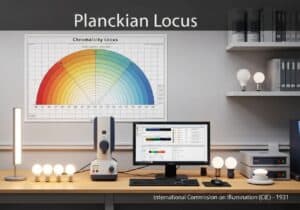
Correlated Temperatura de color (CCT) is a metric for light sources that do not radiate as ideal black bodies, such as LEDs or fluorescent lamps. It is the temperature of the Planckian radiator whose color is perceived as most similar to the light source. This ‘closeness’ is determined by finding the point on the Planckian locus nearest to the source’s chromaticity coordinates.

The need for CCT arose with the advent of artificial light sources that produce light through means other than thermal radiation (incandescence). Plasmas in fluorescent tubes or electroluminescence in LEDs generate spectral power distributions (SPDs) that are often spiky and irregular, unlike the smooth, continuous spectrum of a black body. Consequently, their chromaticity coordinates rarely fall exactly on the Planckian locus.

Para seguir proporcionando una métrica útil y numérica para la «calidez» o «frialdad» de estas fuentes, se desarrolló el concepto de CCT. El cálculo consiste en encontrar la distancia más corta desde la coordenada cromática (u,v) o (x,y) de la fuente de luz hasta el lugar geométrico de Planck. La temperatura asociada a ese punto más cercano en el lugar geométrico es la CCT. Las líneas de CCT constante, conocidas como líneas de isotemperatura, suelen trazarse perpendiculares al lugar geométrico en los diagramas de cromaticidad. Sin embargo, la CCT por sí sola no describe la calidad de reproducción cromática de una fuente; dos fuentes con la misma CCT pueden reproducir los colores de forma muy diferente.

UNESCO Nomenclature: 2209
- Óptica

Tipo

Métrico

Ruptura

Sustancial

Uso

Uso generalizado

Precursores

  • The concept of temperatura de color for black-body radiators
  • El locus de Planck en un color estandarizado espacio (CIE 1931)
  • Development of non-incandescent light sources (fluorescent lamps, LEDs) requiring a comparative metric

Aplicaciones

  • led lighting specifications (e.g., ‘3000K warm white’)
  • fluorescent lamp manufacturing and classification
  • architectural lighting design to create specific ambiances
  • human-centric lighting systems that vary CCT during the day
  • quality control in display manufacturing to ensure consistent white points

Patentes:

NA

Ideas para posibles innovaciones

  • cct-tunable smart fabrics for clothing or furniture
  • ai-driven camera flashes that adjust CCT for perfect skin tone rendering in any environment
  • adaptive street lighting that lowers CCT late at night to reduce ecological impact and skyglow
  • smart contact lenses that adjust their tint to normalize the perceived CCT of ambient light
  • 3d printing materials with phosphors that allow the CCT of embedded LEDs to be customized
  • beverage containers that use CCT-shifting light to indicate if the drink is at its optimal temperature
  • realidad aumentada glasses that overlay CCT correction filters to aid people with color vision deficiencies
  • dynamic museum lighting that adjusts CCT to best represent the historical context of an artifact
  • aquaculture lighting that fine-tunes CCT to optimize growth and reduce stress in fish
  • self-calibrating displays that use an integrated sensor to maintain a consistent CCT over their esperanza de vida
Relacionado con: CCT, temperatura de color correlacionada, lugar geométrico de Planck, cromaticidad, fuente de luz, LED, fluorescente, índice de reproducción cromática, CRI, metamerismo.

Contexto histórico

Temperatura de color correlacionada (CCT)

1927
1930
1930
1930
1931
1932
1936-01-01
1927
1930
1930
1930
1931
1932
1933
1937

(Si la fecha es desconocida o no es relevante, por ejemplo "mecánica de fluidos", se proporciona una estimación redondeada de su aparición notable)

décimo año aniversario

Las imágenes en tamaño completo y las descargas solo están disponibles, de forma totalmente gratuita, para los miembros registrados.

> Acceso <