Product Design, Manufacturing & Innovation Resources
घर » Ductility and Brittleness

Ductility and Brittleness

1850
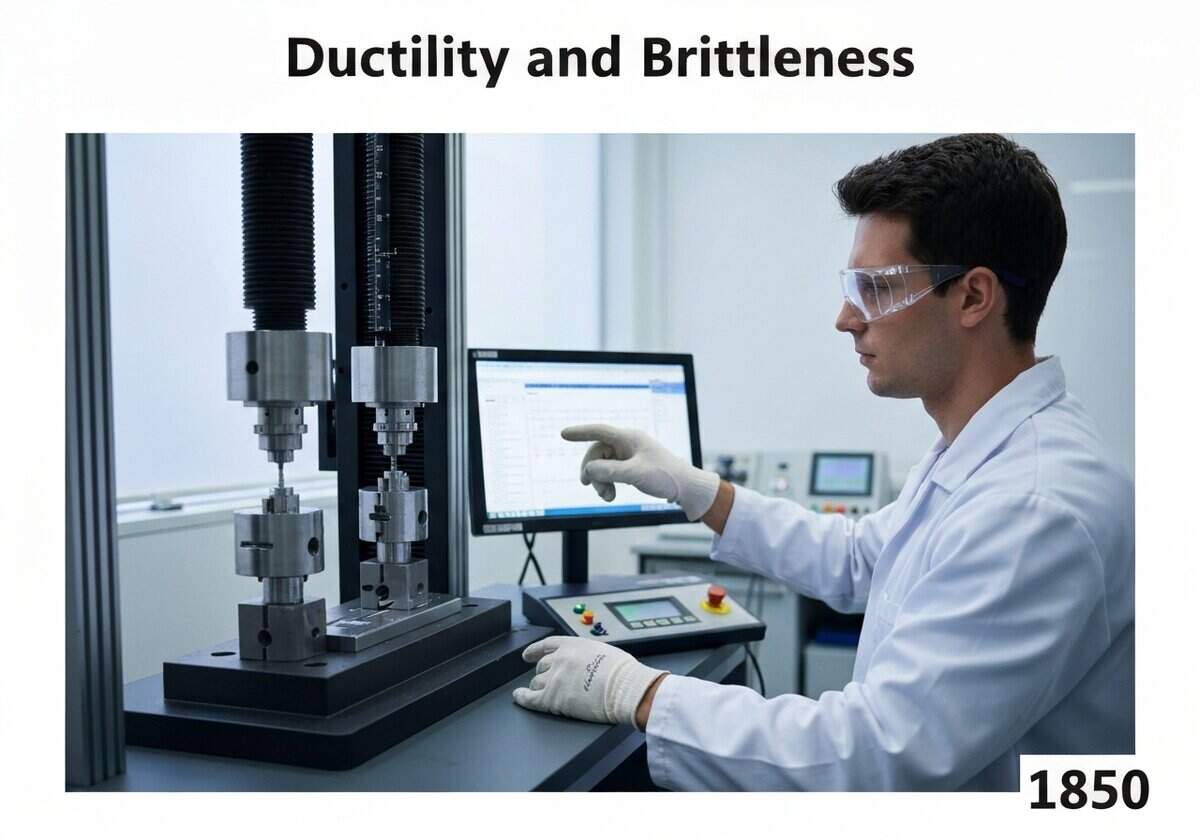
Tensile testing of metal samples in materials science laboratory for ductility and brittleness evaluation.

(यह छवि केवल उदाहरण के लिए बनाई गई है)

तन्यता किसी पदार्थ की टूटने से पहले पर्याप्त प्लास्टिक विरूपण से गुजरने की क्षमता का माप है, जिसे अक्सर प्रतिशत विस्तार या क्षेत्रफल में प्रतिशत कमी के रूप में मापा जाता है। तन्य पदार्थ, जैसे कि स्टील, अपने तनाव-विकृति वक्र पर एक लंबा प्लास्टिक क्षेत्र दर्शाते हैं। भंगुरता इसके विपरीत है; भंगुर पदार्थ, जैसे कि सिरेमिक या कच्चा लोहा, बहुत कम या बिना किसी प्लास्टिक विरूपण के टूट जाते हैं।
तन्य और भंगुर व्यवहार के बीच का अंतर तनाव-विकृति वक्र पर स्पष्ट रूप से दिखाई देता है। एक तन्य पदार्थ तनाव के बाद महत्वपूर्ण विकृति प्रदर्शित करता है। उपज बिंदु और फ्रैक्चर बिंदु से पहले। यील्डिंग के बाद वक्र के नीचे का यह बड़ा क्षेत्र दर्शाता है कि पदार्थ टूटने से पहले बहुत अधिक ऊर्जा अवशोषित कर सकता है। यह गुण कई इंजीनियरिंग अनुप्रयोगों में सुरक्षा के लिए महत्वपूर्ण है, क्योंकि डक्टाइल विफलता पूर्ण पतन से पहले एक दृश्य चेतावनी (जैसे, झुकना या खिंचाव) प्रदान करती है। डक्टिलिटी के प्रमुख माप प्रतिशत बढ़ाव, [latex](frac{L_f – L_0}{L_0}) times 100[/latex], और क्षेत्रफल में प्रतिशत कमी, [latex](frac{A_0 – A_f}{A_0}) times 100[/latex] हैं, जहाँ सबस्क्रिप्ट 'f' फ्रैक्चर पर अंतिम आयाम को दर्शाता है।

Conversely, a brittle material shows very little strain after its elastic limit. The fracture stress is often close to the ultimate tensile strength, and failure occurs suddenly and without warning. Ceramics, glasses, and some polymers are classic examples. The behavior of a material can also depend on external conditions. For instance, many steels that are ductile at room temperature undergo a ductile-to-brittle transition at low temperatures, a phenomenon that has led to catastrophic failures, such as in the Liberty ships during World War II.

UNESCO Nomenclature: 3322
सामग्री विज्ञान

Type

सामग्री गुण

व्यवधान

मूलभूत

उपयोग

व्यापक उपयोग

शगुन

  • metallurgical practices of annealing and tempering to control material properties
  • observations of material failure modes in early engineering structures
  • development of the tensile test as a standard characterization method

आवेदन

  • selection of materials for applications requiring forming (e.g., car bodies)
  • design of structures to ensure failure is gradual (ductile) rather than catastrophic (brittle)
  • wire drawing and metal extrusion processes
  • assessing material performance at low temperatures, where many materials become brittle

पेटेंट:

NA

संभावित नवाचार विचार

  • development of ductile iron to replace brittle cast iron
  • toughened ceramics with engineered microstructures to increase ductility
  • design of earthquake-resistant buildings that rely on the ductility of steel reinforcement
  • polymer blending to create impact-resistant plastics
  • control of grain size in metals to optimize the balance between strength and ductility
  • fracture mechanics analysis to predict the failure of structures containing cracks
  • development of bulk metallic glasses with improved ductility
  • design of safety-critical components like pressure vessels and aircraft fuselages
  • flexible electronic devices built on ductile substrates
  • biomimetic materials that mimic the ductile-brittle hierarchies of natural materials like bone
संबंधित विषय: तन्यता, भंगुरता, प्लास्टिक विरूपण, फ्रैक्चर, बढ़ाव, क्षेत्रफल में कमी, तन्य विफलता, भंगुर फ्रैक्चर, पदार्थ व्यवहार, तनाव-विकृति वक्र।

ऐतिहासिक संदर्भ

Ductility and Brittleness

1788
1834
1850
1850
1850
1850
1867
1761
1807-01-01
1850
1850
1850
1850
1860
1870

(यदि तिथि अज्ञात है या प्रासंगिक नहीं है, उदाहरण के लिए "द्रव यांत्रिकी", तो इसके उल्लेखनीय उद्भव का एक अनुमानित आंकड़ा प्रदान किया गया है)

नवीनतम परिवर्धन

शीर्ष पोस्ट और लेख

शीर्ष मूल उपकरण

10वां वर्ष सालगिरह

पंजीकृत सदस्यों के लिए पूर्ण आकार की छवियाँ और डाउनलोड 100% निःशुल्क उपलब्ध हैं।