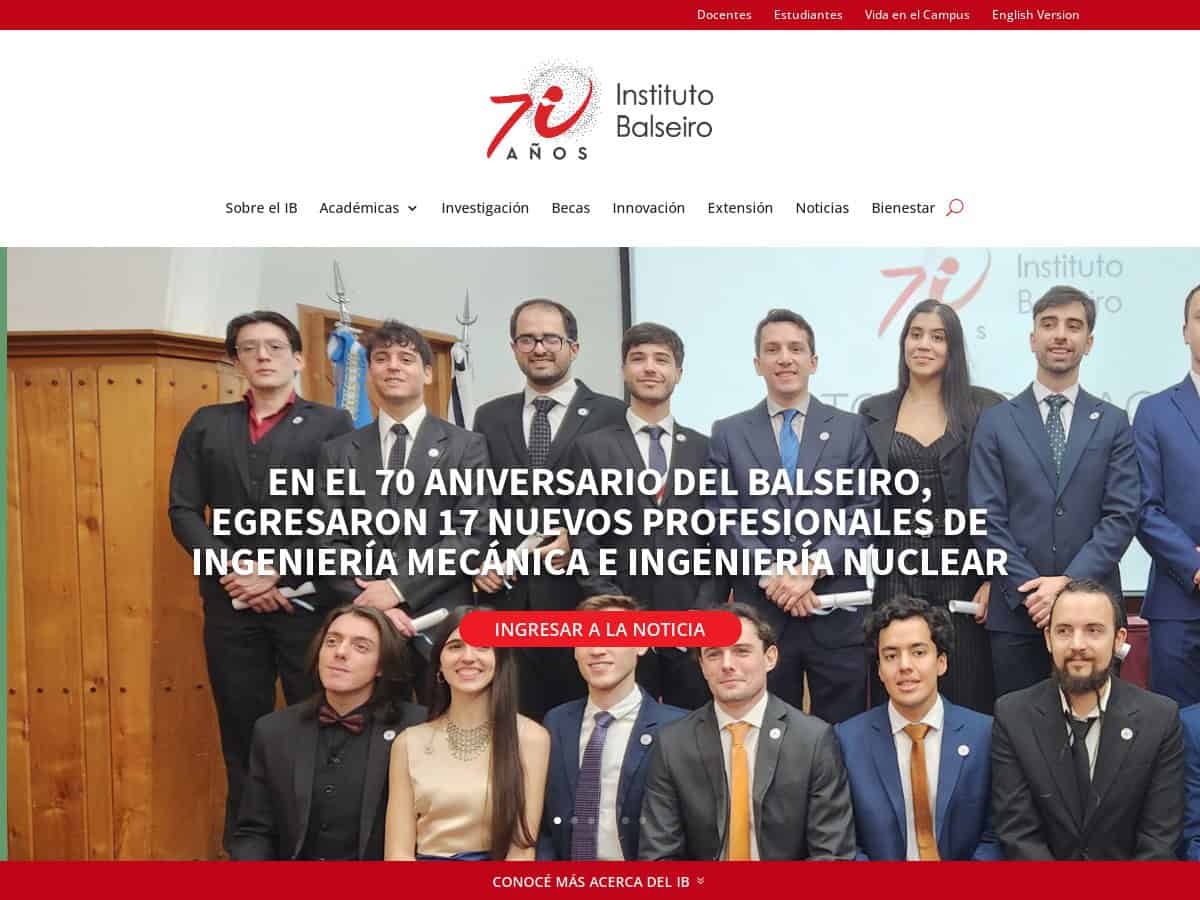
Founded in 1955, the Balseiro Institute is a prestigious academic institution co-managed by the National University of Cuyo (UNCUYO) and Argentina’s National Atomic Energy Commission (CNEA). It is located at the Bariloche Atomic Centre and is renowned for its excellence in physics and engineering.
The institute is tiny by any standard. Around 150 students share a staff of about 250, so nearly every undergraduate works beside an active researcher from the first semester. Teaching follows the rhythm of a research group: problem sets, laboratory sessions and seminars take the place of large lectures. The campus sits inside the Bariloche Atomic Centre, on the road that runs along Lake Nahuel Huapi.
Three degree lines carry most of the load: physics, nuclear engineering and mechanical engineering, with telecommunications engineering also available. Graduates move on to master’s and doctoral programmes in physics and engineering sciences, many of them abroad. The best-known alumnus is Juan Martín Maldacena, now at the Institute for Advanced Study in Princeton, whose 1997 work on the AdS/CFT correspondence is among the most cited papers in theoretical physics.
The setting explains the research profile. The atomic centre hosts groups in condensed matter, materials science, nuclear technology and statistical physics, and the local company INVAP, founded in Bariloche in 1976 with close ties to the centre, has built research reactors for clients such as Australia and Egypt. Collaborations with CERN and Fermilab give students access to large experiments they would otherwise only read about.
Admission is competitive and the cohorts are small. Admitted students receive full financial support, which is why the institute draws applicants from all over Argentina and from neighbouring countries; about one student in five comes from abroad. Courses are taught in Spanish, and the degrees are issued through the National University of Cuyo, which co-manages the institute with the National Atomic Energy Commission.
A few numbers help place the institute. It has graduated roughly 2,500 people since the 1950s, a modest total that has still supplied many of the country’s physicists and nuclear engineers. Many continue their careers in Europe and the United States, while others return to the Atomic Centre, INVAP or university groups elsewhere in Argentina, so the alumni network is small but unusually well placed.
Strong international collaborations with leading research centers and universities in physics and nuclear energy, such as Fermilab (USA) and CERN (Europe). Students and researchers participate in global projects.
Research:
It is one of Latin America’s foremost research centers in physics, materials science, and nuclear engineering. All students are deeply involved in the research activities of the Bariloche Atomic Centre from day one.
Famous Alumnis:
Juan Martín Maldacena, Francisco de la Cruz, Leo Falicov
International recognition**:
Number of staff***:
250
Current students***:
150
Foreign students***:
20%
Cumulative former students***:
2500
Pros
Extremely high academic level with a focus on research, full scholarships for all admitted students, low student-to-faculty ratio, access to world-class research facilities.
Cons
Highly selective and demanding admission process, very small student body, isolated location, narrow disciplinary focus.
Best For
Exceptionally gifted students seeking a world-class, research-intensive education in physics and nuclear engineering with full financial support.
For students who like the physics and engineering focus of this school but want another option nearby, National University of Buenos Aires fits well: it is far larger, with about 310,000 students against roughly 150 here, and runs the same bachelor's, master's and doctoral programmes.
National University of La Plata shares the core fields of this school, namely physics and engineering; it covers astroscience and computer vision as well, and is far larger, with about 115,000 students against roughly 150 here.
National University of Córdoba shares the core fields of this institution, namely physics and engineering; it is far larger, with about 136,000 students against roughly 150 here, and teaches at the same levels, namely bachelor's, master's and doctoral.
A good alternative in the same country is National Technological University, which likewise covers telecommunications, mechanical engineering and engineering; it covers industrial design and civil engineering as well, and is far larger, with about 90,000 students against roughly 150 here.
National University of Rosario sits close to this school on physics and engineering; it covers agriculture and bioengineering as well, and is far larger, with about 80,000 students against roughly 150 here.
Most Similar Schools Abroad
For a study option in Belgium with a comparable spread of physics, mechanical engineering and engineering, Von Karman Institute for Fluid Dynamics is the reference point: it is smaller, enrolling about 80 students against roughly 150 here, and also offers graduate certificate programmes.
For physics, mechanical engineering and materials outside the home country, Pohang University of Science and Technology in South Korea is a natural reference; it is far larger, with about 3,500 students against roughly 150 here, and runs the same bachelor's, master's and doctoral programmes.
Lund University offers an international parallel to this institution, with nanotechnologies, telecommunications and robotics as common ground; it teaches at the same levels, namely bachelor's, master's and doctoral, and covers industrial design and civil engineering as well.
Orona Ideo Innovation City in Spain shares the robotics, mechanical engineering and materials orientation of this institution, and it is far larger, with about 500 students against roughly 150 here, and teaches at the same levels, namely bachelor's, master's and doctoral.
If this school is on your list for physics, materials and engineering, City University of Hong Kong in Hong Kong deserves a comparison, because it covers finance and chemistry as well, and runs the same bachelor's, master's and doctoral programmes.
*our own picks (our criteria: a mix between domains, diploma delivered, reputation and size), but obviously too many criteria for an apple-to-apple ranking.
FAQ
Where is the Balseiro Institute located?
It sits inside the Bariloche Atomic Centre at Av. Bustillo 9500, San Carlos de Bariloche, in Río Negro province, in the Patagonian Andes.
Who runs the Balseiro Institute?
It is managed jointly by the National University of Cuyo and the National Atomic Energy Commission (CNEA), which also operates the Bariloche Atomic Centre.
What can you study there?
Undergraduate degrees in physics, nuclear engineering, mechanical engineering and telecommunications engineering, plus master's and doctoral programmes in physics and engineering sciences.
How many students does the institute have?
About 150 students are enrolled, a very small number compared with Argentine public universities, so groups are small and supervision is close.
Is there tuition to pay?
Admitted students receive full scholarships, which cover the cost of study. Applicants should confirm the current scholarship terms with the institute before applying.
Do international students attend Balseiro?
Yes. Roughly 20 percent of the students come from abroad, many of them from neighbouring Latin American countries.
In which language are courses taught?
Courses are taught in Spanish, although reading the physics and engineering literature in English is expected from the first year.
How competitive is admission?
Places are limited and selection is demanding. The institute organises its own selection process each year and publishes the steps and dates for applicants.
Which research areas are strongest?
Condensed matter and materials physics, nuclear engineering and technology, statistical physics, and applied work connected with research reactors and nuclear instrumentation.
Which well-known scientists studied at Balseiro?
Juan Martín Maldacena, a theoretical physicist at the Institute for Advanced Study, and Francisco de la Cruz, a condensed matter physicist, are among its alumni.
Engineering, Innovation, Materials Science, Mechanical Engineering, Nuclear Physics, Physics, Research and Development
*: without any judgment of the quality, readers are strongly encouraged to check the official status of the exact diploma envisioned as many universities have a mix of recognized diplomas, not recognized, “co-delivered,” “equivalent to”, “some pathways” (…), can change over time, and can be named differently from one country to another.
**: international reputation: is based on some criteria that do not mean much in some domains or specialties (number of researchers, of scientific publications, on budget ….). Our approximate 1-4 scale:
known locally
known locally and internationally
is listed in some of the world university’s classifications
is listed among the 20 firsts in some of world university’s classifications
***: estimated numbers, based on online sources and/or feedbacks. The numbers can vary greatly depending on school organisation (ex.: school is part of a group, it employs internal staff or external consultants or has public staff without employing them …). Refer to all the links provided to have accurate and updated numbers.
Innovation.world is not affiliated with this school/university. We recommend to contact them directly on their website for any special request.
To complete or correct any information here or share your opinion, please comment below or > send us a direct message <.