Qubes OS compared with Tails, VMware Workstation and Windows Sandbox| Qubes OS | Tails | VMware Workstation | Windows Sandbox |
|---|
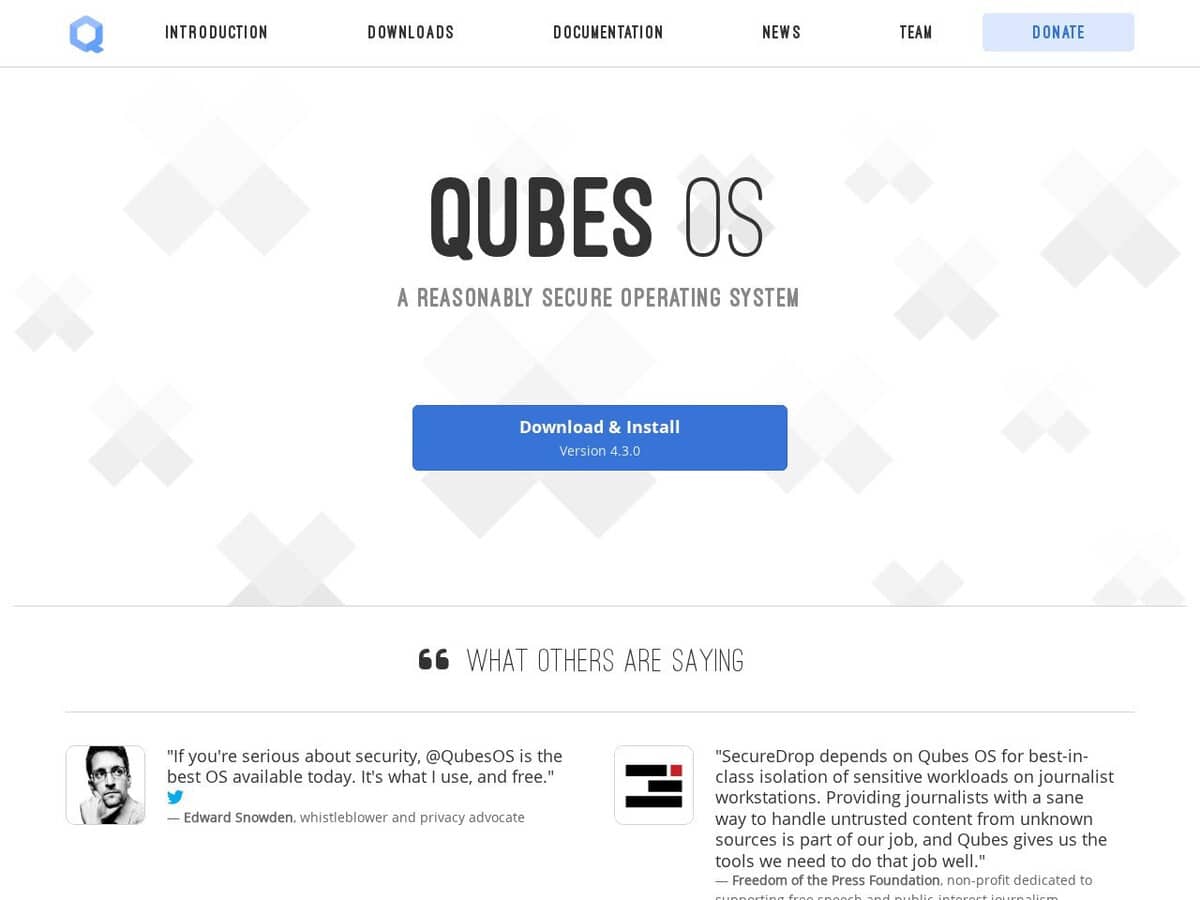
| Isolation model: Qubes OS uses the Xen hypervisor to split activities into separate virtual machines called qubes. Networking runs in an unprivileged net qube, and dom0, which controls the hardware, interacts with the qubes as little as possible. | Isolation model: Tails is a Debian-based live system started from a DVD or USB drive. It runs in RAM, forces all network connections through Tor, and overwrites most of the memory on shutdown. | Isolation model: Workstation is a hosted (type 2) hypervisor that runs several virtual machines on top of a Windows or Linux host operating system. | Isolation model: Windows Sandbox is a disposable virtual machine built into Windows. It uses hardware-based virtualization, and the Microsoft hypervisor runs a separate kernel that isolates it from the host. |
| Persistence and state: Templates provide an immutable root filesystem shared by several qubes. Disposable qubes are destroyed on shutdown after an application is run or a document is viewed. | Persistence and state: Nothing is written to the internal drive unless the user asks. An optional Persistent Storage, encrypted by default, can keep files, applications and settings. | Persistence and state: Snapshots save the state of a virtual machine at any moment, so it can later be restored to that point. | Persistence and state: Closing the sandbox deletes all software, files and state, and each launch is a fresh Windows installation. Since Windows 11 22H2, data survives restarts started from inside the sandbox. |
| Lizenz und Kosten: Qubes OS is free and open source, mainly under GPL v2, with some proprietary blobs. | Lizenz und Kosten: Tails is released under GNU GPLv3 and contains some non-free firmware blobs. | Lizenz und Kosten: Workstation Pro became free for all users in November 2024, including commercial use. Broadcom ended technical support, leaving documentation and a user forum. | Lizenz und Kosten: The feature requires Windows Pro, Enterprise, Pro Education/SE or Education. Windows Home is not supported. |
| Hardware and platform: The minimum is a 64-bit Intel or AMD processor with VT-x (EPT) or AMD-V (RVI), plus VT-d or AMD-Vi, 6 GB of RAM and 32 GB of disk. 16 GB, 128 GB and an Intel processor are recommended. Installing it inside a virtual machine is not recommended. | Hardware and platform: Tails supports x86-64 and has required a 64-bit processor since release 3.0 in 2017. | Hardware and platform: Workstation runs on x64 Windows and Linux hosts. Version 26H1 is fully 64-bit, and 32-bit host support ended with version 10.0.7. | Hardware and platform: Multiple instances cannot run at the same time. Networking is enabled by default and can be disabled in the configuration file to avoid exposing untrusted software to the internal network. |
| Guest systems: Official templates are based on Fedora and Debian. Community templates include Whonix, Ubuntu, Arch Linux, CentOS and Gentoo. | | Guest systems: Guests include Windows, Linux, BSD and MS-DOS. Windows 11 needs Workstation 16.2 or later. | Guest systems: Software installed on the host is not available inside the sandbox and must be installed there explicitly. |
| Release status: Qubes OS 4.3.1 is listed with a release date of June 11, 2026. | Release status: Release 7.12 is listed with a date of September 3, 2026. The Tails Project merged with The Tor Project, completed on September 26, 2024. | Release status: Version 26H1 was released on 14 May 2026. Workstation Player was discontinued in May 2024. | |