Product Design, Manufacturing & Innovation Resources
Heim » Grundlegende Definition von Druck

Grundlegende Definition von Druck

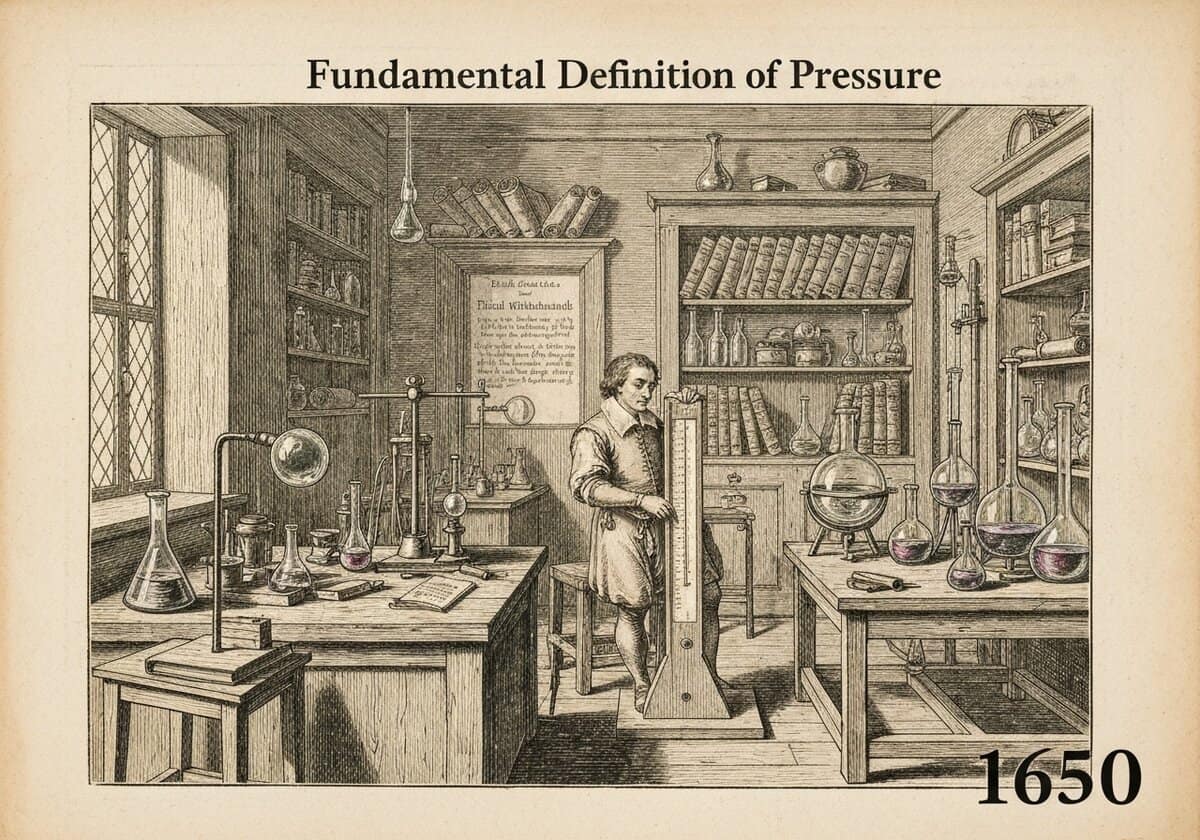
1650
Labor aus dem 17. Jahrhundert, das den Druck mit einem Manometer in der Strömungsmechanik misst.

(Abbildung dient nur zur Veranschaulichung)

Druck ist definiert als die senkrechte Kraft ([latex]F[/latex]), die auf die Oberfläche eines Objekts pro Flächeneinheit ([latex]A[/latex]) ausgeübt wird, über die diese Kraft verteilt ist. Die Formel lautet [latex]p = \frac{F}{A}[/latex]. Es handelt sich um eine skalare Größe, d. h. sie hat eine Größe, aber keine Richtung. Die SI-Einheit für Druck ist das Pascal (Pa), das einem newton pro Quadratmeter.


The concept of pressure evolved from early studies of mechanics and fluids. While earlier thinkers like Archimedes understood buoyancy, the formal quantification of pressure as force per unit area was crystallized during the 17th century through the work of scientists like Evangelista Torricelli and Blaise Pascal. Pressure is a fundamental concept in thermodynamics and fluid mechanics. It is an intensive property, meaning it does not depend on the size of the system. In a static fluid, pressure increases with depth due to the weight of the fluid above. This is the principle behind manometers and barometers. For gases, pressure is understood at a microscopic level as the average force from molecular collisions on the container walls. This kinetic theory of gases connects the macroscopic property of pressure to the microscopic behavior of atoms and molecules. The formula [latex]p = frac{F}{A}[/latex] is a macroscopic definition. For a force applied at an angle [latex]theta[/latex] to the surface normal, the formula becomes [latex]p = frac{F costheta}{A}[/latex]. In continuum mechanics, pressure is often represented as the isotropic part of the stress tensor, which describes the forces internal to a continuous material. This more advanced view allows for the analysis of pressure in solids and complex fluid flows where forces are not uniform or perpendicular. Understanding pressure is critical for designing everything from aircraft wings, which rely on pressure differentials for lift, to deep-sea submersibles built to withstand immense external pressure.

UNESCO Nomenclature: 2209
- Mechanik

Typ

Abstraktes System

Störung

Grundlegendes

Verwendung

Weitverbreitete Verwendung

Vorläufer

  • Archimedes’ Prinzip der Auftriebskraft
  • Galileo Galileis Arbeiten zur Mechanik und Schwerkraft
  • Evangelista Torricellis Erfindung des Barometers
  • Isaac Newtons Bewegungsgesetze

Anwendungen

  • Hydrauliksysteme
  • Wettervorhersage
  • Materialwissenschaftliche Prüfungen
  • medizinische Blutdruckmessung
  • Druckluftwerkzeuge

Patente:

NA

Potenzielle Innovationsideen

Aufgrund des hohen Datenverkehrs durch Web-Scraping-Bots, der derzeit mehr als 40.000 Anfragen pro Tag umfasst, ist dieser Inhalt ausschließlich Community-Mitgliedern vorbehalten.
> Anmelden < oder > Registrieren < (100% kostenlos) Zugriff darauf sowie auf alle anderen eingeschränkten Inhalte und Tools.

Verwandte Begriffe: Druck, Kraft, Fläche, Pascal, Skalar, Strömungsmechanik, Thermodynamik, SI-Einheit, Newton, Mechanik.

Historischer Kontext

Grundlegende Definition von Druck

1600
1650
1650
1678
1687
1687
1738
1750
1650
1650
1672
1687
1687
1738
1750

(wenn das Datum unbekannt oder nicht relevant ist, z. B. „Strömungsmechanik“, wird eine gerundete Schätzung seines bemerkenswerten Auftretens bereitgestellt)

Verwandte Erfindungen, Innovationen und technische Prinzipien

Bilder in voller Größe und Downloads sind nur für registrierte Mitglieder 100% kostenlos verfügbar.

> Login <