Product Design, Manufacturing & Innovation Resources
घर » दबाव की मूलभूत परिभाषा

दबाव की मूलभूत परिभाषा

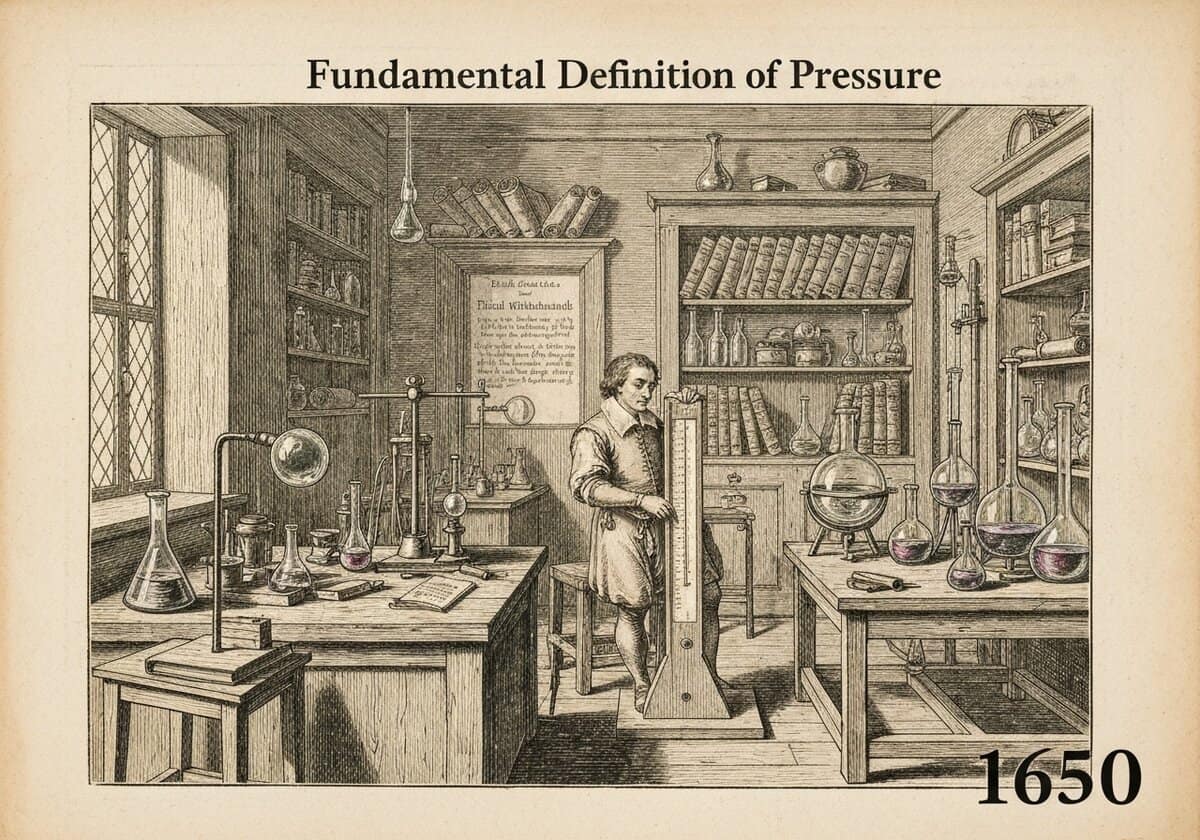
1650
द्रव यांत्रिकी में मैनोमीटर से दबाव मापने वाली 17वीं सदी की प्रयोगशाला।.

(यह छवि केवल उदाहरण के लिए बनाई गई है)

दाब को किसी वस्तु की सतह पर प्रति इकाई क्षेत्रफल (A) पर लगाए गए लंबवत बल (F) के रूप में परिभाषित किया जाता है, जिस पर वह बल वितरित होता है। इसका सूत्र है: π = F/A। यह एक अदिश राशि है, जिसका अर्थ है कि इसमें परिमाण तो होता है लेकिन दिशा नहीं होती। दाब की SI इकाई पास्कल (Pa) है, जो एक सेंटीमीटर (A) के बराबर होती है। न्यूटन प्रति वर्ग मीटर।


The concept of pressure evolved from early studies of mechanics and fluids. While earlier thinkers like Archimedes understood buoyancy, the formal quantification of pressure as force per unit area was crystallized during the 17th century through the work of scientists like Evangelista Torricelli and Blaise Pascal. Pressure is a fundamental concept in thermodynamics and fluid mechanics. It is an intensive property, meaning it does not depend on the size of the system. In a static fluid, pressure increases with depth due to the weight of the fluid above. This is the principle behind manometers and barometers. For gases, pressure is understood at a microscopic level as the average force from molecular collisions on the container walls. This kinetic theory of gases connects the macroscopic property of pressure to the microscopic behavior of atoms and molecules. The formula [latex]p = frac{F}{A}[/latex] is a macroscopic definition. For a force applied at an angle [latex]theta[/latex] to the surface normal, the formula becomes [latex]p = frac{F costheta}{A}[/latex]. In continuum mechanics, pressure is often represented as the isotropic part of the stress tensor, which describes the forces internal to a continuous material. This more advanced view allows for the analysis of pressure in solids and complex fluid flows where forces are not uniform or perpendicular. Understanding pressure is critical for designing everything from aircraft wings, which rely on pressure differentials for lift, to deep-sea submersibles built to withstand immense external pressure.

UNESCO Nomenclature: 2209
– मैकेनिक्स

Type

सार प्रणाली

व्यवधान

मूलभूत

उपयोग

व्यापक उपयोग

शगुन

  • आर्किमिडीज का उत्प्लावन सिद्धांत
  • यांत्रिकी और गुरुत्वाकर्षण पर गैलीलियो गैलीली का कार्य
  • इवेंजेलिस्टा टोरिसेली द्वारा बैरोमीटर का आविष्कार
  • आइजैक न्यूटन के गति के नियम

आवेदन

  • hydraulic systems
  • मौसम पूर्वानुमान
  • material science testing
  • medical blood pressure measurement
  • pneumatic tools

पेटेंट:

NA

संभावित नवाचार विचार

बॉट ट्रैफिक को कम करने के कारण, जो वर्तमान में प्रति दिन 40,000 से अधिक है, यह सामग्री केवल समुदाय के सदस्यों के लिए आरक्षित है।
> लॉगिन < या > रजिस्टर < इस सामग्री और अन्य सभी प्रतिबंधित सामग्रियों और उपकरणों तक पहुंच (100% निःशुल्क) है।

संबंधित विषय: दाब, बल, क्षेत्रफल, पास्कल, अदिश राशि, द्रव यांत्रिकी, ऊष्मागतिकी, एसआई इकाई, न्यूटन, यांत्रिकी।

ऐतिहासिक संदर्भ

दबाव की मूलभूत परिभाषा

1600
1650
1650
1678
1687
1687
1738
1750
1650
1650
1672
1687
1687
1738
1750

(यदि तिथि अज्ञात है या प्रासंगिक नहीं है, उदाहरण के लिए "द्रव यांत्रिकी", तो इसके उल्लेखनीय उद्भव का एक अनुमानित आंकड़ा प्रदान किया गया है)

संबंधित आविष्कार, नवाचार और तकनीकी सिद्धांत

पंजीकृत सदस्यों के लिए पूर्ण आकार की छवियाँ और डाउनलोड 100% निःशुल्क उपलब्ध हैं।