Product Design, Manufacturing & Innovation Resources
Heim » CIE-Weißgradindex (W_CIE)

CIE-Weißgradindex (W_CIE)

1986
  • International Commission on Illumination (CIE)
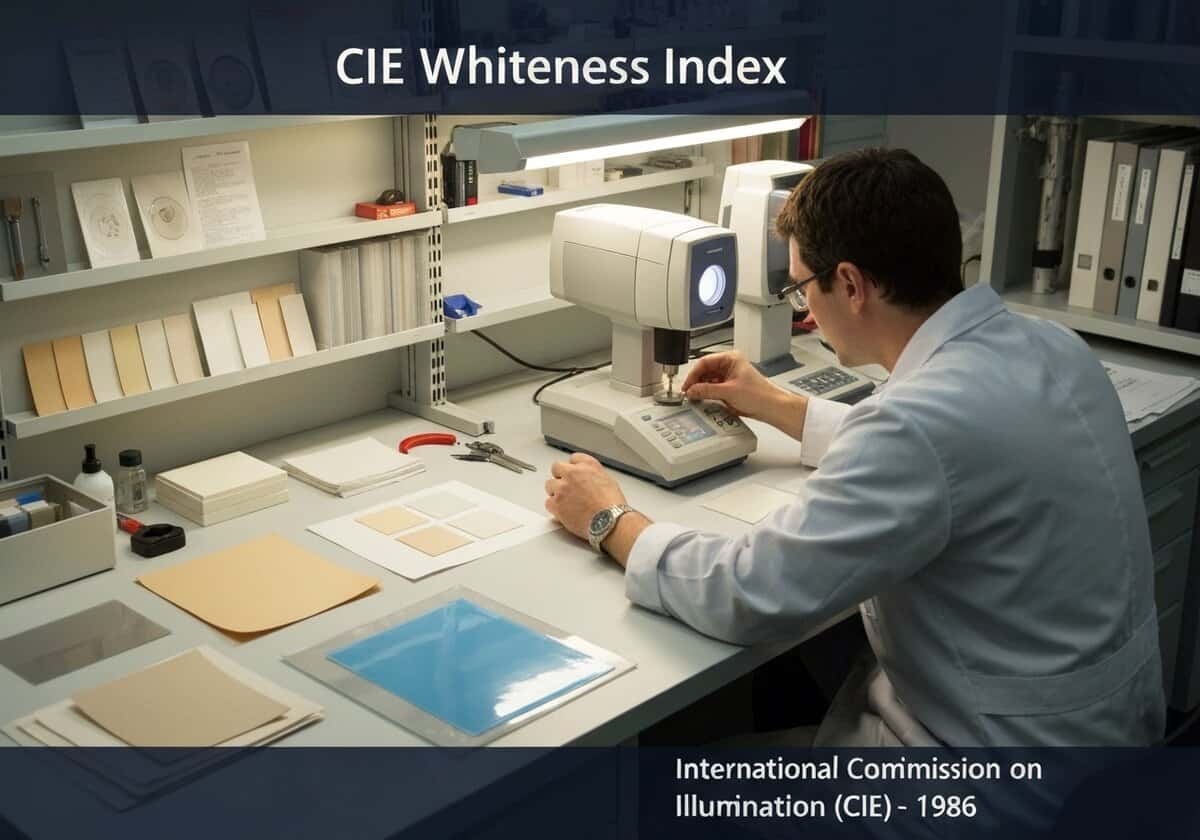
Labortechniker misst den CIE-Weißgradindex mit einem Spektralphotometer in der Optik.

(Abbildung dient nur zur Veranschaulichung)

Der CIE-Weißgradindex ist eine von der Internationalen Beleuchtungskommission (CIE) standardisierte Formel zur Quantifizierung der Weißwahrnehmung. Er wird aus den CIE-Farbwerten (X, Y, Z) und den Farbkoordinaten (x, y) der Probe und einer Referenzlichtart berechnet. Die Grundformel lautet: [latex]W_{CIE} = Y + 800(x_n × x) + 1700(y_n × y)[/latex].

The CIE Whiteness Index (W_CIE or W10 for the D65/10° observer) provides a single numerical value to represent how ‘white’ a material appears to a standard human observer under a specific illuminant. The formula, [latex]W_{CIE} = Y + 800(x_n – x) + 1700(y_n – y)[/latex], is based on the idea that whiteness is a combination of high lightness (represented by the tristimulus value Y) and a specific chromaticity, typically a slightly bluish hue. In the formula, (x, y) are the chromaticity coordinates of the sample, and (x_n, y_n) are those of the perfect diffuser under the same illuminant. The coefficients 800 and 1700 were empirically determined to correlate with visual assessments of whiteness. The formula is valid for a specific range of chromaticities close to the neutral point. A companion value, the Tint Index (T_W or T10), is often calculated as [latex]T_{W,10} = 1000(x_n – x) – 650(y_n – y)[/latex] to quantify the reddish or greenish deviation from a pure white. A positive T_W indicates a greenish tint, while a negative value indicates a reddish tint. The CIE standard specifies conditions for its use, including the illuminant (typically D65) and observer (2° or 10°). This index is crucial for industries where consistent appearance is vital, ensuring that products like paper, textiles, and plastics meet specific whiteness standards regardless of where they are manufactured or viewed.

UNESCO Nomenclature: 2209
- Optik

Typ

Abstraktes System

Störung

Wesentliche

Verwendung

Weitverbreitete Verwendung

Vorläufer

  • CIE 1931 XYZ-Farbraum
  • Entwicklung der Spektrophotometrie
  • Gunter Wyszeckis Forschung zu Farbdifferenzformeln
  • Frühe Weißheitsformeln von Judd, MacAdam und anderen

Anwendungen

  • Qualitätskontrolle bei der Papierherstellung
  • Textilindustrie für die Bewertung von Bleichmitteln und Farbstoffen
  • Kunststoff- und Beschichtungsformulierung
  • Farben- und Pigmentproduktion
  • Farbanpassung von Dentalmaterialien

Patente:

NA

Potenzielle Innovationsideen

Aufgrund des hohen Datenverkehrs durch Web-Scraping-Bots, der derzeit mehr als 40.000 Anfragen pro Tag umfasst, ist dieser Inhalt ausschließlich Community-Mitgliedern vorbehalten.
> Anmelden < oder > Registrieren < (100% kostenlos) Zugriff darauf sowie auf alle anderen eingeschränkten Inhalte und Tools.

Verwandte Themen: Weißgradindex, CIE, Farbmessung, Farbreizwerte, Farbart, D65-Normlichtart, Papierindustrie, Textilqualität, Farbwissenschaft, Erscheinungsbildmessung.

Historischer Kontext

CIE-Weißgradindex (W_CIE)

1980
1984
1985
1986
1990
1994
1997
1980
1980
1984
1986
1986
1991
1995
2000

(wenn das Datum unbekannt oder nicht relevant ist, z. B. „Strömungsmechanik“, wird eine gerundete Schätzung seines bemerkenswerten Auftretens bereitgestellt)

Verwandte Erfindungen, Innovationen und technische Prinzipien

Bilder in voller Größe und Downloads sind nur für registrierte Mitglieder 100% kostenlos verfügbar.

> Login <