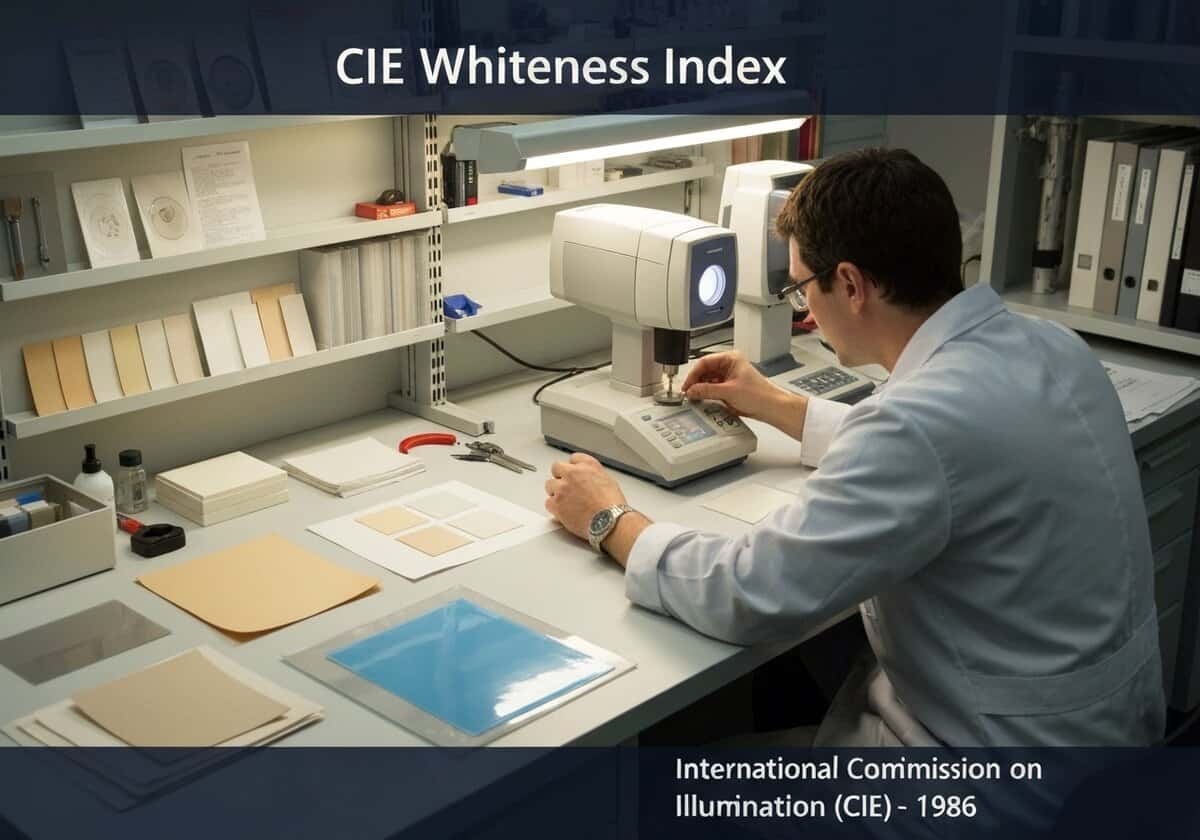
The CIE Whiteness Index (W_CIE or W10 for the D65/10° observer) provides a single numerical value to represent how ‘white’ a material appears to a standard human observer under a specific illuminant. The formula, [latex]W_{CIE} = Y + 800(x_n – x) + 1700(y_n – y)[/latex], is based on the idea that whiteness is a combination of high lightness (represented by the tristimulus value Y) and a specific chromaticity, typically a slightly bluish hue. In the formula, (x, y) are the chromaticity coordinates of the sample, and (x_n, y_n) are those of the perfect diffuser under the same illuminant. The coefficients 800 and 1700 were empirically determined to correlate with visual assessments of whiteness. The formula is valid for a specific range of chromaticities close to the neutral point. A companion value, the Tint Index (T_W or T10), is often calculated as [latex]T_{W,10} = 1000(x_n – x) – 650(y_n – y)[/latex] to quantify the reddish or greenish deviation from a pure white. A positive T_W indicates a greenish tint, while a negative value indicates a reddish tint. The CIE standard specifies conditions for its use, including the illuminant (typically D65) and observer (2° or 10°). This index is crucial for industries where consistent appearance is vital, ensuring that products like paper, textiles, and plastics meet specific whiteness standards regardless of where they are manufactured or viewed.