Product Design, Manufacturing & Innovation Resources
بيت » القانون الثالث للديناميكا الحرارية

القانون الثالث للديناميكا الحرارية

1910
  • Walther Nernst
  • Max Planck
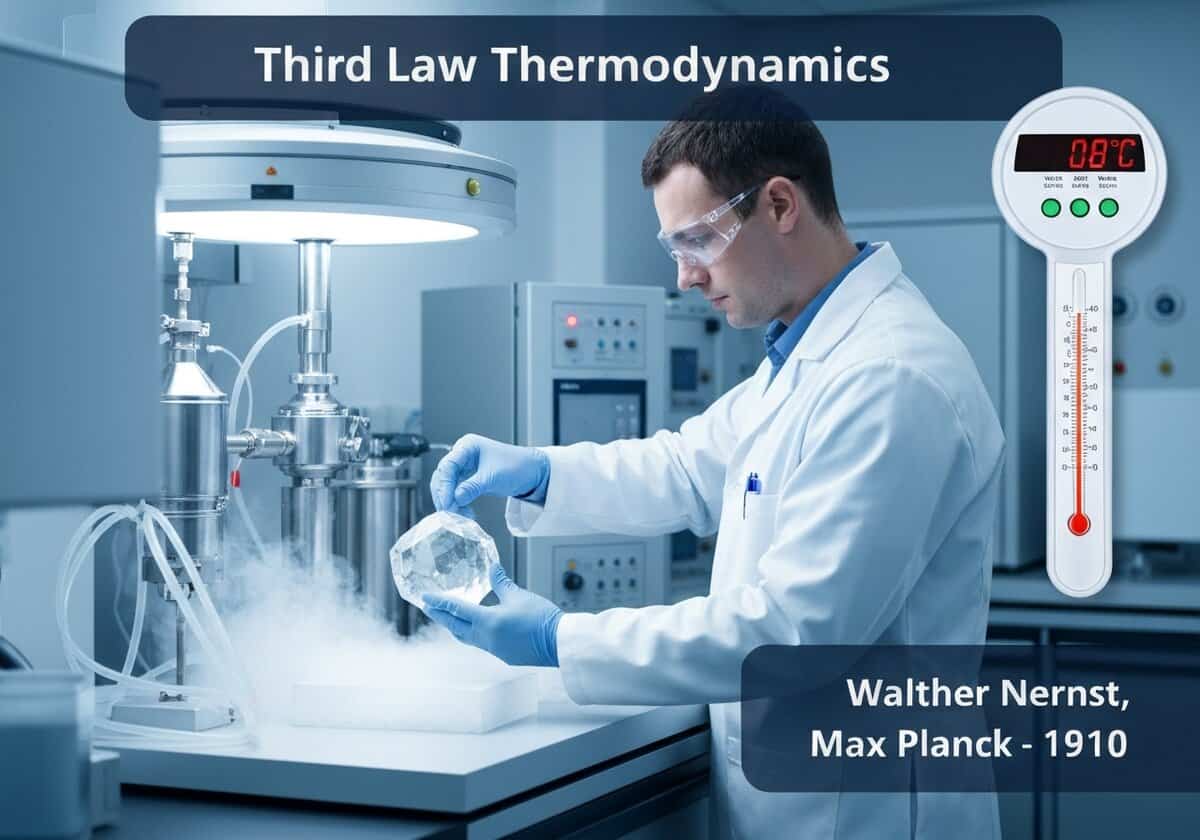
مشهد مختبري يوضح القانون الثالث للديناميكا الحرارية في مجال التبريد.

(صورة تم إنشاؤها للتوضيح فقط)

ينص القانون الثالث على أن إنتروبية البلورة المثالية تقترب من قيمة صغرى ثابتة عندما تقترب درجة حرارتها من الصفر المطلق ([latex]0[/latex] كلفن). وتُعرَّف هذه القيمة الدنيا بأنها صفر. والنتيجة الرئيسية هي عدم إمكانية الوصول إلى الصفر المطلق في عدد محدود من الخطوات. يوفر هذا القانون نقطة مرجعية أساسية لتحديد الإنتروبي المطلق لمادة ما.
The Third Law originated from Walther Nernst’s work on chemical reactions at low temperatures, formulated as the Nernst Heat Theorem in 1906. He observed that the change in entropy for chemical reactions approaches zero as the temperature approaches absolute zero. Max Planck later extended this to state that the entropy of each individual perfect crystalline substance is itself zero at absolute zero. This provides an absolute, rather than relative, scale for entropy.

The law’s novelty lies in its connection between thermodynamics and the quantum-mechanical nature of matter. At absolute zero, a system is in its ground state, which for a perfect crystal is a unique, non-degenerate state, corresponding to zero entropy ([latex]S = k_B \ln(1) = 0[/latex]). Amorphous materials like glass, however, have residual entropy at absolute zero due to their disordered structure. The law also implies that as [latex]T \rightarrow 0[/latex], specific heats ([latex]C_p[/latex], [latex]C_v[/latex]) and the coefficient of thermal expansion also approach zero. The unattainability principle arises because each step in a cooling process removes a smaller and smaller amount of entropy, requiring an infinite number of steps to reach zero entropy.

UNESCO Nomenclature: 2212
- الديناميكا الحرارية والفيزياء الإحصائية والمادة المكثفة

يكتب

النظام التجريدي

الاضطراب

كبير

الاستخدام

الاستخدام الواسع النطاق

السلائف

  • formulation of the Second Law and the concept of entropy
  • experimental advances in liquefying gases (oxygen, nitrogen, hydrogen) and reaching low temperatures
  • development of statistical mechanics by Ludwig Boltzmann and J. Willard Gibbs
  • the emergence of quantum theory from Max Planck’s work on black-body radiation

التطبيقات

  • cryogenics and low-temperature physics
  • calculating chemical affinities and reaction equilibrium constants
  • materials science for understanding crystal structures, defects, and residual entropy
  • research into superconductivity and superfluidity, phenomena that occur near absolute zero
  • determination of absolute entropy values for chemical substances

براءات الاختراع:

NA

أفكار ابتكارات محتملة

بسبب عمليات جمع البيانات من خلال برامج الروبوت، والتي تتجاوز حاليًا 40 ألفًا يوميًا، فإن هذا المحتوى مخصص لأعضاء المجتمع فقط.
> تسجيل الدخول < أو > سجل < (مجاني 100٪) للوصول إلى هذا، وكذلك جميع المحتويات والأدوات الأخرى المقيدة.

Related to: third law, absolute zero, entropy, perfect crystal, Nernst heat theorem, unattainability principle, cryogenics, ground state, quantum mechanics, zero-point energy.

السياق التاريخي

القانون الثالث للديناميكا الحرارية

1902
1907
1909
1910
1911-04-08
1913
1915
1902
1904
1907
1909
1910
1912
1915
1915-11

(إذا كان التاريخ غير معروف أو غير ذي صلة، على سبيل المثال "ميكانيكا الموائع"، يتم توفير تقدير تقريبي لظهوره الملحوظ)

الاختراع والابتكار والمبادئ التقنية ذات الصلة

الصور بالحجم الكامل والتنزيلات متاحة فقط 100% مجاناً للأعضاء المسجلين.