Product Design, Manufacturing & Innovation Resources
بيت » توزيع بولتزمان

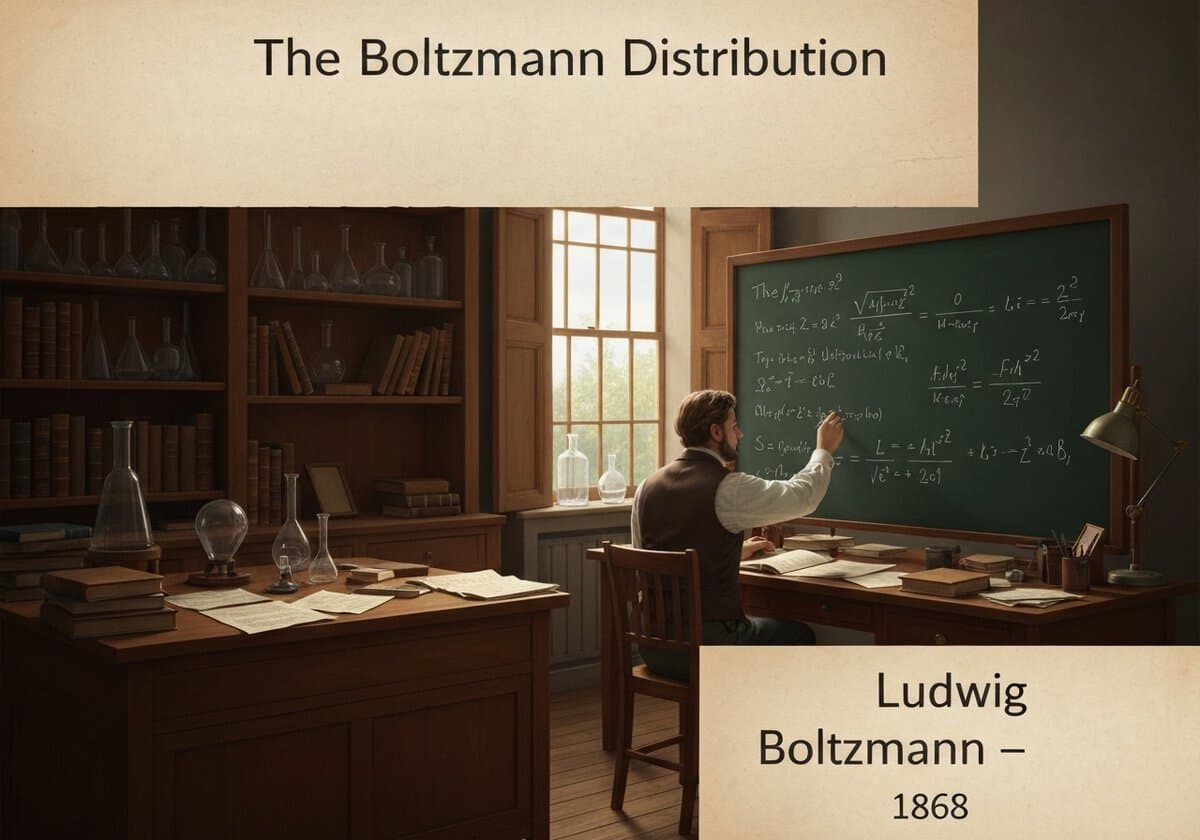
توزيع بولتزمان

1868
  • Ludwig Boltzmann
Physicist analyzing Boltzmann Distribution equations in a vintage laboratory setting.

(صورة توضيحية فقط)

The Boltzmann distribution describes the probability that a system in thermal equilibrium at temperature T will be in a specific microstate with energy E. This probability is proportional to the Boltzmann factor, [latex]e^{-E / k_B T}[/latex]. It implies that states with lower energy are exponentially more likely to be occupied than states with higher energy, with temperature modulating this preference.

The Boltzmann distribution is a cornerstone of statistical mechanics and is arguably its most useful result for practical applications. It can be derived by considering a small system in thermal contact with a large heat reservoir. The combined system (system + reservoir) is isolated, and by applying Boltzmann’s entropy principle ([latex]S = k_B \ln W[/latex]) to the reservoir, one can find the most probable energy distribution for the small system. The result is that the probability of the system being in state ‘i’ with energy [latex]E_i[/latex] is [latex]P_i \propto e^{-E_i/k_B T}[/latex].

The term [latex]k_B T[/latex] represents the characteristic thermal energy available at temperature T. The ratio [latex]E/k_B T[/latex] is dimensionless and determines the probability. If a state’s energy E is much less than the thermal energy ([latex]E \ll k_B T[/latex]), the exponential factor is close to 1, and the state is highly probable. If the energy is much greater than the thermal energy ([latex]E \gg k_B T[/latex]), the factor is very small, and the state is very unlikely to be occupied. This exponential dependence is responsible for many phenomena, such as the rapid increase in chemical reaction rates with temperature, as more molecules possess the necessary activation energy.

UNESCO Nomenclature: 2211
– Thermodynamics

يكتب

نظام مجرد

خلل

Revolutionary

الاستخدام

استخدام واسع النطاق

مقدمات

  • James Clerk Maxwell’s distribution of molecular speeds in a gas (a specific case of the Boltzmann distribution)
  • النظرية الحركية للغازات، التي ربطت درجة الحرارة بمتوسط ​​الطاقة الحركية
  • Rudolf Clausius’s work on heat and the second law of thermodynamics
  • تطور نظرية الاحتمالات

التطبيقات

  • فيزياء أشباه الموصلات لتحديد كثافة حاملات الشحنة
  • علم الغلاف الجوي لنمذجة تغير الضغط مع الارتفاع (الصيغة البارومترية)
  • الحركية الكيميائية لاعتماد معدلات التفاعل على درجة الحرارة (معادلة أرينيوس)
  • التحليل الطيفي for understanding the doppler broadening of spectral lines

براءات الاختراع:

NA

أفكار ابتكارية محتملة

  • خوارزميات تحسين الذكاء الاصطناعي مثل محاكاة التلدين التي تستخدم توزيع بولتزمان للهروب من الحدود الدنيا المحلية
  • تطوير مواد حرارية كهربائية جديدة من خلال هندسة حالات طاقة الإلكترون لتحسين توزيع بولتزمان
  • تقنيات التبريد بالليزر التي تتلاعب بحالات الطاقة الذرية لتحقيق درجات حرارة منخفضة للغاية
  • أجهزة استشعار متقدمة تكتشف المواد الكيميائية النزرة عن طريق قياس التحولات في توزيع بولتزمان للحالات الدورانية الجزيئية
  • نماذج التعلم الآلي للتنبؤ ببنية البروتين التي تستخدم متوسطًا مرجحًا ببولتزمان للتكوينات المحتملة
  • أنظمة توليد المفاتيح التشفيرية القائمة على الخصائص الإحصائية للضوضاء الحرارية، والتي تتبع توزيع بولتزمان
  • النماذج المالية التي تستخدم عامل بولتزمان لوصف تفضيل الوكيل للأصول منخفضة المخاطر (منخفضة الطاقة)
  • الشبكة العصبية architectures with activation functions inspired by the boltzmann distribution for probabilistic inference
Related to: Boltzmann distribution, Boltzmann factor, thermal equilibrium, probability distribution, energy states, statistical mechanics, temperature, canonical ensemble.

السياق التاريخي

توزيع بولتزمان

1859
1861
1865
1868
1870
1873
1877
1859
1860
1861
1865
1869
1871
1876
1877

(إذا كان التاريخ غير معروف أو غير ذي صلة، على سبيل المثال "ميكانيكا الموائع"، يتم توفير تقدير تقريبي لظهوره الملحوظ)

أحدث الإضافات

أهم المنشورات والمقالات

أفضل الأدوات الأصلية

السنة العاشرة عيد

الصور والتنزيلات بالحجم الكامل متاحة فقط، ومجانية تمامًا، للأعضاء المسجلين.