Product Design, Manufacturing & Innovation Resources
بيت » المجال الكهرومغناطيسي مقابل فرق الجهد

المجال الكهرومغناطيسي مقابل فرق الجهد

1870
  • James Clerk Maxwell
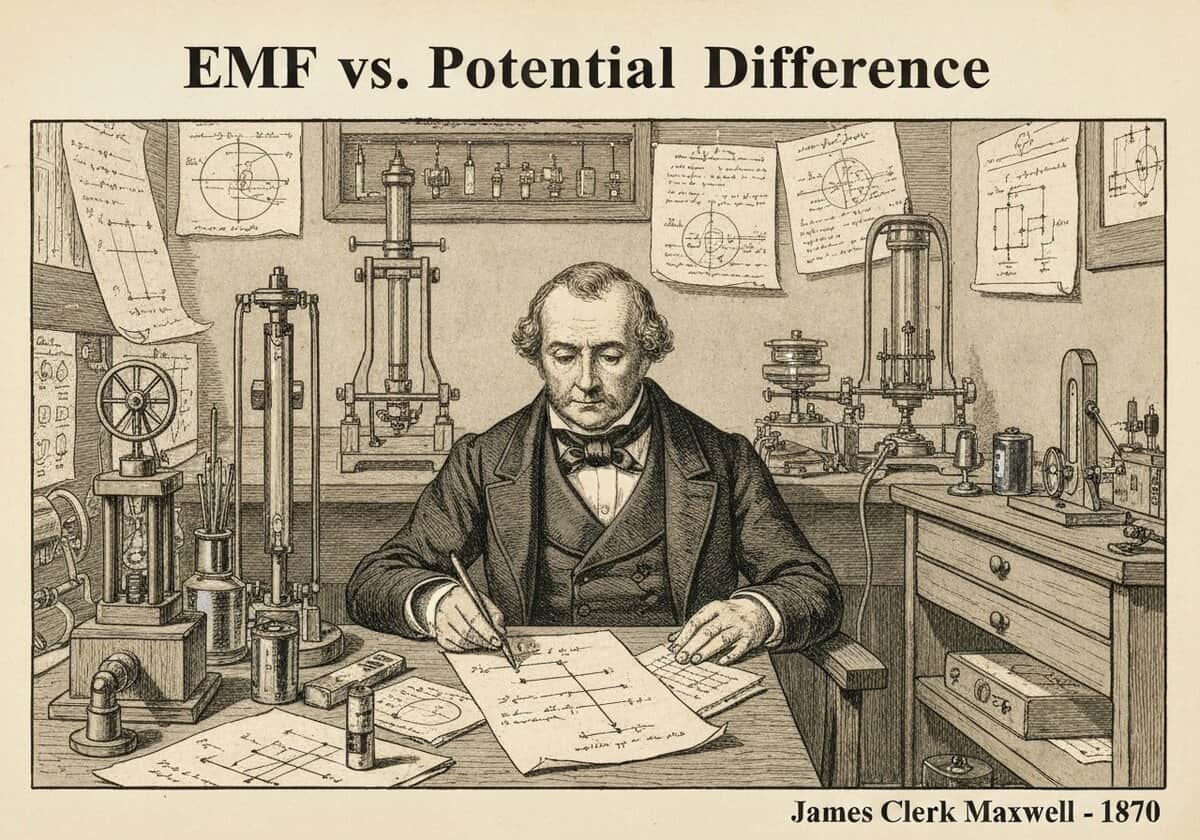
Historical laboratory scene with James Clerk Maxwell studying electromotive force and electric potential difference.

(صورة توضيحية فقط)

Electromotive force (EMF) and electric potential difference (voltage) are distinct concepts, though both are measured in volts. EMF is the work per unit charge done by a non-conservative force (e.g., chemical reaction, changing magnetic field) to move charge within a source. Potential difference is the work per unit charge done by the conservative electrostatic field between two points.
The core difference between EMF and potential difference lies in the nature of the underlying fields. The electrostatic field ([latex]\mathbf{E}_{c}[/latex]), created by static charges, is conservative. This means the work it does on a charge moving around any closed loop is zero: [latex]\oint \mathbf{E}_{c} \cdot d\mathbf{l} = 0[/latex]. The potential difference, or voltage, between two points is the line integral of this conservative field, [latex]V = -\int \mathbf{E}_{c} \cdot d\mathbf{l}[/latex]. In contrast, an EMF source generates a non-conservative field or “impressed field” ([latex]\mathbf{E}_{nc}[/latex]). This field does non-zero work on a charge around a closed loop: [latex]\mathcal{E} = \oint \mathbf{E}_{nc} \cdot d\mathbf{l} \neq 0[/latex].

In a simple DC circuit with a battery, the battery provides the EMF. Inside the battery, the non-conservative chemical forces move positive charges from the negative to the positive terminal, against the opposing conservative electrostatic field. This “uphill” journey is where the EMF does its work. Outside the battery, in the external circuit, the charges move “downhill” from the positive to the negative terminal, driven by the conservative electrostatic field. The potential drop across the external resistor is equal to the EMF minus the potential drop across the battery’s internal resistance. Thus, EMF is the cause of the sustained current, while potential difference is the measure of energy dissipated per unit charge in a part of the circuit.

UNESCO Nomenclature: 2205
– Electricity and Magnetism

يكتب

نظام مجرد

خلل

أساسيات

الاستخدام

استخدام واسع النطاق

مقدمات

  • Alessandro Volta’s work on electric potential
  • Georg Ohm’s law relating voltage, current, and resistance
  • Gustav Kirchhoff’s circuit laws
  • James Clerk Maxwell’s field equations

التطبيقات

  • circuit analysis (kirchhoff’s voltage law)
  • تصميم البطارية وتوصيفها
  • فهم المولدات والمحركات
  • تحليل الأجهزة الحرارية الكهربائية

براءات الاختراع:

NA

أفكار ابتكارية محتملة

  • المواد الطوبولوجية التي تولد EMF من تأثيرات هول الكمومية
  • الأجهزة الإلكترونية الدورانية التي تولد قوى دورانية بدون حركة شحن
  • الدوائر القائمة على الميمرستور والتي تظهر قوة كهربائية مغناطيسية تعتمد على التاريخ
  • أنظمة إدارة البطاريات المتقدمة التي تميز بين القوة الدافعة الكهربائية الحقيقية والجهد الطرفي لتقدير حالة الشحن بدقة
  • المواد الخارقة المصممة لإنشاء مجالات كهربائية غير محافظة موضعية من الموجات الخارجية
  • الأجهزة التي تستغل تأثير كازيمير لتوليد فرق الجهد
  • أنظمة الطاقة الحرارية الضوئية ذات المجالات غير المحافظة المصممة خصيصًا لتحقيق كفاءة أعلى
  • التحويل المباشر للطاقة من تقلبات الفراغ (مفاهيمي)
Related to: emf, potential difference, voltage, conservative field, non-conservative field, electrostatic field, kirchhoff’s laws, circuit theory.

السياق التاريخي

المجال الكهرومغناطيسي مقابل فرق الجهد

1861
1865
1868
1870
1873
1877
1880
1860
1861
1865
1869
1871
1876
1877
1880

(إذا كان التاريخ غير معروف أو غير ذي صلة، على سبيل المثال "ميكانيكا الموائع"، يتم توفير تقدير تقريبي لظهوره الملحوظ)

أحدث الإضافات

أهم المنشورات والمقالات

أفضل الأدوات الأصلية

السنة العاشرة عيد

الصور والتنزيلات بالحجم الكامل متاحة فقط، ومجانية تمامًا، للأعضاء المسجلين.