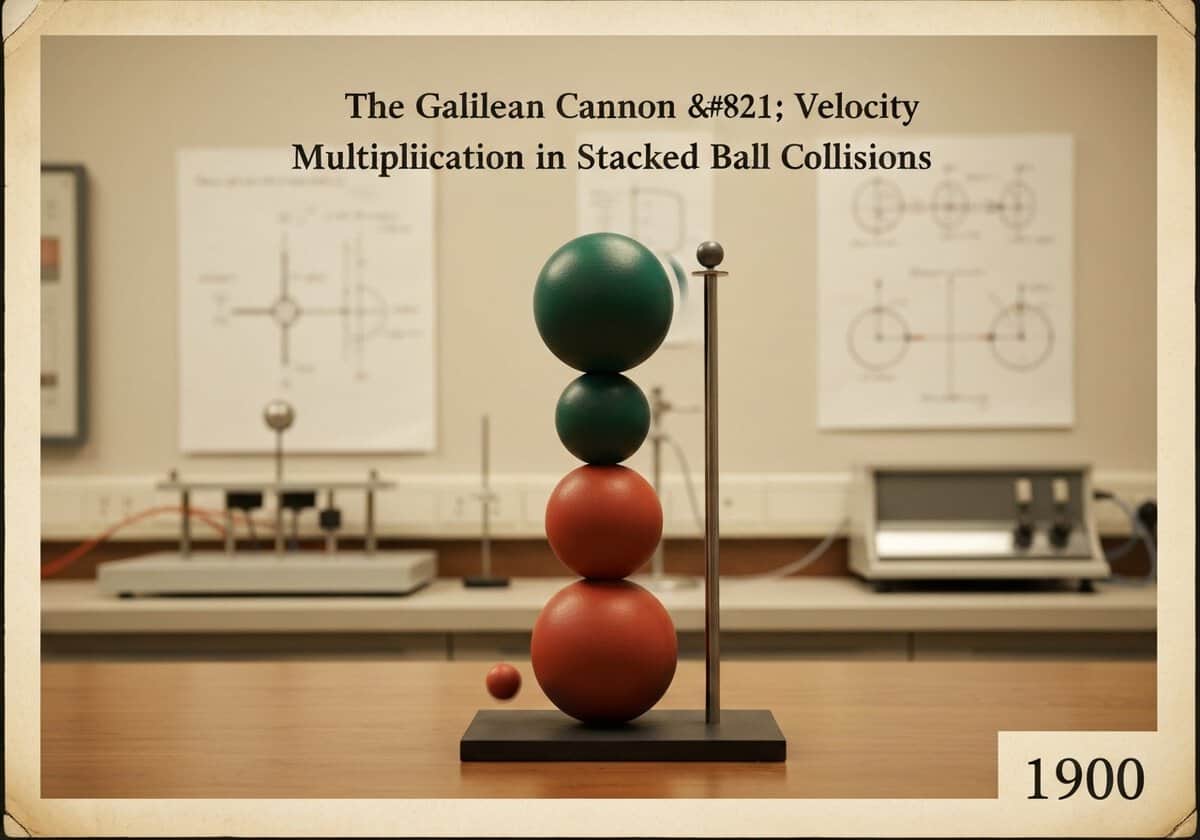
The Galilean cannon demonstrates velocity multiplication through sequential, one-dimensional elastic collisions. When a stack of balls with decreasing mass is dropped, the bottom ball rebounds and collides with the one above. In an idealized case where a large mass [latex]m_1[/latex] rebounds at velocity [latex]v[/latex] and hits a much smaller mass [latex]m_2[/latex] moving down at [latex]v[/latex], the smaller mass is propelled upwards at nearly [latex]3v[/latex].
The core principle of the Galilean cannon relies on the conservation of linear momentum and kinetic energy in perfectly elastic collisions. Consider two balls, a large one of mass [latex]m_1[/latex] and a small one of mass [latex]m_2[/latex]. The entire stack falls under gravity, reaching a velocity [latex]-v[/latex] just before impact. The bottom ball, [latex]m_1[/latex], strikes the ground and perfectly rebounds with velocity [latex]+v[/latex]. It immediately collides with ball [latex]m_2[/latex], which is still moving downwards at [latex]-v[/latex].
From the perspective of an observer on ball [latex]m_1[/latex], ball [latex]m_2[/latex] is approaching at a relative velocity of [latex](-v) – (+v) = -2v[/latex]. In a perfectly elastic collision, the relative velocity of separation is equal to the negative of the relative velocity of approach. Therefore, after the collision, ball [latex]m_2[/latex] will be moving away from [latex]m_1[/latex] with a relative velocity of [latex]+2v[/latex].
To find the final velocity of [latex]m_2[/latex] in the lab frame, [latex]v_2′[/latex], we add this relative separation velocity to the final velocity of [latex]m_1[/latex], [latex]v_1′[/latex]. The formula for the final velocities in a 1D elastic collision gives [latex]v_2′ = \frac{v(3m_1 – m_2)}{m_1 + m_2}[/latex]. In the limiting case where [latex]m_1 >>>> m_2[/latex], the mass of [latex]m_1[/latex] is so large that its velocity is barely affected by the collision, so [latex]v_1′ \approx v[/latex]. The final velocity of [latex]m_2[/latex] is then [latex]v_2′ \approx v_1′ + 2v \approx v + 2v = 3v[/latex]. This tripling of velocity for the second ball is the fundamental amplification effect. If more balls are stacked, this effect cascades, leading to even higher velocities for the topmost ball.
جهاز Astroblaster® كانت لعبةً متوفرةً تجاريًا تُجسّد مبدأ المدفع الغاليلي: تتكون من أربع كراتٍ متناقصة الحجم والكتلة، مُثبّتة معًا على عمودٍ مركزي، مما يضمن أن تكون الاصطدامات أحادية البعد. عند سقوطها، ترتد الكرة الصغيرة العلوية إلى ارتفاعٍ يُعادل أضعاف ارتفاع السقوط الأصلي، مُوضّحةً بوضوحٍ انتقالَ الطاقة الحركية وتركيزها.
Related to: Galilean cannon, elastic collision, conservation of momentum,
conservation of energy، مضاعفة السرعة، الميكانيكا الكلاسيكية، الكرات المتراصة، ديناميكيات التصادم، الدفع، الطاقة الحركية، Astroblaster®.