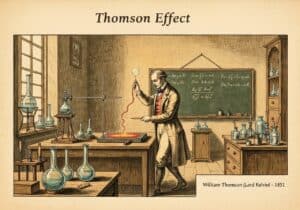
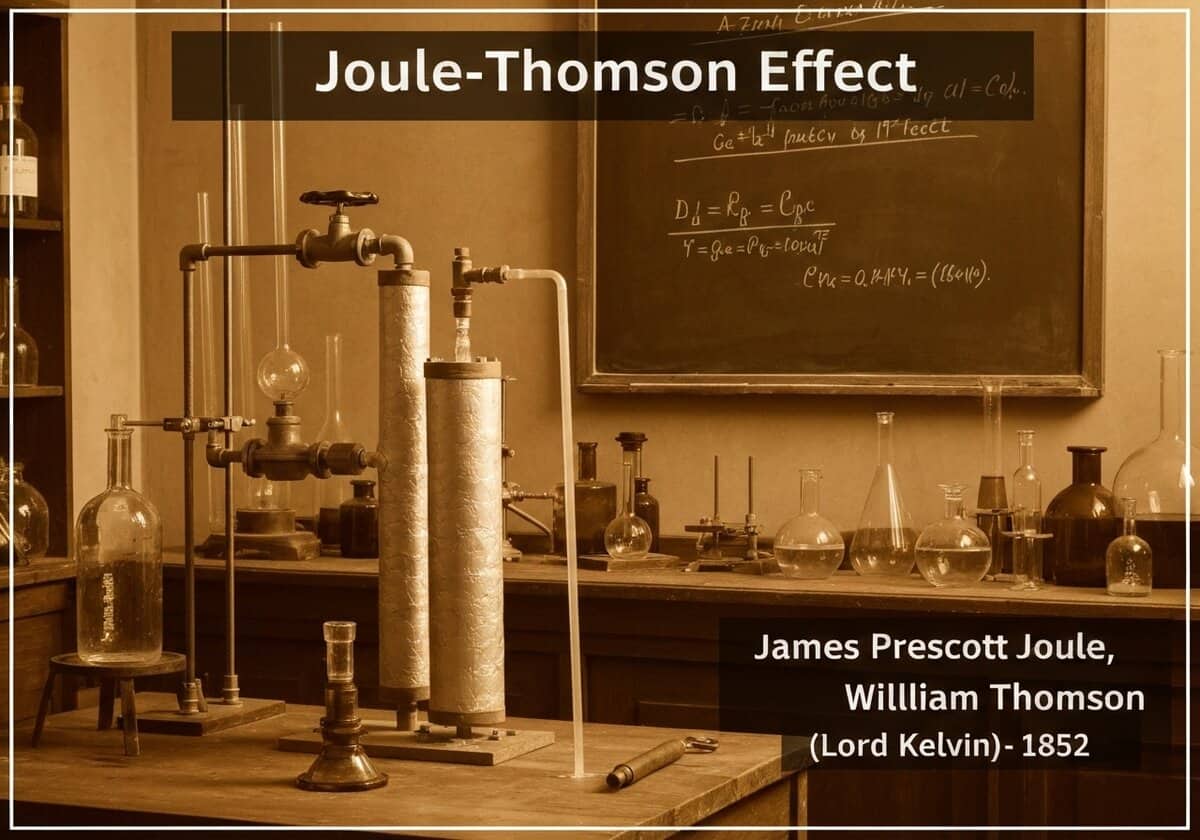
The effect arises from the work done against intermolecular forces (van der Waals forces) as the gas expands. For an ideal gas, where intermolecular forces are negligible, the Joule-Thomson coefficient [latex]\mu_{JT} = (\frac{\partial T}{\partial P})_H[/latex] is zero, meaning no temperature change occurs. However, for real gases, these forces are significant. When a gas expands, the average distance between molecules increases. If attractive forces dominate (as they do at lower temperatures), the molecules must do work to overcome these forces, converting internal kinetic energy into potential energy, which results in a temperature decrease. Conversely, at high temperatures, repulsive forces can dominate, and expansion can lead to an increase in temperature. The temperature at which the effect switches from cooling to heating is the inversion temperature. This discovery was crucial for liquefying ‘permanent’ gases like oxygen and nitrogen, which have very low inversion temperatures, requiring pre-cooling before throttling could be effective.