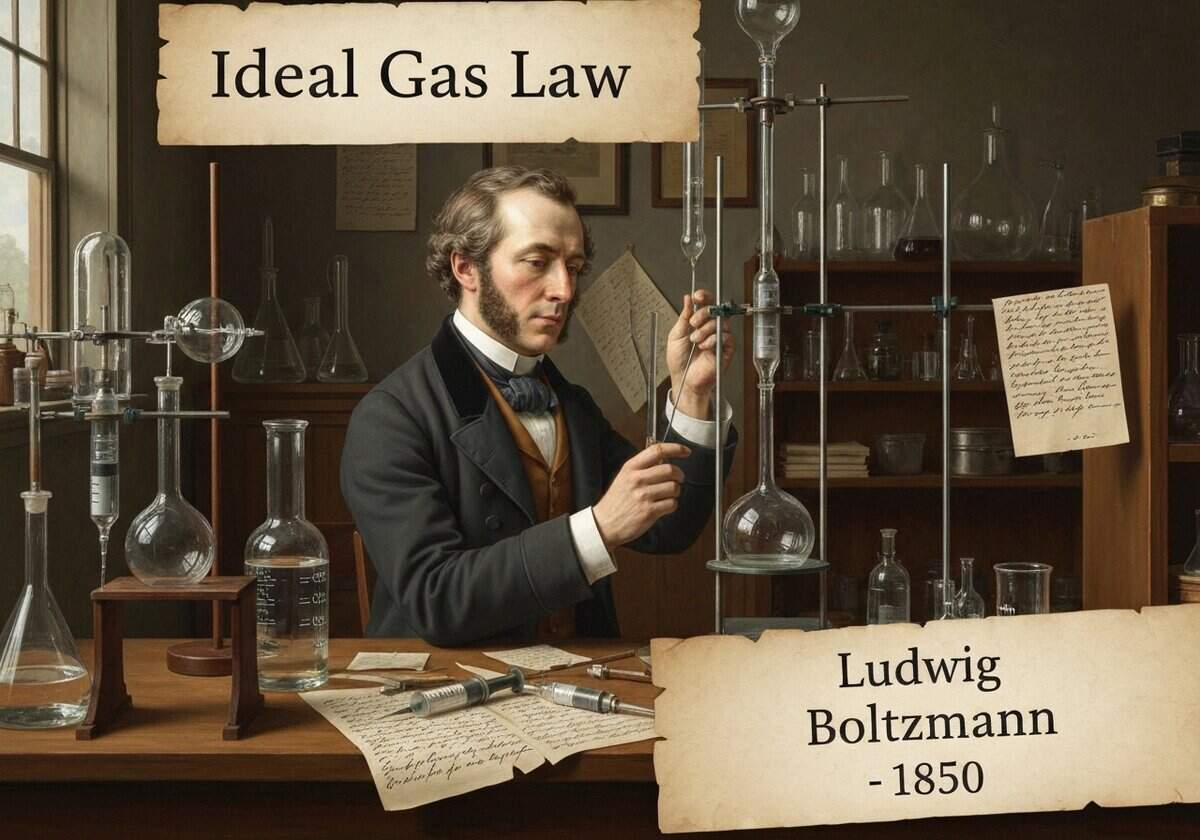
统计学 力学 配方 理想气体定律 expresses the relationship in terms of the microscopic properties of the gas. It relates 压力 通过玻尔兹曼常数 (k_B),将 ([latex]P[/latex]) 和体积 ([latex]V[/latex]) 与粒子总数 ([latex]N[/latex]) 和绝对温度 ([latex]T[/latex]) 联系起来:[latex]PV = Nk_BT[/latex]。
(图片仅供参考)
统计学 力学 配方 理想气体定律 expresses the relationship in terms of the microscopic properties of the gas. It relates 压力 通过玻尔兹曼常数 (k_B),将 ([latex]P[/latex]) 和体积 ([latex]V[/latex]) 与粒子总数 ([latex]N[/latex]) 和绝对温度 ([latex]T[/latex]) 联系起来:[latex]PV = Nk_BT[/latex]。

理想气体定律的摩尔形式(PV = nRT)便于化学和宏观热力学的研究,而统计形式(PV = Nk_BT)则直接与原子和分子的微观世界联系起来。在该方程中,N 是气体中粒子(原子或分子)的总数,k_BT 是玻尔兹曼常数,它是物理学中以路德维希·玻尔兹曼命名的基本常数。玻尔兹曼常数连接着宏观能量尺度(与温度 T 相关)和单个粒子的微观能量尺度。其值约为 1.38 × 10⁻²³ J/K。
This form of the law arises directly from the principles of statistical mechanics and the kinetic theory of gases. It highlights that the macroscopic pressure of a gas is a direct consequence of the collective motion of its constituent particles. The two forms of the ideal gas law are equivalent, connected by the relationship between the universal gas constant ([latex]R[/latex]), the Boltzmann constant ([latex]k_B[/latex]), and Avogadro’s number ([latex]N_A[/latex]), which is the number of particles per mole: [latex]R = N_A k_B[/latex]. The statistical form is preferred in fields like condensed matter physics, plasma physics, and astrophysics, where it is more natural to consider the number of individual particles rather than the number of moles.
理想气体定律(统计形式)
(如果日期未知或不相关,例如“流体力学”,则提供其显著出现的近似估计)
只有注册会员才能免费获得 100% 的全尺寸图片和下载。.
> 登录 <