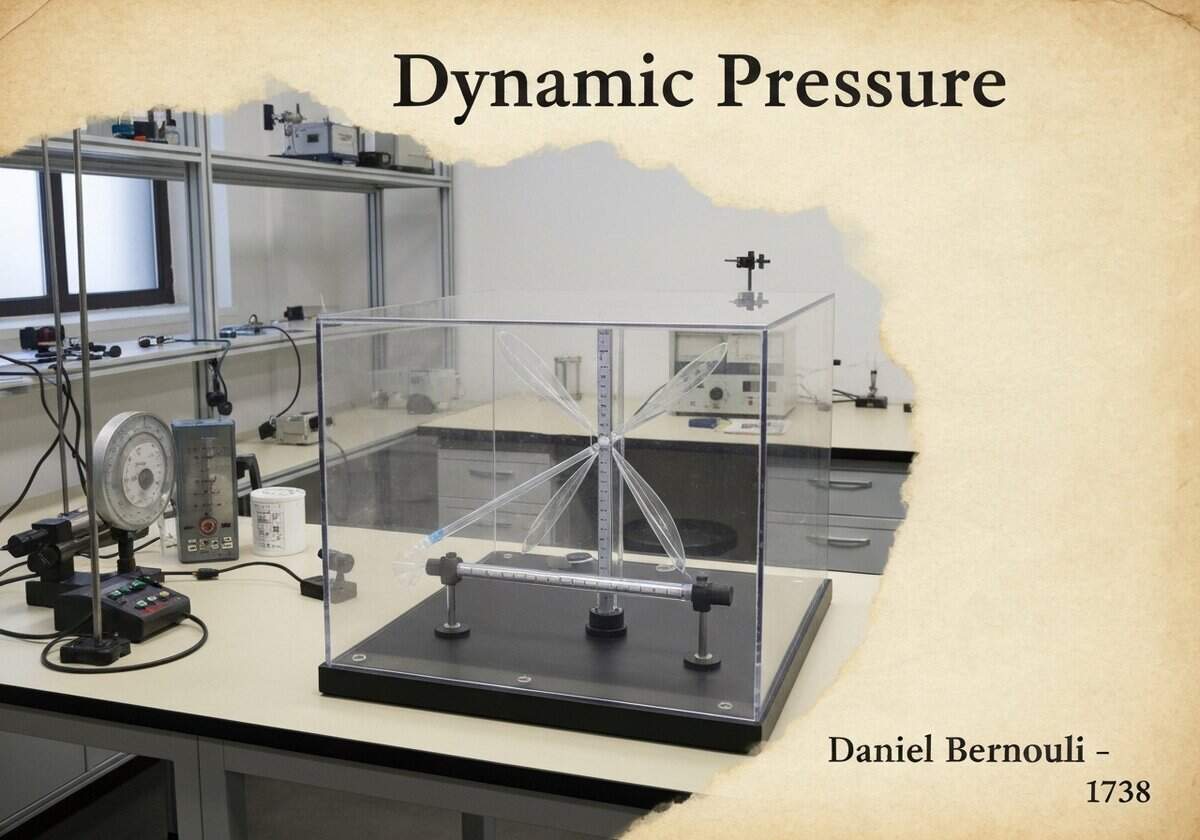
The concept of dynamic pressure originates from the 能量守恒 for a moving fluid. It represents the portion of the fluid’s total energy associated with its bulk motion. The formula [latex]q = \frac{1}{2} \rho u^2[/latex] can be derived by considering the kinetic energy ([latex]E_k = \frac{1}{2} m u^2[/latex]) of a small parcel of fluid with mass [latex]m[/latex] and volume [latex]V[/latex]. Since density [latex]\rho[/latex] is mass per unit volume ([latex]\rho = m/V[/latex]), the kinetic energy per unit volume is [latex]E_k/V = (\frac{1}{2} m u^2)/V = \frac{1}{2} (m/V) u^2 = \frac{1}{2} \rho u^2[/latex]. This result shows that dynamic pressure is not a pressure in the conventional sense of a normal force per unit area exerted by molecular collisions (which is static pressure). Instead, it is a scalar quantity with units of pressure (Pascals in SI units) that conveniently represents the kinetic energy density of the flow. This distinction is crucial; dynamic pressure cannot be measured directly by a standard pressure gauge oriented parallel to the flow. It can only be measured by bringing the fluid to a stop isentropically, converting its kinetic energy into a measurable pressure increase.