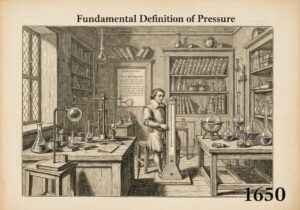
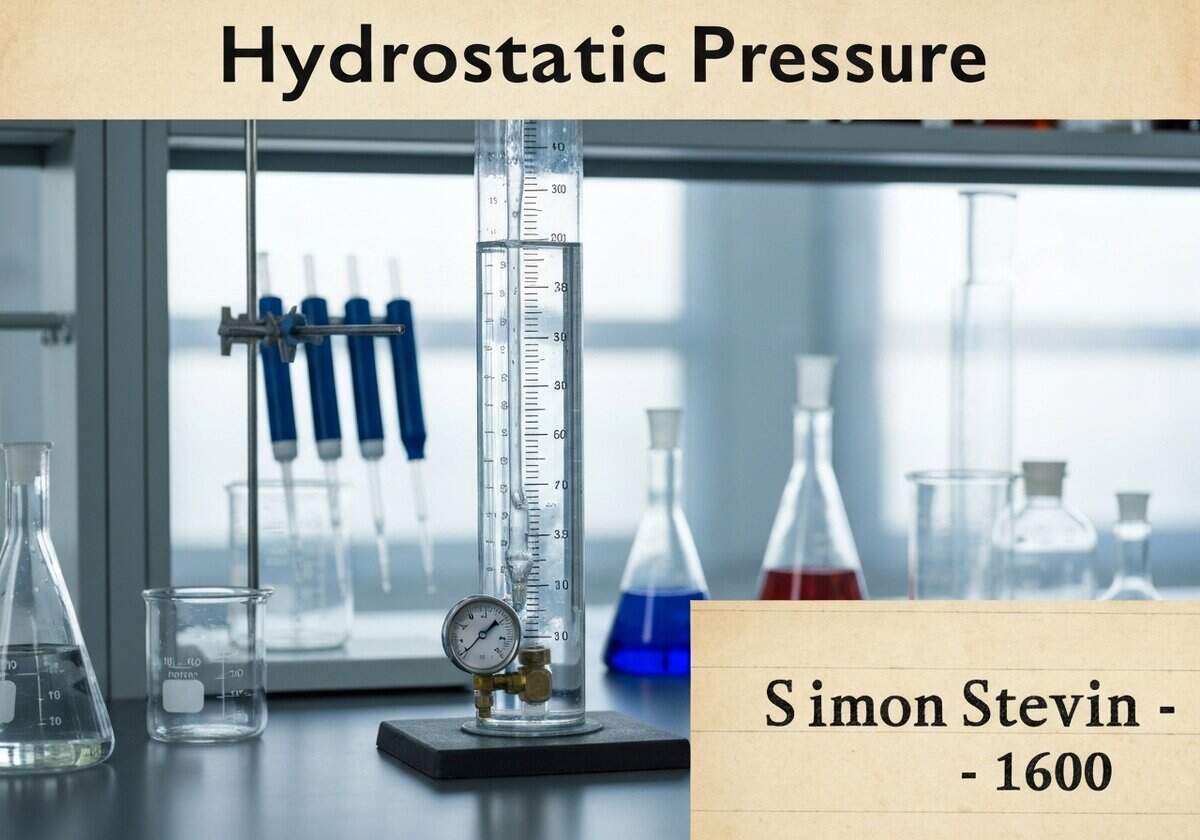
水静水压 压力 压力是指流体在平衡状态下,由于重力作用,在流体内部某一点所受到的压力。它随着深度的增加而增大,这是因为流体的重量从上方施加向下的压力也随之增大。压力的公式为 p = ρgh,其中 ρ 为流体密度。
The principles of hydrostatic pressure were explored by Simon Stevin in the late 16th century, who demonstrated the hydrostatic paradox—that the pressure at the bottom of a container depends only on the height of the fluid, not the shape of the container or the total weight of the fluid. This concept was a significant advance from Archimedes’ earlier work on buoyancy. The formula [latex]p = \rho g h[/latex] quantifies this relationship, where [latex]p[/latex] is the hydrostatic pressure (gauge pressure, not including atmospheric pressure at the surface), [latex]\rho[/latex] is the fluid density, [latex]g[/latex] is the acceleration due to gravity, and [latex]h[/latex] is the height of the fluid column above the point of measurement. This linear relationship means that for every 10 meters of depth in water, the pressure increases by approximately one atmosphere. This has profound implications for deep-sea exploration, where submersibles must be engineered to withstand crushing forces. The same principle governs atmospheric pressure, although the calculation is more complex because air is a compressible gas, and its density ([latex]\rho[/latex]) is not constant with altitude. Hydrostatic equilibrium is a key concept in 天体物理学, describing the balance between gravity pulling inward and a pressure gradient pushing outward that keeps stars and planets stable.