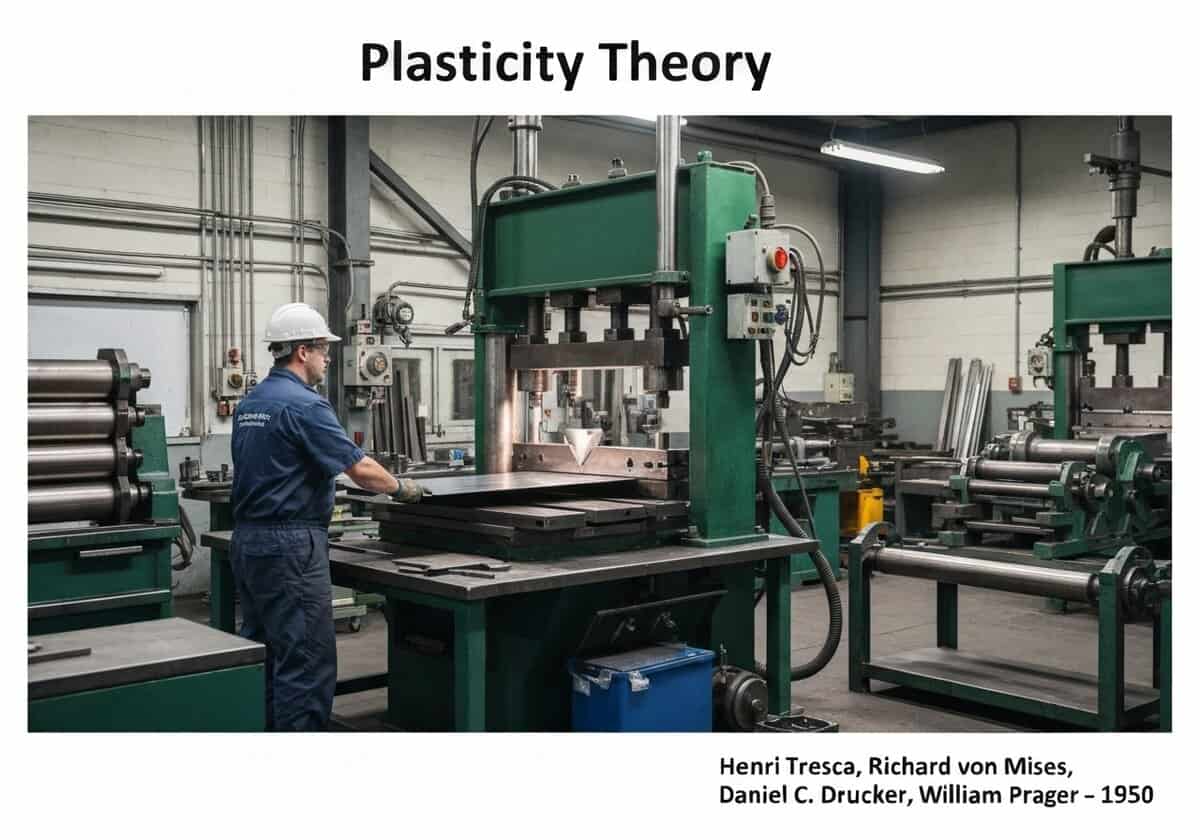
Finally, a hardening rule describes how the yield surface changes as plastic deformation accumulates. Isotropic hardening assumes the yield surface expands uniformly in all directions, meaning the material’s yield strength increases equally regardless of the loading direction. Kinematic hardening, on the other hand, assumes the yield surface translates in stress space without changing its size, which is useful for modeling the Bauschinger effect observed in cyclic loading. More complex models combine both isotropic and kinematic hardening to accurately capture real material behavior under complex loading paths. These three components—yield criterion, flow rule, and hardening rule—form the core of classical plasticity theory.