Product Design, Manufacturing & Innovation Resources
家 » PN结光伏原理

PN结光伏原理

1940
  • Russell Ohl
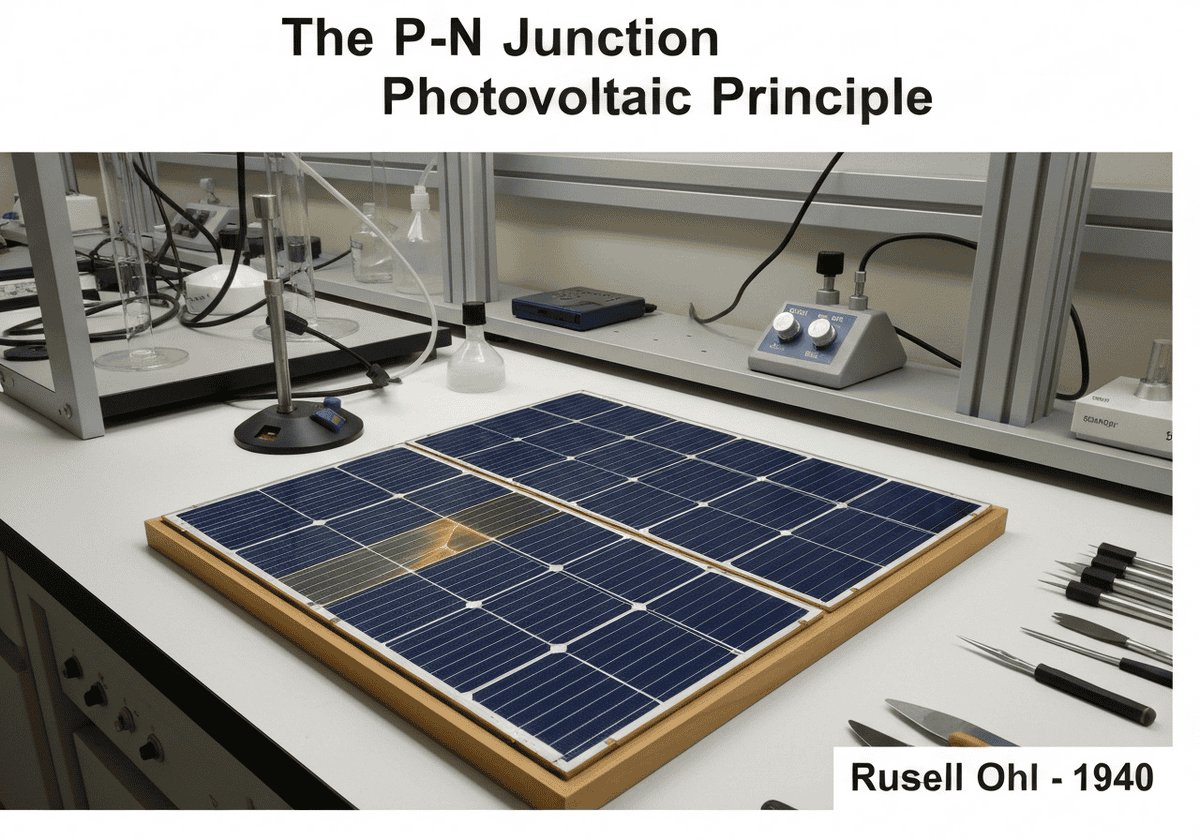
P-N junction in a solar cell demonstrating semiconductor physics.

(图片仅供参考)

A solar cell’s core is a p-n junction, an interface between p-type and n-type 半导体 materials. This junction creates a built-in electric field in a depletion region. When photons with sufficient energy strike the semiconductor, they create electron-hole pairs. The electric field separates these charge carriers, driving electrons to the n-side and holes to the p-side, generating a voltage.

pn结是大多数太阳能电池的基本组成部分。它由空穴(正电荷载流子)过剩的p型半导体与电子(负电荷载流子)过剩的n型半导体连接而成。这通常是通过在单个半导体晶体(例如硅)的两侧掺杂不同的杂质来实现的。

At the interface, electrons from the n-side diffuse into the p-side, and holes from the p-side diffuse into the n-side. This diffusion process doesn’t continue indefinitely. As electrons and holes cross the junction, they recombine, leaving behind ionized donor atoms on the n-side and ionized acceptor atoms on the p-side. This creates a region depleted of free charge carriers, known as the depletion region or space charge region. The fixed, ionized atoms in this region establish a strong, static electric field pointing from the n-side to the p-side.

This built-in electric field is crucial for the photovoltaic effect. When a photon with energy greater than the semiconductor’s bandgap energy ([latex]E_g[/latex]) is absorbed, it excites an electron from the valence band to the conduction band, creating an electron-hole pair. If this pair is generated within the depletion region or close enough to diffuse into it, the electric field acts on them. The field sweeps the electron towards the n-side and the hole towards the p-side. This separation of charge prevents immediate recombination and creates an accumulation of positive charge on the p-side and negative charge on the n-side. This charge separation across the device results in a photovoltage, which can drive a current through an external circuit, thus converting light energy into electrical energy.

UNESCO Nomenclature: 2210
– Physics

类型

Physical Device

中断

Revolutionary

用法

广泛使用

前体

  • 海因里希·赫兹发现光电效应(1887年)
  • einstein’s explanation of the photoelectric effect (1905)
  • 半导体物理和掺杂技术的发展
  • 发现金属-半导体接触处的整流(1874年)

应用程序

  • 光伏太阳能电池板
  • 光电二极管
  • 发光二极管(LED)
  • 半导体晶体管

专利:

  • US2402662A

潜在创新理念

  • 用于窗式太阳能电池的透明pn结
  • flexible p-n junctions woven into textiles for wearable power
  • 用于为医疗植入物供电的生物集成pn结
  • 针对特定窄带光源(如激光器)优化的 pn 结
  • 利用pn结将声波转化为电能的声光电器件
  • 使用聚合物基半导体的自修复pn结
  • p-n junctions designed for underwater energy harvesting from bioluminescence
  • 使用金刚石半导体的抗辐射pn结,用于深空任务
Related to: p-n junction, photovoltaic effect, semiconductor, depletion region, electron-hole pair, charge separation, built-in field, solar cell.

历史背景

PN结光伏原理

1932
1933
1937
1940
1947
1950
1950
1931
1932
1936-01-01
1938
1940
1950
1950
1950

(如果日期未知或不相关,例如“流体力学”,则提供其显著出现的近似估计)

第十年 周年纪念日

只有注册会员才能免费获取完整尺寸的图片和下载内容。

> 登录 <