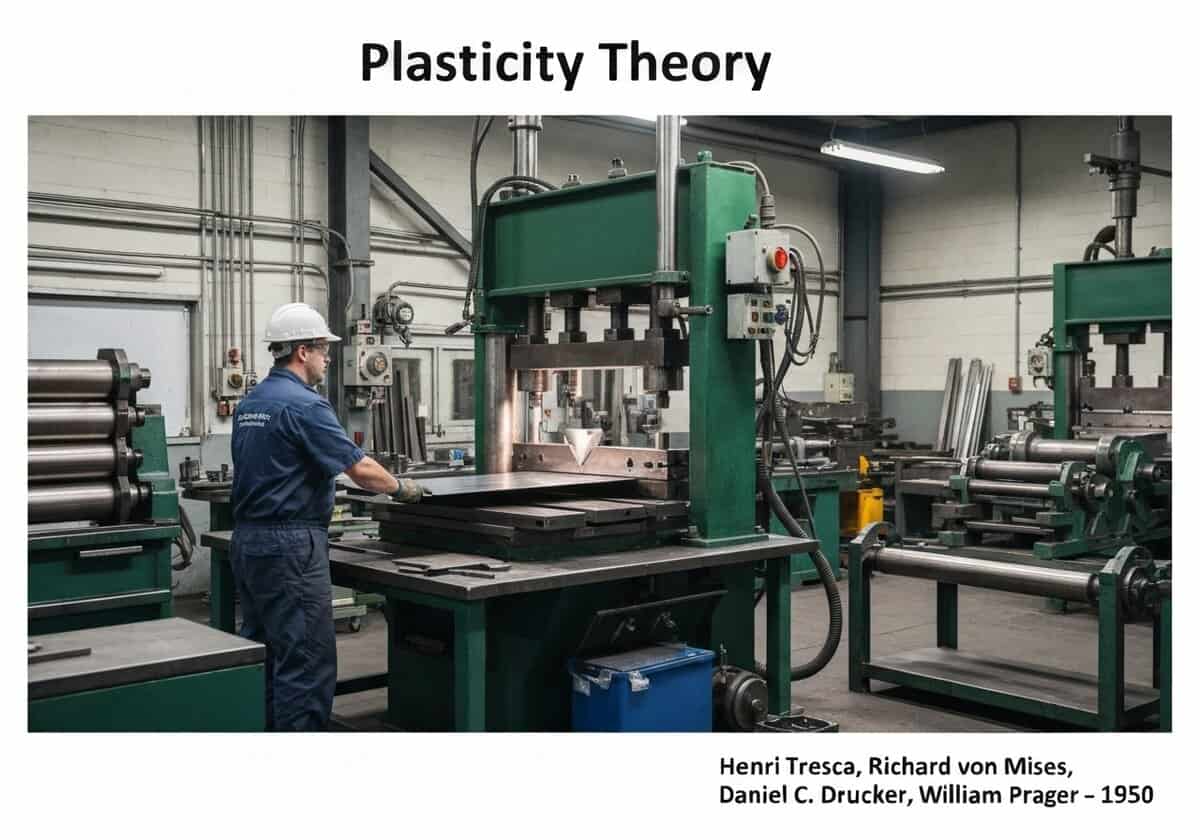
소성 이론은 고체 재료가 가해진 힘에 반응하여 비가역적인 형상 변화를 겪는 현상을 설명합니다. 하중이 제거되면 변형이 원래대로 돌아오는 탄성 이론과는 달리, 소성 변형은 영구적입니다. 이 이론은 소성 변형의 시작을 정의하는 항복 기준과 소성 변형의 진행 과정을 설명하는 흐름 법칙을 포함합니다. strain그리고 강화 규칙이 있습니다.


(설명을 위한 생성된 이미지입니다)
소성 이론은 고체 재료가 가해진 힘에 반응하여 비가역적인 형상 변화를 겪는 현상을 설명합니다. 하중이 제거되면 변형이 원래대로 돌아오는 탄성 이론과는 달리, 소성 변형은 영구적입니다. 이 이론은 소성 변형의 시작을 정의하는 항복 기준과 소성 변형의 진행 과정을 설명하는 흐름 법칙을 포함합니다. strain그리고 강화 규칙이 있습니다.

Plasticity theory provides the framework for analyzing materials stressed beyond their elastic limit. The transition from elastic to plastic behavior is governed by a yield criterion, which defines a surface in stress space (the yield surface). For stress states inside this surface, the material behaves elastically. When the stress state reaches the surface, plastic deformation begins. Two of the most common yield criteria for metals are the Tresca (maximum shear stress) and von Mises (maximum distortion energy) criteria.
항복이 발생하면 소성 변형의 진행은 흐름 법칙으로 설명됩니다. 가장 일반적인 것은 연관 흐름 법칙으로, 소성 변형의 증가는 항복면에 수직인 방향으로 발생한다고 명시합니다. 이는 소성 변형 성분의 상대적인 비율을 결정합니다.
Finally, a hardening rule describes how the yield surface changes as plastic deformation accumulates. Isotropic hardening assumes the yield surface expands uniformly in all directions, meaning the material’s yield strength increases equally regardless of the loading direction. Kinematic hardening, on the other hand, assumes the yield surface translates in stress space without changing its size, which is useful for modeling the Bauschinger effect observed in cyclic loading. More complex models combine both isotropic and kinematic hardening to accurately capture real material behavior under complex loading paths. These three components—yield criterion, flow rule, and hardening rule—form the core of classical plasticity theory.
현재 하루 4만 건이 넘는 봇 트래픽을 차단하기 위해 이 콘텐츠는 커뮤니티 회원만 이용할 수 있습니다.
> 로그인 < 또는 >등록 < 이 콘텐츠를 비롯한 모든 제한된 콘텐츠와 도구는 (100% 무료로) 이용할 수 있습니다.
가소성 이론
(날짜를 알 수 없거나 관련이 없는 경우, 예를 들어 "유체역학"의 경우, 주목할 만한 등장 시기를 대략적으로 추정하여 제공합니다.)

고화질 이미지 및 다운로드는 등록된 회원에게만 100% 무료로 제공됩니다.
> 로그인 <