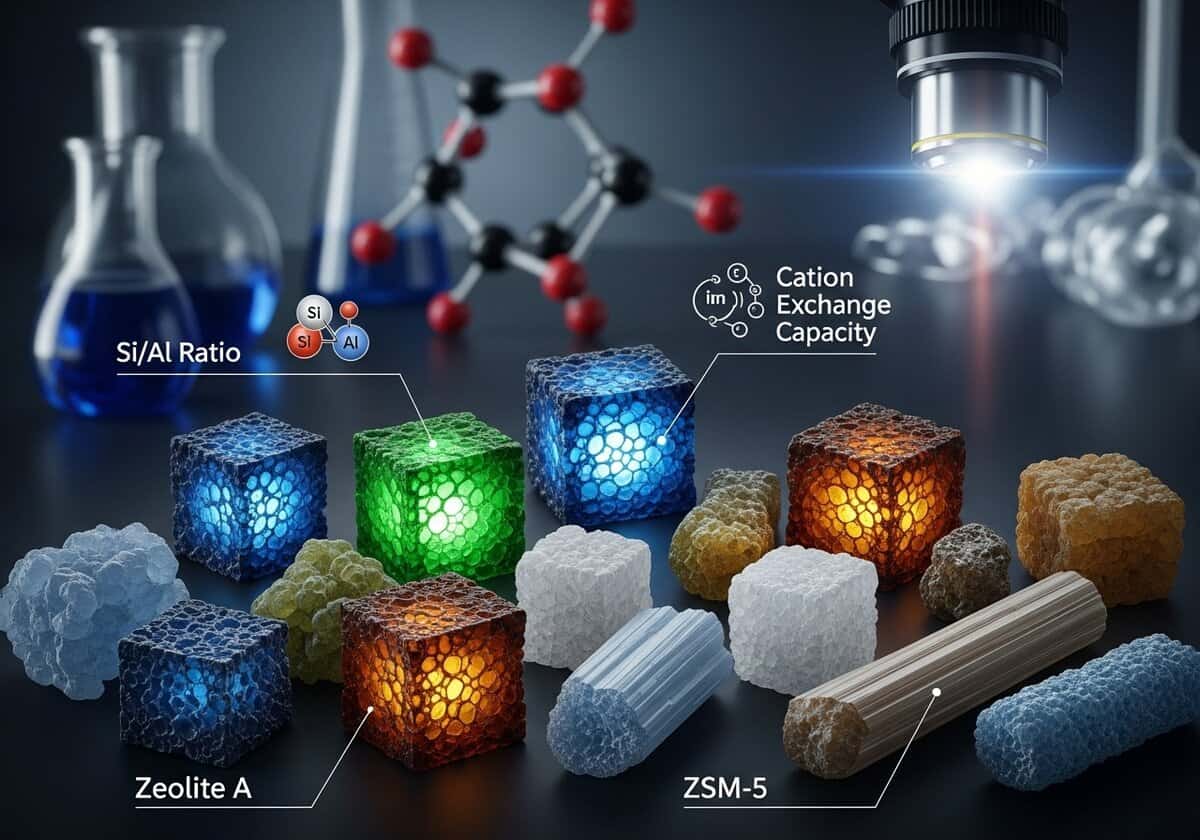
沸石是具有分子级通道和笼状结构的微孔铝硅酸盐。硅铝比决定了其酸度和离子交换容量,同晶置换则会改变其性质。常见的沸石类型包括八面沸石、ZSM-5沸石、A型沸石和斜发沸石。它们可作为分子筛。
Large industries rely on them: fluid 催化 cracking, detergents, gas drying, water softening and soil amendment. Shape selectivity allows products to be filtered by size at the pore. Synthesis control of crystal size and hierarchical pores improves diffusion. Open metal sites and new frameworks extend the use. The patents and papers below follow 催化作用, 吸附 and materials work.
沸石是多孔固体中的工业主力军,广泛应用于催化裂化装置、洗涤剂和气体干燥器中。新型设计框架的追踪信息如下: 金属有机框架 和 共价有机框架它们在分离过程中的作用自然而然地与此相关 工业气体 和 渗透作用, 尽管 热能储存 利用沸石床保温。
这是我们最新精选的有关沸石的全球出版物和专利,涉及许多科学在线期刊,分类并侧重于沸石、微孔铝硅酸盐、硅/铝比、分子筛、开放金属位、阳离子交换容量、铝硅酸盐、沸石 A (LTA)、ZSM-5、Faujasite、Clinoptilolite、同构取代和沸石面貌。
Recycled concrete/geopolymer for oil and gas zonal isolation applications
Patent published on the 2026-11-05 in US under Ref US20260347256 by SCHLUMBERGER TECH CORPORATION [US] (Wei Xia [us], Pernites Roderick [us])
Abstract: [0000] Polysialate compositions and methods of using such compositions to make polysialate systems are described herein. The polysialate compositions generally use a recycled cementitious material as a polysialate raw material. Other polysialate raw materials, such as aluminosilicate sources and alkaline activators, can also be used. These materials can be dispersed in water to form a pumpable polysialate precursor, which can be used to form a polysialate system having suitable compressive stren[...]
Our summary: This document discusses polysialate compositions made from recycled cementitious materials for oil and gas applications. It describes the use of aluminosilicate sources and alkaline activators in these compositions. The resulting polysialate systems achieve suitable compressive strength after curing.
recycled concrete, geopolymer, polysialate, zonal isolation
Patent
Filtration system
Patent published on the 2026-10-28 in SK under Ref SK2612026U by BAJCIK SLAVOMIR [SK] (BajČÍk SlavomÍr [sk])
Abstract: Filtration system comprises filtration layers situated within the pool vessel; the uppermost impact filtration layer consists of natural microporous zeolite mixed with expanded vermiculite for the passive capture of mechanical sludge, odors, and ion-exchange agents. Beneath this impact layer lies a filtration layer composed of a homogeneous mineral mixture, while the bottom of the pool vessel features a filtration layer formed by a perforated metallurgical grid made of pure red copper and zinc. [...]
Our summary: The filtration system includes multiple layers within the pool vessel. The upper layer uses zeolite and vermiculite for sludge and odor capture. A metallurgical grid at the bottom ensures direct contact with the liquid.
Filtration system, microporous zeolite, expanded vermiculite, metallurgical grid
Patent
Cooling system
Patent published on the 2026-10-21 in GB under Ref GB2705543 by H DEUX LTD [GB] (Ahmad Najjaran Kheirabadi [gb], Seyedhamed Shariatmadar [gb])
Abstract: A cooling system 100 comprises one or more adsorption beds 110-1, 110-2, each comprising adsorbent material 111 for adsorbing a refrigerant. A heat exchanger 112 heats the adsorbent facilitating desorption of the refrigerant. A condenser 130 connected to the adsorption bed(s) condenses a desorbed refrigerant vapour received from an adsorption bed into its liquid phase. An evaporator 140 receives a liquid phase refrigerant from the condenser and evaporates the refrigerant causing cooling in a tar[...]
Our summary: The cooling system utilizes adsorption beds to adsorb and desorb refrigerants for cooling. A heat exchanger facilitates the desorption process, while a condenser converts refrigerant vapor to liquid. An evaporator then cools a target area by evaporating the refrigerant and directing vapor back to the adsorption beds.
adsorption, refrigerant, heat exchanger, evaporator
Patent
Zeolite composite catalysts and methods using the same
Patent published on the 2026-10-15 in US under Ref US20260316063 by SAUDI ARABIAN OIL CO [SA] (Tammana Veera Venkata Ramakrishna [sa], Jazzar Ahmad A [sa], Al Khunaizi Hashim Nabeel M [sa])
Abstract: A method of producing a zeolite composite catalyst may comprise: impregnating a zeolite composite with molybdenum to form a molybdenum impregnated zeolite composite, wherein the zeolite composite comprises a mesoporous mordenite and a mesoporous ZSM-5; calcining the molybdenum impregnated zeolite composite to form a calcined, molybdenum impregnated zeolite composite; impregnating the calcined, molybdenum impregnated zeolite composite with one or more active metals selected from platinum, rutheni[...]
Our summary: The method involves impregnating a zeolite composite with molybdenum to create a molybdenum impregnated zeolite composite. It is then calcined and further impregnated with active metals to form a multi-metallic impregnated zeolite composite. Finally, this composite is calcined again to produce the final zeolite composite catalyst.
Zeolite, Catalyst, Impregnation, Molybdenum
Patent
Catalyst compositions that include zeolite with reduced average crystallinity
Patent published on the 2026-10-15 in US under Ref US20260316064 by SAUDI ARABIAN OIL CO [SA] (Osorio Isidoro Morales [sa], Almajnouni Khalid A [sa], Alfilfil Lujain R [sa], Hakami Mohammed Abdulrahman [sa])
Abstract: According to embodiments, a catalyst composition may comprise from 10 wt. % to 75 wt. % of binder; and from 5 wt. % to 70 wt. % of zeolite, wherein the zeolite comprises a first portion of zeolite having a 10-membered ring pore structure, wherein the first portion of zeolite has an average crystallinity of greater than or equal to 30% and less than or equal to 90%.[...]
Our summary: This document describes catalyst compositions containing zeolite with reduced average crystallinity. The compositions include 10 wt. % to 75 wt. % binder and 5 wt. % to 70 wt. % zeolite. The zeolite features a 10-membered ring pore structure with an average crystallinity between 30% and 90%.
Catalyst compositions, Zeolite, Crystallinity, Binder
Patent
Transition metal and cerium exchanged zeolites for hc trap applications
Patent published on the 2026-10-15 in WO under Ref WO2026215630 by JOHNSON MATTHEY PUBLIC LIMITED CO [GB] (Andersen Paul Joseph [us], Chen Hai-ying [us], Cortes Felix Noelia Montserrat [gb], Fedeyko Joseph [us], Howard Michael [us], Levine-ramirez Sarah [us], Lu Jing [us], Mcnamara Nicholas [us], Simmance Kerry [gb], Smith Thomas [us], Turrina Alessandro [gb])
Abstract: TRANSITION METAL AND CERIUM EXCHANGED ZEOLITES FOR HC TRAP APPLICATIONS The present invention relates to a hydrocarbon trap for treating exhaust gas from a gasoline engine, the hydrocarbon trap comprising: a substrate; and a first hydrocarbon trap material disposed on the substrate, the first hydrocarbon trap material comprising a first molecular sieve ion-exchanged with cerium and one or more transition metals.[...]
Our summary: The invention involves a hydrocarbon trap designed for gasoline engine exhaust treatment. It features a substrate with a molecular sieve ion-exchanged with cerium and transition metals. This configuration enhances the effectiveness of hydrocarbon trapping.
zeolites, hydrocarbon trap, transition metals, cerium
Patent
A Viable Supplementary Pathway Toward Low-Carbon Concrete Production
Published on 2026-01-30 by Tu?ba zdemir Mazlum, Nihat Atmaca @MDPI
Abstract: Amid growing environmental concerns, resource depletion, and the pressing challenges of industrial waste management, this study investigates the potential of magnesium slag (MS) as a sustainable alternative binder in the production of one-part geopolymer concretes (OPGCs). The objective is to reduce reliance on conventional cementitious materials while promoting the valorization of industrial by-products in construction practices. For this purpose, ten different mixtures were designed by replaci[...]
Our summary: This study explores magnesium slag as a sustainable binder alternative for one-part geopolymer concretes. Ten mixtures were tested, replacing conventional materials with varying levels of magnesium slag. Results indicate that up to 30% replacement maintains acceptable mechanical performance, promoting sustainable construction practices.
magnesium slag, low-carbon concrete, geopolymer, industrial by-products
Publication
Preparation of Faujasite-Type Zeolite (13X) from Angren Kaolin for Hydrogen Sulfide Adsorptive Purification of Natural Gas
Published on 2026-01-29 by Mohsen H. Al-Rashed, Mirzokhid Abdirakhimov, Robert Kubica, Alicja Kazek-K?sik, Roman Turczyn @MDPI
Abstract: The extraction of hydrogen sulfide (H2S) from gases is essential in numerous industrial applications to safeguard human safety, preserve equipment, and mitigate environmental harm. In these circumstances, zeolites are crucial for the extraction of H2S from these gases. This study reports, for the first time, the synthesis of 13X zeolite from Angren kaolin using an optimized, fully autoclave-free fusion/hydrothermal route. This method enables 13X crystallization under atmospheric pressure, greatl[...]
Our summary: This study presents the synthesis of 13X zeolite from Angren kaolin using an autoclave-free method. The synthesized zeolite shows superior H2S adsorption capacity compared to commercial 13X molecular sieves. The research highlights the importance of NaOH ratio in optimizing the synthesis process for effective natural gas purification.
Zeolite, Hydrogen Sulfide, Adsorption, Kaolin
Publication